Showing posts with label Case Form F. Show all posts

Missing Person Case: Jeannetta Ruth LaBelle (Presumed Drowned)

Missing Person Case: Jeannetta Ruth LaBelle

Jeannetta Ruth LaBelle, a 39-year-old White/Caucasian woman, went missing on January 25th, 1969, in Ojai, Ventura County, California. She was swept downstream during a creek flood, according to the National Missing and Unidentified Persons System (NamUs #MP138874). According to limited newspaper coverage that I found, she was in her home at the time of the flash flood.

At the time of her disappearance, Jeannetta stood at 5'5" and weighed 170 lbs, with red/auburn hair, green eyes, and a distinctive horizontal scar on her leg. However, if her remains are discovered, the scar would not be an indicator at this point as only skeletal remains can be expected.

The blurb below spells the first name differently but only slightly. Due to everything else matching, it appears to be the same case. This blurb appeared the day after Jeannetta disappeared in a newspaper local to where she lived.

January 26th, 1969. Ventura County Star.

Case Form F:

(1) Subject known and seen to be swept into flood waters.
(2) Subject not seen again.

This is a generalized form of a kind of missing person that I use at this site. It fits because the newspaper article confirms that she was "swept away" into raging waters that appear to be what we would call a flash flood today. She remains missing as of October 1st, 2025.

Missing Person Case: Jeannetta Ruth LaBelle
NamUs Case Number MP138874
Name Jeannetta Ruth LaBelle
Date of Last Contact January 25, 1969
Missing From Ojai, Ventura County, California
Missing Age 39 Years
Current Age 96 Years
Biological Sex Female
Race / Ethnicity White / Caucasian
Height 5'5" (65 Inches)
Weight 170 lbs
Hair Color Red/Auburn
Eye Color Green
Distinctive Physical Features Horizontal scar on leg
Circumstances of Disappearance Swept downstream during a creek flood in Ojai, CA on January 25, 1969
NamUs Case Created February 19, 2025

Commentary

By: Shane Lambert

People who disappear into rivers or flood waters can stay missing for ages. That is the case even when they are known to have been swept away, which is different than someone who was only presumed to be swept away (ie. no witness).

Jeanetta might have ended up buried under a lot of sediment and there is potential for dismemberment en route. Accordingly, it probably won't be amateur researchers that shed any light on this case. 

If she is found, then it will likely be due to a chance event, like excavation, or a nature lover encountering her remains somehow (ie. luck). My recommendation for amateur researchers is not to work on this case as people who are known to be swept away and presumably drowned are not the kind of missing people that surface with 'new lives' at some other point.

However, a Jane Doe found in the area could be cross examined. On that matter, people who are lost in rivers or flood waters are likely to show up in so-called "depositional zones." These are places alone the water's route where something slows the flow of the water, like a bend. A beach in this area is more likely than other spots to contain buried human remains of people lost to the waters.

The San Antonio Creek flows into the Ventura River which flows toward the Pacific Ocean. Jane Does found in this drainage system could be cross referenced to Jeannetta's case but it's hard to picture one intact skeleton after all these decades.

Case Forms: Categorizing Missing People Into Patterns

By: Shane Lambert
Original publication date: September 30th, 2025

I’m excited to launch a new section for my blog posts that focus on Missing Persons cases. This will be called "Case Form," a subsection of my posts where I’ll delve into the structure of a missing persons case through a unique lens.

A "form" is like a form of an argument in logic, where there is a general outline covering an argument type. In my missing persons context, it will refer to a general category defined by the major details or recurring patterns that shape disappearances that may be unrelated but still provide insight into one another's case—such as the circumstances, locations, or key events involved. It will aim to be broad and yet concise: covering case details in a general way but not detailing too much criterion.

Using a Case Form, is the opposite of treating each case as unique. Rather this approach identifies broader frameworks, like a journey abroad or a sudden change in behavior, allowing us to group similar cases for deeper study and comparison.

It’s a way to organize the complexities of these mysteries into recognizable types, revealing insights into how and/or why people go missing. By exploring these forms, we can better understand common threads and spark curiosity about potential resolutions.

Furthermore, using forms can help relate solved cases to unsolved cases. I plan to list all the forms below with ambitions or revisiting the scores of cases from the past.


Case Forms Used at Missing Persons Commentary

Case Form A:

(1) Subject Travels Abroad
(2) Subject Does Not Check-in For Return Transportation

Example: Christine Linda Longino, unsolved as of the original publication date

The working hypothesis behind Case Form A would be that the failure to check-in for the return transportation is a big blue that something is amiss.

Case Form B:

(1) Subject (Woman) Last Seen By Husband
(2) Subject Argued With Husband at Last Sighting

Example: Jennifer Provencal, unsolved as of the original publication date.

The working hypothesis behind Case Form B is the confrontational aspect of the marriage had something to do with the disappearance. 

Case Form C:

(1) Subject Went Hiking With a Group
(2) Subject Separated From Group

Example: Alan Visher, unsolved as of the original publication date.

Case Form D:

(1) Subject Went Hiking Alone
(2) Subject Enters Dangerous Area

Example: Jesse Pinegar, unsolved as of the original publication date.

Case Form E:

(1) Subject (Female) is Driving Without Passengers
(2) Subject's Vehicle Breaks Down

Example: Robin Ann Graham, unsolved as of the original publication date.

Case Form F:

(1) Subject known/or and seen to be swept into flood waters or a river.
(2) Subject not seen again.

Example: Jeannetta Labelle, unsolved as of the original publication date.

Missing Marilyn Byskal: Unsolved 1974 Canoe Trip Disappearance in Manitoba

Missing Person: Marilyn Byskal

  • Learn about the mysterious disappearance of Marilyn Byskal, including details of the last known sighting, the extensive but fruitless 10+ day search, and why the prevailing theory makes the most sense.
  • Explore newspaper articles from the time of her disappearance and a sad classified ad from the time that highlights her family's grief.
Not the actual setting. AI-generated image with prompts for a fast-flowing river in the late spring in northern Manitoba.

Case Form F:

(1) Subject known and seen to be swept into flood waters or a river.*
(2) Subject not seen again.
*Loose fit: this person was not seen or absolutely known to have entered the river but was assumed to.

Details (paraphrased) from a Government Source


Marilyn Byskal was last seen at about 7AM on June 20th, 1974, during a school-organized canoe and camping trip near Wabowden, Manitoba, Canada. She was 18 years old at the time.

According to the official report, she was last spotted in the morning at her tent as the group woke up along the Grass River. Most campers believed she may have fallen into the river’s fast-flowing waters, though no one witnessed such an incident. 

An extensive 10-day searanch of the water and surrounding ground was conducted, but it yielded no results—no body, no belongings, no clues. She has not been seen or heard from since.

Source: Canada’s Missing, Case Reference #2012020052 (accessed via RCMP website, last modified May 10, 2023).

Last Contact: June 20th, 1974 (Thursday).
Additional Reference: Wabowden RCMP, Case #2012-534333.

Last Location: Near the Grass River, 25 miles northwest of Wabowden, Manitoba, Canada. Whitewood Falls is mentioned at the DoeNetwork.
Age When Disappeared: 18
DOB: May 1st, 1956 (DoeNetwork)

Sex: Female
Height in Inches: 69 (5’9”)
Weight in Pounds (lbs): 150
BMI: Marilyn Byskal had a BMI of 22.06, calculated from her height (69 inches) and weight (150 lbs). This places her in the normal range by BMI standards—just an observation, as BMI isn’t a definitive indicator of health or lifestyle.

Ethnicity: White
Hair Color: Brown
Eye Color: Brown
Scar or Distinctive Characteristic: None noted
Clothing and Accessories: No specific details were provided in the RCMP report

Transportation: No vehicle or specific transportation details noted. She was on a canoe trip, suggesting she was on foot or in a canoe before her disappearance.
Parents: Not listed in the source material

Clothing and Accessories
At the time of her disappearance on June 20th, 1974, no specific clothing or accessories were detailed in the RCMP report.

Down and Out in the Canadian Rockies

A BLEAK GLIMPSE INTO RESORT TOWN LIFE FROM A WORKER'S PERSPECTIVE

Get your copy of this engaging ebook now

Available on Amazon for Kindle or as a physical copy

Commentary and Research

By: Shane Lambert
Original Time of Writing: March 22nd, 2025

Has Marilyn Byskal Been Found?


As of the time of writing, Marilyn Byskal remains missing. Her case, now over 50 years old, is a cold one with little online buzz. There are no recent news updates or significant social media discussions breaking new ground.

Looking back at the journalism from the time of her disappearance, she received some minor attention in marginals in The Brandon Sun. There was also a larger article on July 2nd, 1974 in The Brandon Sun that mentioned she was a high school student on the cusp of graduation when she disappeared. Her disappearance turned the festivities around graduation into a more somber atmosphere. 

I think there were 12 people in her camping group, 10 students (including her) and 2 teachers. Here are some bullet points from the long article from July 2nd, 1974:

  • She went to the river when she woke up but returned to her tent (her toiletries and toothbrush were found back in her tent).
  • One important point is that the Grass River was only 2-3 feet deep at the point where students accessed the river. It was the speed of the river that was considered to be the risk. Aside from the journalism, I will later suggest that the temperature of the river would be a major risk as well.
  • Two students and a teacher had to paddle 20 miles to alert the RCMP, suggesting that it would have been tough for them, the police, to start an immediate search.

There seemed to be an extensive search. I would say that the search might have been longer than what Canada's Missing described with an estimated 12+ days, including the group she was with and the RCMP's search.


What stands out in her case is the lack of witnesses and the inconclusive search. The Grass River’s fast currents could easily sweep someone away.

Did she fall in, or did something else happen that morning? The group’s assumption of a river accident feels plausible, yet without evidence, it’s just a theory. An alternative theory might be that she fell prey to a campground stalker.

If she did fall in the river, then it's not surprising at all that the search didn't turn her up. Thomas William Richey is pretty much known to have fallen in a river and he has been gone for a lot longer than Marilyn. The same goes with Duane Ludwig Winget.

If fast-flowing water takes you away, then you might end up buried in sediment, either ashore or underneath the water, and that's a really good hiding spot -- for decades and decades and decades.

Beyond the River: Other Possibilities? It seems they were considered.

My research into this case suggests that some entertained the possibility that she survived her disappearance event. Consider the following classified advertisement from the summer of 1975, published about 13 months after she was last seen.

August 2nd, 1975. The Vancouver Sun.

The mention of Erickson, Manitoba, where our missing person was from, suggests enough to me that we are talking about the same case. The classified ad is likely nothing more than the family's unwillingness to accept that Marilyn had died.

You see this a lot with missing-person cases: the lack of a body means no conclusive death. That allows family members to keep hope alive for survival.

Yet, if two students and a teacher had to canoe 20 miles to find the RCMP, then I'm not sure how Marilyn woke up one morning and then just disappeared to Vancouver from northern Manitoba after doing little more than brushing her teeth.

I did find a marriage involving a same-name match in Surrey in May 1975 but the wedding picture looks very different. I won't republish the image but it's in the May 8th, 1975 edition of the The Surrey Leader. I wonder if this same-name match to the area, which looks like a different person entirely, spawned an effort for the family to look there and that's all the classified ad is about.

Marilyn Byskal Disappearance Theories

The best alternative theory to drowning would be a campground stalker, in my opinion. The missing person was someone who I think would have a general appeal for physical attractiveness to the male population. She was young and athletic.

September 8th, 2009. The Toronto Star.

There have been lots of campground stalkers in the past. I would think a high school field trip to the backwoods involving 10 girls/women would be a magnet for a campground stalker. Half of the horror movies from the 1970s and 1980s loosely resembled that plot.

Tragic Cases of Young Women Attacked at Campgrounds

The following table details cases where young women were targeted at campgrounds, highlighting the dangers of remote outdoor settings.

Date Location Victims
June 13, 1977 Camp Scott, Mayes County, Oklahoma, USA Lori Lee Farmer (8), Doris Denise Milner (10), Michelle Heather Guse (9)
May 24, 1996 Shenandoah National Park, Virginia, USA Julianne "Julie" Williams (24), Laura "Lollie" Winans (26)
May 1992 Beverly Beach State Park, Oregon, USA Melissa Sanders (20), Sheila Swanson (19)


It's a matter that might warrant mild interest. However, I do not believe that she fell victim to a campground stalker.

Campground Stalker Theory: Not Likely

Firstly, a 7 AM abduction time is weird in my opinion. If she went on a bathroom trip from her tent at 3AM and disappeared at that time, then I would be more partial to a campground stalker theory. The situation as it was, I would file "campground stalker" into the "very improbable" category. Especially since there is no hint of evidence of an abduction in anything that I read.

As for the disappearance involving the river sweeping her away. There isn't much I found weird at all. The theory made pretty good sense. If she did go into the water and drowned there, then it's not at all surprising that she has not been found. 

The only thing I found a bit weird was there was no description of a call for help and simply falling into a river is a little strange. If someone falls into a river from shore, I would think there would be moments where the person struggles but stays above water and these moments would involve a call for help. However, a quick submersion is possible as well, coupled with shock.

As for falling into the river without anyone pushing you, it is hard to picture. But there are all kinds of tripping hazards in natural settings, like rocks and roots. I would not be surprised if she went for a walk and fell in a little ways away from the camp.

Although it was June 20th, northern Manitoba has a subarctic climate. At that time of year, falling into water in the area would produce immediate shock. Even if the air was comfortable, bodies of water in the area would still be extremely uncomfortable due to snowmelt. I doubt the river water would be warmer than 10C.

What does all this mean? If Marilyn Byskal did fall into the Grass River, you or I won't generate a clue in finding her. So in the final analysis, I simply don't think researchers should work on this case unless they can link a known abductor to the area at the time of the disappearance. But going down that rabbit hole could be a colossal waste of time.

Thomas William Richey -- Missing From Fishing Trip Since 1950

Details from NamUs**: "Thomas 'Tommy' Richey left home to go fishing on the Rogue River on July 11, 1950. He liked to fish in an area where there was a cable car above the river that you could move to the middle and fish from above. His fishing pole as well as several fish he caught were found inside the cable car. He has not been seen or heard from since that day. The cable car was braked in the middle of the river which is why it was presumed something happened causing him to fall or jump and ultimately drown. The cable car and fishing hole are located 4 miles outside Prospect, Oregon on Mill Creek Lane and 6 miles upriver from the Lost Creek Dam."

Case Form F:

(1) Subject known and seen to be swept into flood waters or a river.*
(2) Subject not seen again.
*Loose fit: Thomas was not absolutely known to have entered the river.

Missing Person: Thomas William Richey
Last-contact date: July 11th, 1950
The area where the MP was last seen: Prospect, Oregon


Link to government source: NamUs #MP51989

VITAL DETAILS

Ethnicity: White
Sex: Male
Age at time of disappearance: 16 years old
Birthdate: between July 12th, 1933 and July 11th, 1934
  • When the birthdate isn't known, I calculate a range using the age at the date of the missing person's disappearance.
Hair: Brown
Eyes: Brown, wore prescription eyeglasses
Scar: None known
Height/weight: 5-foot-9 to 5-foot-10 and 165 to 170 pounds
BMI*: Thomas William Richey was in the normal range for BMI.
  • BMI is body mass index. It relates to an individual's height and weight. I include it believing it can help picture a missing person or describe one.
Thomas William Richey, a missing person, was last heard from on July 11th, 1950 when he was 16 years old. He has now been missing for 71 years as of the original publication date of this blog post.

Since this individual has been missing for several decades some might think that it's pointless or futile to work on the case. However, in my opinion, there's not just the missing person to look at but historical matters involved and coming to better understand the issues that surround disappearances. This case did remind me of a few other cases and that's not to say that they are related in an investigative way.

Firstly, it reminded me of the case of Duane Ludwig Winget. This is an individual who has been missing since 1962. Winget was known to have fallen in a river while in a position directly above it and central to the river. He was performing a hand-over-hand military exercise crossing the Nisqually River when he lost his balance at the same moment that his safety equipment failed. Nearly 60 years later, he has yet to turn up.

Richey wasn't performing a military exercise when he went missing -- he was fishing. However, he seems to have been in a similar position relative to the river as Winget -- directly above it and central to the river. In neither case do we have someone jumping or falling from a bridge, nor do we have someone falling from a riverbank. Richey, judging by the position of his fishing rod and the fish he caught, was in a cable car. That much was communicated in the journalism that was published the day after his disappearance.

12 Jul 1950, Wed Medford Mail Tribune (Medford, Oregon) Newspapers.com

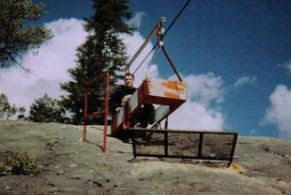
Picturing this cable car is important for making a reasonable guess as to what happened to Richey. I don't picture the kind of cable car that's associated with San Francisco transit. Instead, I picture the swaying small ones that you find in the mountains of western Canada and the western USA.

The picture below is of me in a cable car in the Rocky Mountains. If you have ever been in one, then you know that it doesn't always feel stable. I couldn't imagine trying to fish from one of these without causing it to tilt a little. 

In short, I do think that Thomas William Richey simply fell from the cable car and drowned in the Rogue River. It certainly isn't beyond belief that he has never turned up: after all, Winget was known to have fallen in a river from a similar position and he has yet to be found.


The other scenario that I considered with Richey was that he had been abducted. The case of Dario Cicolecchia was something that I thought of. He went fishing, he left his bicycle visible on the side of the road, and a passerby that happened to be a pedophile saw it. However, Dario was fishing from a shoreline, while Richey's fishing pole and the fish he caught were found in the cable car. Abduction from a cable car would be difficult.

Fishing isn't passive in any sense. There is tugging, pulling, and fighting for balance. Fishing from a cable car just doesn't sound like a safe thing to do. This missing person is likely due to youth-related poor judgment. If he is found, the remains are likely to be skeletal and I would imagine scattered. 

I did receive a reply to this article by an individual that identified as the person who opened the missing person case for Thomas. This is what was communicated from her:

"When I opened the missing persons case that appears on NamUs I didn't quite have all the details of the disappearance yet and just wanted to have DNA collected to compare to Tommy's brother (still alive) to see if there was a match in CODIS. Unfortunately, we did not get any results from that. The cable car in this case is still the most mind-boggling part. It was reported to some degree and I also discovered that the cable car had a puller and winch that had to be used manually to stop, start, and brake the cable car. Tommy's brother and dad are the ones who originally went to the cable car when looking for Tommy and discovered the fish, rod and creel inside it. It was in the middle of the river and Tommy's brother had to shimmy the cable line hand over fist to get into it. Also, Tommy's brother insists the cable car was not something you could easily fall out of. While they didn't actually fish from the cable car itself, the boys used it to cross the river to seek out better fishing areas. 

The cable car was built and placed near Prospect on the Rogue River by the Army Corps of Engineers who were scouting the area for a potential dam site in the 1930s. The Lost Creek Dam is what eventually transpired from this endeavor. I have contacted the Army Corps of Engineers to see if they have records of what the cable car looked like since I cannot find anything even remotely close to what Tommy's brother describes. Unfortunately I haven't gotten anything worthwhile. The cable car is described as being 7 feet in length, 4 ½ -5 ft wide and about 5 feet high and made of lumber with metal strapping.

An accidental fall resulting in drowning was the main conclusion that law enforcement drew to explain Tommy's disappearance. After a week-long search, the community was asked to keep an eye out for his body. No trace of Tommy's body, clothing, or glasses has ever been recovered. As the decades have passed, there has been some speculation as to whether or not Tommy may have staged the scene and purposely went missing, either of his own free will or some type of foul play. However, there has been very little evidence to support these theories either. I believe understanding more about the cable car may help shed some light on what really happened.

Thank you for taking an interest in this case. Even if we never find out what really happened, I appreciate that his story is being told.

Thanks,
Heather V."

Please, share this article to social media using hashtags that are related to where the missing person went missing from, which is Prospect, Oregon.

Author: Shane Lambert
All articles are subject to editing after the original posting.
Shane Lambert is not a Private Investigator, however, he is currently studying to be one as of February 2021.
Website hashtag: #MPCSL

*For BMI values, I use the UPPER or HIGHER ranges that are given for height and weight.
**Text might be paraphrased. If taken verbatim, then grammar or spelling errors are not necessarily corrected from original sources.
Disclaimer: Whenever possible, government sources are preferred for getting the details of a missing person's case. However, any source that the article writer deems reputable may be used.


Duane Ludwig Winget -- Missing Since February 1962

Missing Person: Duane Ludwig Winget
Last-contact date: February 15th, 1962
The area where the MP was last seen: Fort Lewis, Washington in the Pacific Northwest


Link to government source: NamUs #MP35935

Case Form F:

(1) Subject known and/or seen to be swept into flood waters or a river.
(2) Subject not seen again.

Ethnicity: White
Sex: Male
Age at time of disappearance: 23 years old
Hair details: Red/auburn
Eye details: Blue eyes and wore glasses at times
Scars: None known
Height/weight: 5-foot-5 to 5-foot7- and 145 to 170 pounds
BMI: The missing person was overweight by BMI at the time of the last contact, however, he may have had an athletic appearance.
Details from NamUs*: "SPC Winget was last seen on 02/15/1962 while training at Fort Lewis Military Base. He was participating in a hand over hand river crossing training in the Nisqually River when he lost his grip and went down the river. He was never located."
*Grammar or spelling errors are not corrected from original sources.

Case Form F:

(1) Subject known and seen to be swept into flood waters or a river.
(2) Subject not seen again.

What Happened to Duane Ludwig Winget


Duane Ludwig Winget has not been seen since February 15th, 1962 when he was 23. At about that time, he was known to have been from Fort Lewis, Washington.

What stands out with this case, is the fact that his fate can be reasonably assumed. He was performing a military exercise over a hazard. In this case, he lost his grip and fell into a river. He can be presumed drowned or dead from the fall. A relative of Duane's contacted the site and offered the following location of the incident as well as where search efforts took place.


I found a newspaper article associated with this case. It appeared in the Wasau Daily Herald on February 17th, 1962 (page 2). Apparently, Winget's safety belt failed at the exact moment that he suffered some kind of balance mishap. This lead to him falling six feet into the Nisqually River where he was presumed drowned according to the original journalism in the days after his disappearance.

Sat, Feb 17, 1962 – 2 · Wausau Daily Herald (Wausau, Wisconsin) · Newspapers.com

John Does associated with the Nisqually River are candidates for a rule-out with this missing person but after all this time Winget's remains are likely to be separated. I've wondered if his safety vest might contain metal and be embedded along the shores of the river. From that point of view, a metal detector combing the river shores might help with this case.

Note: when people are missing for several years as this person has been, some of their distinctive characteristics may no longer be relevant as identifiers. This is because many distinctive characteristics such as scars, birthmarks, or tattoos may be lost as identifiers through putrefaction if the person has died.

AuthorShane Lambert (Facebook profile)
Facebook GroupMissing Person Commentary
Twitter@UncoolNegated (Twitter)

All articles are subject to editing after the original posting.
I am not a Private Investigator, however, I am currently studying to be one as of February 2021.
Website hashtag: #MPCSL

Featured Post

Netanyahu Dead Rumors 2026: AI Deepfakes or Proof He's Alive? Societal and Legal Issues for Missing People

By: Shane Lambert Rumors claiming that Israeli Prime Minister Benjamin Netanyahu is dead or missing have surged across social media since ...

Best of MPC (as selected by the site's author)