By: Shane Lambert Original publication date: October 6th, 2025
Sylvia Ann Lee went missing on Hallowe'en in 1995. That made me wonder if she abducted while out trick or treating, however, she was 17 years old, generally a little old for that activity. She was dressed in all black and the color of her hair was dyed. I didn't find any information regarding whether that was part of a costume for the day or night but it may have been.
I did think that Hallowe'en would be an increased risk night for teens. They are out and about and abductors would probably recognize increased opportunities for that.
What I did find is that her fate is not considered mysterious. There is a conviction for her murder, which dates the information at NamUs. At time of writing, NamUs did not mention that someone, Wilbur Wade Atcherley, was convicted for murdering her.
September 24, 2011. Record Searchlight.
Charley Project had a good write-up for this case as summarize.
She was last seen boarding a bus to a light rail transit station, heading to her grandmother's house. He appears to have lured her into a taxi. Atcherley said he took her to a remote area in New Aladen, sexually assaulted her, killed her, and left her in a creek bed. Authorities believe she washed away from there.
Speculation: So Where Was She Exactly?
If Atcherley left her in a creek bed and she washed up, then you might think Alamitos Creek is where she died. Alamitos Creek is the primary waterway running through this area, flowing from the Santa Cruz Mountains northward toward Coyote Creek and eventually the San Francisco Bay. I found some evidence online that the creek experiences season flooding, lending some support to how she stayed missing. The creek has a significant floodplain.
Regardless of where she went or what creek she was left at, if she washed away in flowing water then she will be hard to find. Missing people who are lost in water often stay missing for decades.
Wilbur Wade Atcherley: Criminal Record in Sylvia Ann Lee’s Case
Wilbur Wade Atcherley, a registered sex offender, is infamous for the 1995 murder of 17-year-old Sylvia Ann Lee in Campbell, California. On October 31, 1995 (Tuesday), Atcherley visited the Campbell Police Department to update his registration, per CBS San Francisco. Hours later, he lured Sylvia into a taxi from a San Jose light-rail station, sexually assaulted and killed her, and dumped her body in a in New Almaden. In 1999, he abducted, assaulted, and attempted to murder another woman in Gilroy, earning a 61-years-to-life sentence. In 2011, Atcherley confessed to Sylvia’s murder, corroborated by taxi records, and received an additional 15 years.
I briefly looked into his past. It looks like he had brushes with the law as a young adult as a thief. I did find a 1984 article indicating that he kidnapped and raped a woman.
Potential Matches for Unidentified Female NamUs #UP147381 - Missing Persons in Washington
Original publication date: August 18th, 2025 Update: Online discussions at Websleuths imply that my top guess for this Jane Doe, missing person Marla Thomas, is correct.
This article explores potential matches for the unidentified female (NamUs #UP147381) found in Maple Falls, Washington. NamUs lists the discovery date as November 28th, 1978, however, I think this is wrong. The discovery made the news on that date, suggesting that the remains were found at least the day prior. Newspapers are printed so early in the morning that same-day news is rare, except for evening editions.
Bellingham Herald. November 28th, 1978.
The remains, consisting of a skull with maxillary teeth, right pelvis, right femur, and right tibia, belong to a female estimated to be under 40 years old.
Jane Doe Case Details
The following table summarizes the known information about this Jane Doe, as reported in NamUs:
Category
Details
NamUs Case Number
UP147381
Biological Sex
Female
Race / Ethnicity
Uncertain
Estimated Age Group
Adult - Pre 40
Estimated Age Range
--
Estimated Year of Death
Reportedly, the Jane Doe was thought to be dead for 3-5 years, making 1973 to 1975 the likely year of death.
Estimated PMI
3-5 years, loose estimate.
Height
Cannot Estimate
Weight
Cannot Estimate
Date Body Found
Monday, November 27th, 1978. NamUs is wrong to state November 28th. That is the date it made the news but the remains were found the day earlier.
NamUs Case Created
July 8, 2025
ME/C Case Number
A-49-78
Location Found
Maple Falls, Washington
County
Whatcom County
GPS Coordinates
Not Mapped
Found On Tribal Land
Unknown
Circumstances of Recovery
Skull with maxillary teeth (upper jaw teeth), right pelvis, right femur, and right tibia found by workers doing tree service work.
Inventory of Remains
One or more limbs not recovered
Condition of Remains
Not recognizable - Partial skeletal parts only
Hair Color
Unknown
Head Hair Description
--
Body Hair Description
--
Facial Hair Description
--
Left Eye Color
Unknown
Right Eye Color
Unknown
Eye Description
--
Distinctive Physical Features
No Information Entered
Clothing and Accessories
No Information Entered
Notes on Remains
The way the teeth sounded, it said that the maxillary teeth were present. This made me think that the other teeth were not. The way it read, I assumed that the mandible may have been missing.
Top Candidates for Missing Women in the Area
The following are candidates for this Jane Doe, ranked in order. They warrant picking over by anyone interested in the topic.
Rank
NamUs #
Name
Date of Last Contact
Age
City, County
Reason for Ranking
1
MP31485
Marla Thomas
12/11/1974
22 Years
Anacortes, Skagit
Skagit County is adjacent to Whatcom County (~40 miles). Last seen in 1974, 4 years before the remains were found, aligns with a plausible PMI for skeletal remains. Age (22) fits "Adult - Pre 40."
2
MP4581
Jeannette Miller
09/16/1970
17 Years
Arlington, Snohomish
Snohomish County is near Whatcom County (~60 miles). Last seen in 1970, 8 years before, is possible for skeletal remains. Age (17, would be 25 by 1978) is within range.
3
MP14106
Pamela Burrows
01/01/1973
23 Years
Seattle, King
King County (~100 miles) is farther, but Seattle was a hub for missing persons. Last seen in 1973, 5 years before, fits PMI. Age (23) is ideal for "Adult - Pre 40."
4
MP14223
Teresa Davis
11/01/1973
18 Years
Tacoma, Pierce
Pierce County (~130 miles). Last seen in 1973, 5 years before, fits PMI. American Indian / Alaska Native aligns with "Uncertain" race and "Unknown" tribal land status.
5
MP14018
Salie Signani
06/01/1973
32 Years
Renton, King
King County (~100 miles). Last seen in 1973, 5 years before, fits PMI. Age (32) is within range but older than top candidates.
6
MP11981
Nellie Davis
01/27/1975
35 Years
Duvall, King
King County (~100 miles). Last seen in 1975, 3 years before, is a close PMI. Age (35) is near the upper limit of "Pre 40."
7
MP14228
Lorelee Lhotka
01/01/1975
19 Years
Seattle, King
King County (~100 miles). Last seen in 1975, 3 years before, is a close PMI. Age (19) is ideal, but distance lowers ranking slightly.
8
MP4935
Barbara Jolly
08/22/1976
19 Years
Seattle, King
King County (~100 miles). Last seen in 1976, 2 years before, is a very close PMI. Age (19) is ideal, but distance lowers ranking.
9
MP4398
Cherry Greenman
09/14/1976
20 Years
Waterville, King
King County (~100 miles). Last seen in 1976, 2 years before, is a very close PMI. Age (20) is ideal, but distance lowers ranking.
10
MP5896
Rhonda Burse
08/08/1977
21 Years
Burien, King
King County (~100 miles). Last seen in 1977, 1 year before, is a very close PMI. Age (21) is ideal, but distance lowers ranking.
Female, White / Caucasian: Jane Doe Date Body Found: May 10th, 1950 (Wednesday)
Location Found: Bath (Berkeley Springs), West Virginia. According to early journalism, she was found "along a little used road near the bridge which crosses the Potomac River of Hancock." She was found next to a ditch about 30 yards from the bridge. I think the Google Maps coordinates would be about 39.69214444454965, -78.1844344136343, River Road would have been a "little used road" back then, I think.
She is barely across state lines between West Virginia and Maryland. That could mean whoever dumped her body did so in a way to try and get the wrong authorities to investigate.
May 12th, 1950. Beckley Post-Herald
County: Morgan County Who found the body: Benjamin Miller of Hancock (his name is a good keyword to search to find early journalism)
Estimated Age Range: 35-50 Years Birthdate Estimate: The person’s birthdate would fall between May 11th, 1900, and May 10th, 1915, based on the estimated age range and the date of death.
This individual was found nude according to reports. Clothing must have been added for the photo.
Demographics
Biological Sex: Female Race / Ethnicity: White / Caucasian
Estimated Year of Death: 1950 Estimated PMI: 48 Hours Date of Death: Situation would suggest she died on May 8th, 1950. Early journalism suggested a bit longer time frame as an investigator said they weren't sure within five days how long she has been at her found location.
Height: 5' 5" (65 inches), Estimated Weight: 130 lbs, Estimated BMI: 21.6, meaning she would have looked average to slender
Circumstances
Date Body Found: May 10, 1950 NamUs Case Created: March 20, 2012 Circumstances of Recovery: Body was discovered by an individual while mushroom hunting along U.S. Route 522.
Scar/Mark: Y-shaped scar on outside right wrist approx. 3" long. W-shaped scar in center of forehead. 2 surgical scars—one a 10" hysterectomy scar and one a 4" appendectomy scar. Other Characteristics: Freckles on back of hands and lower arms. Hands very small, shoe size 4 1/2 narrow.
Research
By: Shane Lambert
NamUS UP10026 is an old and cold case in the United States. It has drawn a fair amount of online attention with one Alice Kelly suggested as a potential match.
Journalism for this case started the day after she was found. On May 11th, 1950, The Beckley Post-Herald headlined "Nude Body of Woman Found Near Highway." Despite the nudity, it was thought that she had not been raped.
At the time of her discovery, it was originally thought that she was younger than what is now thought. A mushroom picker named Benjamin Miller found the body.
Journalism from the very next day estimated her to be 35 years old. A second piece of journalism said she did not have any ring marks on her fingers.
Her remains were found near a "lover's lane," a term meant to describe parking spots where people often go for intimacy. There have been numerous murders in lover's lanes in American history. But her proximity to the locale could also easily be a red herring.
This woman's body was displayed for viewing, and it seemed anyone from the public could have a look at her. In one instance of the early journalism, it was stated that she must not have been from around the area because so many locals had a look at her remains that she would surely have been identified. It was therefore thought that she was driven to the location where she was found as a body dump.
May 11th, 1950/Hinton Daily News
The cause of death in the early journalism was strangulation and a broken neck. Her neck was "seared by rope marks" according to the source immediately above. When I read the description of her neck, it sounded like someone murdered her by hanging her. However, the term "garrote" was used
In journalism that followed a short time later, the case was described as the "Berkeley Springs Murder." They were not sure, "within five days," how long the woman had been at the location she was found (May 19th, 1950/Berkley Post-Herald).
In cases like these where a body is displayed for public viewing, a lot of 'tips' come in. They all have to be taken lightly, in my opinion. One man said she was a hitchhiker. Another man said he found a woman's dress some 38 miles away. There were some other murders in the area that involved strangulation of women.
Alice Kelly Theory
One popular theory with this case online is that she might be a missing person, Alice Kelly. She was from New York, which would actually align with this case in a way. The decadent was thought to be from far away based on the fact that scores of locals saw her body and none could name her.
I will note that the Jane Doe had red hair while Kelly had brown hair. Furthermore, the Jane Doe's hair was described as naturally red, instead of dyed. She was examined in relation to a missing woman who had red hair but was ruled out because the missing woman had dyed her hair. Furthermore, I found a source that called the Jane Doe's hair "flaming" red. That would suggest that it would not be confused with brown hair if they a mixed or kind-of in-between red and brown color.
Other aspects of the two people, Alice Kelly and the Jane Doe, do, in fact, match up. Hair color can be misdescribed. Furthermore, the journalist's description of "flaming" red hair might be an attempt to be overly descriptive with writing that emphasizes imagery over fact.
Missing Person: Kathy M. Goad Full Name: Kathy Mae Brownfield Goad
Details from a Government Source (Paraphrased):
Namus: On November 11th, 1982, Kathy was going shopping instead of to her job at a bank. She disappeared that day. On November 15th, 1982, her vehicle was found abandoned in a parking lot at Dallas/Fort Worth International Airport. Foul play is possible.
Last Contact: November 11th, 1982 (Thursday, Veterans Day in the U.S.) Last Location: Fort Worth, Texas Age When Disappeared: 20 Birthdate: August 17th, 1962 (Charley Project) Sex: Female Height: 65 inches (5’5”) Weight: 110 lbs BMI: 18.3 (normal range) Ethnicity: Caucasian Hair Color: Brown Eye Color: Green Scars/Distinctive Characteristics: No known information Government Source: NamUs MP8539 Websleuths Discussion: Kathy M. Goad
Search tips: She primarily made the news in Texas and Kentucky. She was from the latter state but resided in the former at the time of her disappearance.
Commentary and Research By Shane Lambert Originally written: March 9th - March 14th, 2025
Has Kathy M. Goad Been Found?
As of March 16th, 2025, Kathy Goad remains missing. Her NamUs profile (MP8539) is still active, indicating an unresolved case.
One thing that I wanted to state is that I don't like the NamUs description. I am worried some readers might get misled.
As it sounds, it reads like she decided to go shopping instead of going to her bank job. But November 11th, 1982, was Veterans Day, a federal holiday. While not all banks closed, many did, or operated with reduced staff.
It’s likely Kathy, a bank employee, had the day off, making her shopping trip unremarkable, not a deviation suggesting something was amiss on its own. I read that she was going to the mall to exchange some items the day she disappeared.
She seemed to have a stable routine in her life. She had worked at the bank, her place of employment, since high school, according to an article in the February 20th, 1983, Park City Daily News.
Not Thought to Have Boarded a Flight
This article is part of my "vehicle at airport series." For these articles, the tag denotes case where a missing person's vehicle is found at an airport. I've come to the opinion that this is usually done as a way of misleading investigators.
Kathy’s vehicle was found at DFW Airport on November 15th, 1982, but that doesn’t mean she took a flight. Per Charley Project and Websleuths, no flight records match her departure. Physical evidence, like hairs linking Kathy to a car salesman’s vehicle (more below), suggests she never reached the terminal.
Her husband, Steven Goad, is the person who found the car. Some might take that as evidence of him 'conveniently' knowing where it was. I took it to me he was exhaustive in searching for her. That the husband might have done something because he found the car was explored and abandoned as a lead early in the investigation. He also convincingly passed a lie detector test.
A Car Salesman’s Shadow: A Theory
What happened to Kathy? One compelling lead points to a car salesman from Hurst, Texas.
What follows is a constructed scenario based on available evidence and critical reasoning, aiming to provide clues to her fate. But first, I will bullet point some matters of fact. The following are true details, according to the early journalism of this case:
The salesman, after selling the truck to Kathy and her husband, saw Kathy two other times; once at her home when she was locked out and once at a restaurant. That was noted in the Park City Daily News on February 20th, 1983.
Reportedly, he made advances toward her the day she purchased the truck with her husband.
In a different case, the salesman damaged a woman's car (called a "girl" in reporting) after she refused a sexual advance. This act led to his firing.
He was arrested for the vehicle damage.
The salesman, who became a suspect, agreed but then refused to take a lie detector test.
The investigators took hair samples from the trunk of the salesman's demo car, and these samples matched hair samples from a brush and roller that belonged to Kathy Goad.
The salesman had a history of sexual assault, assault, and criminal mischief. He had been charged with rape before.
July 31st, 1983. Courier-Journal.
A witness claimed he saw the suspect put concrete blocks and a cord in the back of the car, where the missing person's hair was found (December 3rd, 1984/Courier Journal) on the afternoon of the day Kathy disappeared.
Concrete blocks and cords could be used to weigh down a body.
As of December 3rd, 1984, the suspect was in jail, either for assaulting or raping a woman. (December 3rd, 1984/Courier-Journal).
He had a 14-year sentence and was in a penitentiary in Huntsville.
Since he was fired, I assumed that the vehicle damage he did was to a client's car. However, it might have been on his personal time.
Meeting Up With a Salesman Not To Be Ignored
The first bullet was of extreme importance. In between the date when Kathy purchased the truck from the salesman and her disappearance, she had 'chance' encounters with the salesman: once at a restaurant and once at her home when she was locked out.
Firstly, I don't think the meetings are random. I think he was stalking her.
Secondly, that he was 'on the spot' when she needed help getting back into her house is very weird. It does prove that he, at least, learned of her address if this was a random encounter.
The paperwork associated with a vehicle purchase would have provided the car salesman with access to the missing person's address. He made a sexual advance toward her, showed up at her home on another occasion, and ended up in jail long-term for a serious offense against another woman.
However, on this occasion I think he was probably stalking her and that he used the fact that she was locked out to reacquaint himself at this point. For me, the fact that he was at her house is clear evidence that he knew her address somehow. In my theory below, I assume that he simply got her address from the paperwork involved in the truck purchase at the dealership. But even if him meeting Kathy and her home is a random thing where he was just passing by, the bottom line is he knew where she lived by the date of her disappearance.
A Theory on What Happened to Kathy Goad
The following sections are my guess on what happened to Kathy Goad after a lot of research into her case.
Theorized: Morning, November 11th, 1982 (Veterans Day) – East Fort Worth
Kathy, a 20-year-old newlywed, has Veterans Day off at her bank job. She is going to shop, likely at North East Mall in Hurst, 10 miles from her East Fort Worth home.
Not long ago, she and her husband bought a truck from a Hurst dealership. The salesman for the vehicle, known for inappropriate advances, is said to have made an advance toward Kathy.
In my theory, I suggest that he accessed her address from the paperwork of the vehicle sale. He had met up with her twice before, according to the journalism covering this missing person's case, at about the time of the disappearance. I think he had been stalking her fairly steadily ever since she and her husband bought the truck.
According to my research, dealerships commonly took people's addresses for vehicle purchases in Texas in 1982. This was needed for any purchase that required financing, and it was still standard for record-keeping and warranty purposes, even for purchases that did not require financing.
The car salesman was extremely likely to have had access to her address based solely on her buying a vehicle from him. That's corroborated by the fact that he ended up showing up at her house the day she got locked out.
In my theory, he is stalking her on Veterans Day 1982. As a holiday, it stands to reason he has the day off as well and therefore has the leisure time to stalk her.
Theorized: Midday – North East Mall Parking Lot, Hurst
Kathy parks at the mall, unaware that the salesman has followed her. As she exits her car, he approaches—perhaps pretending it’s a coincidence and/or using the truck as an excuse. His familiarity lowers her guard. He lures her to his demo car, then attacks her or maybe chloroforms her. Her hairs, later found in the vehicle he operated, mark this moment. He locks her in the trunk unconscious and drives off, leaving her car behind.
Theorized: Afternoon – Murder and Disposal
His prior advances and criminal history (assault, harassment) suggest a motive—rejection turned violent. The salesman rapes and murders Kathy Goad. That afternoon, he loaded concrete blocks and cord into his vehicle, as supported by an eyewitness. In my theory, he is doing this to sink Kathy's body somewhere.
The salesman heads to a secluded spot, possibly near Lake Worth or Eagle Mountain Lake, 10-20 miles from Hurst. He hides the body well.
Theorized: Evening to November 15th – Staging Kathy's Car
With Kathy’s keys (taken during the abduction), the salesman returns to the mall at some point. He drives her car to DFW Airport, and abandons it by November 15th. The four-day gap implies he hid the car first and then moved it during the night at some point. He is doing it to suggest she’d fled in hopes of confusing the investigators, whom he knows are coming. He returns to Hurst using a taxi or transit.
Aftermath: Not Theorized
The salesman did, in fact, end up fired after an unrelated arrest (damaging a woman’s car). Police then found Kathy’s hair in the demo car he used, and an informant shared the second-hand confession.
Furthermore, Kathy's family hired an investigator who did not believe much the salesman said. The salesman agrees to a lie detector test but withdraws. Also, the salesman ends up in jail on a fourteen-year sentence for a crime against another woman.
As for Kathy's case, second-hand confessions aren't good for much. Without her body, prosecutors decline to charge him in 1983. The case goes cold - and here we are.
Why My Theory Fits
Address Access: Sales records gave him her East Fort Worth address, enabling stalking. Journalism covering the case supports the notion that he had her address by November 11th, 1982.
Hairs: Forensic evidence ties Kathy to his demo car, suggesting he abducted her. Those hairs are in the trunk, further suggesting abduction. Sometimes teenagers ride in the trunks of cars for lack of a seat. But when missing people are linked to a car trunk, it's only because they were there against their wills, either unconscious or restrained.
Airport: The car’s location at an airport could easily be just deliberate misdirection as she was a happy newlywed. It's common for missing people to have their vehicles found at airport parking lots. They rarely have documented flights from the same airports.
Lake: The informant’s tip and local geography point to a hidden disposal site.
Profile: His previous behavior and job firing make him an interesting person to incorporate into the hypothetical scenario. His profile is clearly that of a misogynist.
Conclusion
This theory posits the salesman stalked Kathy from her home, abducted her from a mall parking lot, killed her, and dumped her body in a lake, using her car to mislead investigators.
Could Lake Worth or Eagle Mountain Lake hold the final clue? As of now, Kathy’s fate and what happened to her remains unsolved.
UP125213 is a Jane Doe that was found on October 27th, 1985 at 1 PM. She was only recently entered into NamUs (July 3rd, 2024).
The Jane Doe is a white female adult in the pre-30s category. She was believed to be about 5'2" and 135 pounds by post-mortem measurements. She had black hair and is described as an unidentified female who was found in a wooded area.
Clothing: white tank top, small bra size, Blue501's Levis brand blue jeans, backless sandals with clear plastic-webbed material over instep, cork-heel insert, and rubber-ribbed soles; fingernails and toenails that were pink or fuschia.
Location: The Google Maps coordinates that open when you follow the NamUs location are 37°20'19.5"N 121°53'06.9"W. However, she was discovered in a wooded area and that location looks urbanized. I did find some journalism on what I believe to be this Jane Doe. She was found "in the Coyote Creek area," at least that's what a blurb in the October 28th, 1985 edition of The San Francisco Examiner states of the discovery of a "badly decomposed body." The blurb says that the body was found near "Teurs Road" and Loupe Avenue. Teurs Road is probably "Tuers Road." I think 37.30182080459984, -121.82666137092619 are better coordinates.
Who Found the Body: Children playing in the area.
There did not seem to be a lot of follow-up journalism on this case with the database I use. NamUs has an article posted to the profile which states that this Jane Doe had been strangled.
By: Shane Lambert Original time of writing: July 18, 2024 Updated: October 3, 2025
Introduction to Madera County Jane Doe Case #UP125443
#UP125443 is a Jane Doe who was added to the NamUs system on July 8, 2024. There is a significant gap between the entry date and the date her remains were discovered on September 24, 1989. Journalism coverage from September 1989 provides some details on the discovery, with additional information recently added to the NamUs file.
Jane Doe. Madera County Jane Doe.
Physical Description of the Jane Doe
The NamUs report provides limited details about the Jane Doe. She was determined to be a female of uncertain race, placed in the Adult Pre-40 category, with journalism suggesting an age in her 20s.
Her estimated weight was 130 to 135 pounds, and her height was between 4'8" and 5'2". Using the upper estimates, she would fall in the upper normal range on many BMI scales, possibly appearing slightly chubby if she was 5'2" and 135 pounds.
She had black, shoulder-length hair. NamUs notes a condition called "enamel hypoplasia," a dental condition where enamel does not develop properly, which could be a key identifier if dental records are available.
Location Where the Body Was Found
Location of her body: About 10 miles southwest of Madera in a vineyard, near Avenue 6 and Road 23, approximately 50 feet from the paved road. 36.83692288193394, -120.12828210216904 are the approximate Google Maps coordinates. Vineyards remain prevalent in the area today.
Discovery of the Remains
Who found the body: A crew of grape pickers on September 24, 1989.
Condition of remains: The remains were not recognizable due to decomposition/putrefaction, likely due to exposure in the warm September climate.
Estimated Time of Death
Time of death: No precise post-mortem interval is provided in NamUs. Journalism from September 1989 suggested the body had been at the location for 2–3 weeks, but this estimate should be taken with caution due to lack of forensic confirmation.
Clothing and Personal Items
Clothing and accessories: According to the updated NamUs file, the Jane Doe was found wearing a white bra (size 36C), blue socks, and white bikini panties. She also had a white metal ring with four bands and six white balls soldered together in a triangular shape, described in 1989 journalism as a "cocktail ring."
Media Coverage of the Case
The case appeared in The Fresno Bee on September 28, 1989, four days after the remains were found. The article described the discovery as a likely body dump. The Medical Examiner/Coroner case number is 89-2730, which may provide access to additional records.
Speculative Connections to Known Serial Killers: Samuel Little, William Suff
The late 1980s Central Valley landscape, with its sprawling vineyards and transient populations, invites speculation about notorious figures like Samuel Little and William Suff, though no evidence ties them to the Madera County Jane Doe (#UP125443), to my knowledge.
Little, a drifter with a confessed 93 murders across the U.S., was active in 1989, strangling women and leaving them in remote spots—vaguely reminiscent of this vineyard dump. His mobility via bus routes could have brought him near Madera, yet his documented 1989 kills cluster in Los Angeles, leaving this as a mere possibility. The newspaper clipping below shows that Samuel Little was committing murders in California in 1989.
April 8th, 2013. Johnson City Press.
Similarly, Suff, active in Riverside County during the same period, targeted women with a pattern of rural disposals, sometimes with partial clothing, echoing the Jane Doe’s location in a vineyard. His job allowed travel, but his confirmed crimes stay south, making a northern jaunt speculative.
Both men’s methods included isolation and align with a body dump hypothesis, and the era’s unsolved cases fuel such theories. Without DNA matches or new confessions, these connections remain hypothetical, underscoring the need for modern forensic analysis to either confirm or dispel such links.
Attempt to Match: Debbit Misquez Escalante
Debbie Misquez Escalante (NamUs MP2694), missing from Las Cruces, New Mexico, since August 21, 1989, emerges as a potential match for the Madera County Jane Doe, though significant gaps remain. I would consider Escalante a loose fit, partly because of the distance between her last-known location and the location of the Jane Doe discovery.
But the timeline aligns seamlessly, with her disappearance fitting the Jane Doe’s estimated death window of late August to early September 1989, based on the 2–3 week decomposition period noted in 1989 journalism. Physically, Debbie’s 5'3" height and 140 lbs weight are close to the Jane Doe’s 4'8"–5'2" and 130–135 lbs, suggesting a similar medium build.
Her Hispanic/Caucasian heritage also aligns with the Jane Doe’s uncertain race, which could possibly point to a shared background across different ethnicities. Additionally, a visual comparison shows Debbie’s image bears a slight resemblance to the Jane Doe’s forensic bust, adding a subjective but intriguing layer.
However, challenges persist. Debbie’s brown hair contrasts with the Jane Doe’s black hair, and her reported gray t-shirt and pants differ markedly from the Jane Doe’s undergarments and cocktail ring. Clothing articles can change easily but hair color does make you lean toward "mismatch" a bit.
Debbie’s tattoos—a rose on her right breast, a unicorn on her right shoulder, and others on her hand/finger—could be a key eliminator, but the Jane Doe’s advanced decomposition (not recognizable due to putrefaction) raises doubts about tattoo preservation. In warm Madera conditions, skin may have sloughed off and thus not made the coroner's report.
I don't think this is a match but it was the best match I could find in NamUs at the time of updating in October 2025. Hopefully, with other cases added in the future, a stronger candidate will arise.
Mae W. Gebhard has been missing since February 24th, 1981. Coincidentally, that's precisely 40 years prior to the date of this article's publication. I think there's a Jane Doe in the NamUs database that is a good candidate for comparison. This is an opinion that other members of Websleuths are aligned with. Importantly, neither the Jane Doe in question nor Mae W. Gebhard have any rule-outs listed.
Gebhard's disappearance was covered in The San Francisco Examiner. On March 5th, 1981 I found news coverage of her disappearance. It said that she disappeared after a fight with her husband, that she left with 30 sleeping pills, no coat, and no money.
According to the profile NamUs #MP17556, Mae W. Gebhard's disappearance had the following details:
She was 65 years old when she went missing
She was last seen on February 24th, 1981
She is missing from San Francisco, California
She was 5'3" and 100 to 104 pounds
She was white/caucasian
Her hair was gray or partially gray and short to medium length
Everything listed above matches up to a Jane Doe that was found on March 2nd, 1981 at the dump that serviced the San Francisco area. NamUs #UP77595, which is a Jane Doe of which only the head was recovered, has the following details:
Estimated to be between 55 and 70 years old
CORROBORATES Mae W. Gebhard, who was 65 years old when she disappeared
Estimated year of death 1981
CORROBORATES the year that Mae. W. Gebhard disappeared
Remains found March 2nd, 1981
CORROBORATES the time frame -- the decedent was found after Mae Gebhard disappeared
Remains were found at a part of the Shoreline landfill garbage dumping area among refuse that appeared to be from the San Francisco County area
CORROBORATES -- Mae Gebhard went missing from San Francisco and there is a suggestion that the Jane Doe may have come from there
Gray or partially gray hair that was medium length
CORROBORATES -- hair length of Mae Gebhard is thought to be medium and gray/partially gray
The Jane Doe may have been dead for two weeks. It's here that someone might point out a discrepancy. However, decomposition rates vary with the temperature of the environment one major factor. Estimates of a date of death are nowhere near foolproof. I'm thinking that her remains being in a landfill site would serve to make her environment hotter.
Comparing Mae W. Gebhard and Jane Doe: Key Similarities
Characteristic
Mae W. Gebhard (NamUs #MP17556)
Jane Doe (NamUs #UP77595)
Match?
Age
65 years old
Estimated 55–70 years old
Yes
Date
Last seen Feb 24, 1981
Found Mar 2, 1981; Est. death 1981
Yes
Location
Missing from San Francisco, CA
Found in landfill with San Francisco refuse
Yes
Hair
Gray/partially gray, short to medium
Gray/partially gray, medium length
Yes
Height/Weight
5'3", 100–104 lbs
Not available (head only)
N/A
Artificial Intelligence Weighs on the Chances of the Match
Given these striking similarities, the likelihood of Mae W. Gebhard and this Jane Doe being the same person appears significant. Grok, an AI developed by xAI, analyzed the details presented here and estimated a 70–80% chance of a match, citing the alignment in age, hair, location, and timing, tempered only by the uncertain decomposition timeline. This percentage could change with more information being factored in.
Without forensic confirmation like DNA, it’s not definitive, but the overlap is compelling enough to warrant serious investigation, according to AI. This is one of those cases where the match seems so plausible that if they are not one and the same, then they need to be listed as rule-outs of one another. Without that, I think that amateur investigators will continue to associate the cases.
Height and weight: no estimate provided for weight; journalism from 1980 says she was 5'5" to 5'8"
Body found: May 26th, 1980; estimated to have been there about five months or less
Location: Des Moines River, southeast Des Moines, Iowa; south of Carlisle Road near Hubbell Park
Hair: maybe red, not sure
Eyes: not sure
Other: deformity, severe lumbar curvature at L5
Clothing: close to the body a tube top was found (not really summer clothes which might be a clue that this Jane Doe went missing in the winter); also a ring and cross necklace and hairpins
On May 26th, 1980, Maynard David Jr., his younger brother, and Rick Kimmel were walking in the area of Hubbell Park in southeast Des Moines, Iowa. They were taking their dogs to some water in a wooded area when one in their party thought that he saw a skull. It turned out to be the Jane Doe with the details above. A bullet was found near the body.
Tue, May 27, 1980 – 8 · Des Moines Tribune (Des Moines, Iowa) · Newspapers.com
Candidates for ruling out
I have not yet looked at the following cases too closely. However, they are cases that other amateurs or Websleuths might do some research on for this Jane Doe as any one case might be a match.
Brenda Sue Black went missing sometime in 1980. Her NamUs profile says she was last heard from on January 1st of that year. However, last-contact dates of January 1st often mean that they don't know what time of year she went missing and just filled in the first day of the year to fill in the data fields. Black is in the height range, she is the right race, she is the right sex, and the right year. There's a remark at NamUs that this person was moving from Ohio to California and that might go through Iowa. No mention of the jewelry.
January 10th, 2025: A websleuth (kara1218) recently attempted to match this Jane Doe to a missing person named Julie Ann Derouin.
All articles are subject to editing after the original posting.
Unidentified Jane Doe in Carbon, Alberta
Who: Jane Doe found roadside near Carbon, Alberta, Canada
When: Discovered on April 20th, 1995 or April 21st, 1995
Post-mortem period: Thought to be dead for 10 to 15 years, meaning missing people last seen in April 1980 to April 1985 are all in play. However, missing people outside of this range cannot be ruled out based only on the post-mortem period's estimation.
Ethnicity/Race: Uncertain. Appears aboriginal by the construction; could be other ethnicities for sure but does not look Caucasian. One source says she may have been of north African descent but that dark skin color does not come through in the bust above. Mixed background possible.
Sex: Female
Age at time of death: 22 to 35 years old, estimated. Broadened range 20 to 40. Height: 5'0" to 5'4" (combined range from Service Canada and the Youtube video below which is of a press conference that was held, in part, for this Jane Doe)
Other: she had suffered from a disease called brucellosis
Case Details and Indigenous Connection
This is a case that doesn't have a lengthy profile with Canada's National Centre for Missing Persons and Unidentified Remains. However, the Youtube video posted above will help deliver some case details.
I thought, at first glance, that this individual was one of the missing aboriginal women of Canada, a group that some think doesn't get a lot of police attention. However, I'm not sure this Jane Doe is actually in any missing person's database. Part of me wonders if no one at all is looking for her.
Be warned, this isn't an article for the weak-stomached. I don't apologize. If you are seeking out articles on missing people or Jane Does then you have to be ready for some topics that aren't exactly those for the pleasure reader.
I think she is aboriginal but my basis for designating her as such is tenuous. Firstly, she was found in the Albertan plains and that area has plenty of aboriginals. Secondly, she looks aboriginal to me in the police recreation but she could be of other groups. I've wondered if Indian reserves of Alberta might be alerted to this case. However, I really have low confidence that this person will be identified. I don't think there's a soul out there that is looking for her.
Websleuths or amateurs looking at this case should know that Carbon, Alberta is tiny. It's a village northeast of Calgary by about an hour. If she was from Carbon then she would have been identified, I think. Her roadside location sounds like a body dump to me and a person doing that would be looking for somewhere far away from where people knew her, I think.
Media Coverage and Grave Site Mystery
It was hard to find news that covered this Jane Doe. However, I believe that the following article from the April 25th, 1995 Calgary Herald might pertain to her. There is a statement in this news article that brings bizarreness into play.
Note, that the "last Thursday" that is referenced in the article would actually be April 20th, 1995 as opposed to April 21st, 1995 (the date that Service Canada reports as the date that the Jane Doe was found). Furthermore, the age range in the news article is different.
Both inconsistencies can be explained: dates are often a tad off in reporting and age ranges that are based on estimates can change over time. The reason I think that the reporting pertains to the Jane Doe pictured at the start of this article is just that Carbon, Alberta is puny. I don't think two Jane Does pop up in consecutive days but it's possible.
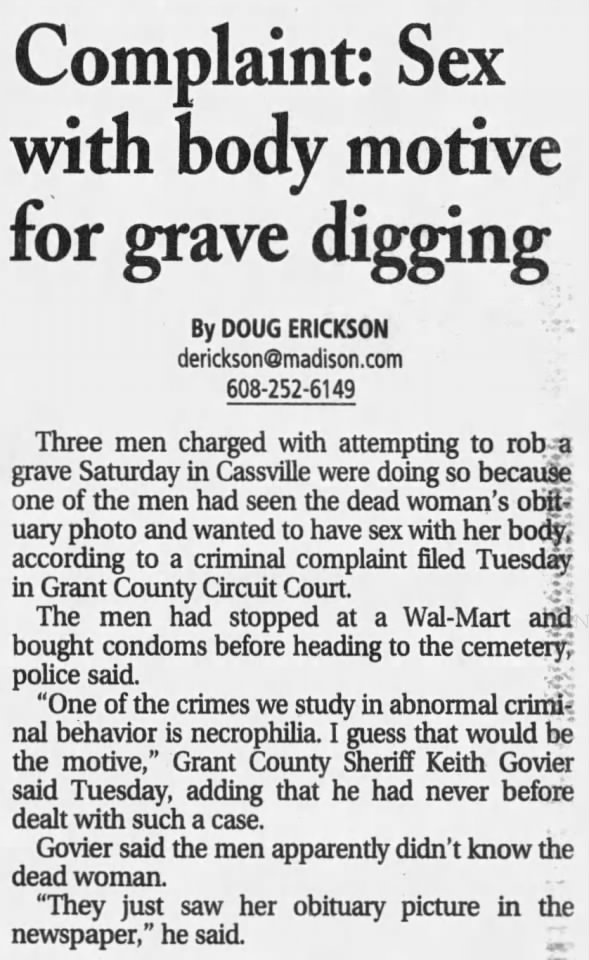
The news article says something that's very unique when it comes to Jane Does. According to the news article, this Jane Doe "may have been removed from a grave site."
What does that make you think? The RCMP might have been able to study the body and conjectured that it had been serviced by a mortician? That's what I think when I read that. Maybe there was a presence of embalming fluid. However, maybe they had different reasons for believing that she was previously buried. A lot more information is needed about the grave site that this person came from.
Was it a marked grave?
Was it a clandestine grave?
If it was the latter, then it's hard to think of a way to generate leads. It's also perplexing: why would someone unearth an individual in a clandestine grave and leave her on the side of the highway? If her grave was of a clandestine nature, then one would conjecture that the grave site was a better hiding spot than on the side of the road. However, the article also said that foul play was ruled out. That suggests that her original resting place was not clandestine in nature.
Timeline and Identification Challenges
If it was the former (ie. she was in a marked grave), then leads are possible. The timeline with this Jane Doe could be as follows:
a death between April 1980 and April 1985
a burial in a gravesite assumingly near her time of death
removal from the gravesite at some point
then she ends up roadside near Carbon, Alberta
discovered there on April 20th or April 21st, 1995 after laying dead outdoors for maybe 10 to 15 years
If all that is true then this Jane Doe case isn't going to be solved through any conventional means. Conventionally, when an amateur or websleuth is working on a Jane Doe's case, that person would cross reference the Jane Doe against missing person's reports.
That's worked in the past for many cases but if this particular Jane Doe died and was buried in a marked grave, then maybe she wasn't missing at the time of her death. Maybe the family and friends had a funeral for her and had a sense of closure. If that's true then it brings the following into consideration: maybe nobody that encounters this Jane Doe's profile, that actually knew her in life, will ever think to connect her to the person that she/he knew. This truly is a problematic Jane Doe when one considers that she was unearthed from a grave.
In this peculiar case, identifying the Jane Doe might involve looking for an empty grave in the region, one that belongs to a woman who died between the ages of 20 and 40, one who matched the height range, and someone who died between 1980 and 1985. I'm not sure how a Websleuth or amateur investigator goes about checking graves for empty coffins without stepping on a whole bunch of toes. But I do have ideas as to why someone would dig up human remains from a grave.
One understandable reason is exhumation for a legal reason, a historical one, or a scientific one. However, exhumation is not a good explanation in this case so long as you accept the following. Someone in charge of exhuming a body would be someone responsible enough to put it where it belonged afterward. The authorities, if they exhumed this person, wouldn't discard her remains on the side of a highway.
Another reason someone would dig up human remains borders on the bizarre and the grotesque: necrophilia. If you find it difficult to accept that someone would dig up a body for that purpose, then the definitive answer is that such acts are known to have happened before.
Furthermore, another reason why someone would take a body from a grave for clandestine purposes is to fake a death. That's believed to have happened before as well.
I think another reason someone might dig up a body from a marked grave is one that's less sinister in nature: extreme mourning. Somebody who is psychologically changed due to someone's death might have an insane episode and seek out the remains. I didn't find any historical news article about that but, I think, it can happen. Read the poem "Annabel Lee" by Edgar Allen Poe. It tells a tale of a man who sought out his wife's tomb for comfort.
I really don't see this case as probable to be solved due to a lead from a missing relative. Firstly, there's hardly any news coverage that I could find. Secondly, there is barely anything in her profile. Lastly, I don't think there is anyone looking for her. If her grave was a marked one then the people that knew this Jane Doe might have buried her according to their customs and they might already have closure -- for decades. They might not know at all that she was removed.
The only point to take away is that if you ever come across any news from Alberta about an empty grave then think of this Jane Doe and cross-reference her particulars with that of the relevant grave marker or obituary.
Brucellosis Outbreak in Alberta
In the YouTube video, Staff Sergeant Jason Zazulak of the RCMP made the following statement:
"She may be or appeared to have been of north African ancestry or possibly of indigenous or mixed ancestry. She was approximately 5-foot to 5-foot-three inches in height...She had suffered from a disease called brucellosis and repetitive fever. Brucellosis is not a disease commonly found in Canada and may suggest that this person was born abroad."
I do not think that this person was born abroad.
Alberta’s 1980s Brucellosis Context
It's important to note that brucellosis might not be a common disease in Canada in modern times. However, the Jane Doe in question is believed to have died in the early 1980s and her remains were found in Alberta. It's important to note, I think, that there was a brucellosis outbreak in Alberta in the 1980s. The balance of my research on this outbreak makes me think that this individual was an Albertan and that she had some kind of exposure to a farm or farm products.
Lethbridge Outbreak and Potential Leads
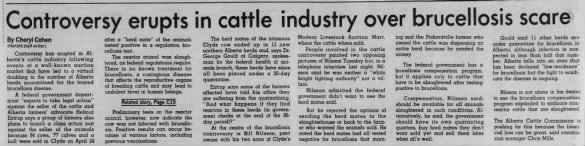
The second snipped article below is interesting. It says that there was an outbreak that affected people in Lethbridge in 1980. Note, that you didn't have to work on a farm to get brucellosis. It seems like any work related to cattle could expose you to the disease. It's also interesting that this outbreak is within the range of the Jane Doe's estimated death.
The second snipped article above is interesting. It says that there was an outbreak that affected people in Lethbridge in 1980. Lethbridge is not particularly close to where the Jane Doe was found, however, nor can it be considered out of range for someone who owned a vehicle. According to Google Maps, a drive from Lethbridge to where the body was dumped in Carbon would be just under three hours.
The six employees in the news article might know something about who this person is. They had the disease she had and they may have transmitted it to people they knew. Furthermore, it's not impossible that the Jane Doe was one of the six employees, yet, that would seem like a fluke if it was so.
Note, that you didn't have to work on a farm to get brucellosis. It seems like any work related to cattle could expose you to the disease. It's also interesting that this outbreak is within the range of the Jane Doe's estimated death.
Alberta’s Agricultural Link to Brucellosis
Farms in Alberta are very common. You will find them across a huge range of the province and the province itself is enormous. The only place in Alberta where you won't find many farms would be in the mountain parks on the province's western border.
Accordingly, that she might have worked or lived near cattle or their products isn't necessarily going to be a case-breaker. However, I would reject the opinion that she was of foreign originations based on her exposure to a disease that's not common in Canada. At the time when she lived and in the province where her remains were found, brucellosis was part of life.