Showing posts with label unidentified remains. Show all posts

Unidentified Woman 1979 Vista CA: Who Was HHW? Or is it Maria? - NamUs #UP99440

Unidentified Person / NamUs #UP99440

Female, Hispanic / Latino
Date Body Found: May 17, 1979
Location Found: Vista, Californi
Estimated Age Range: 35-45 Years
Birthdate estimate: The person’s birthdate would fall between May 18th, 1933, and May 17th, 1944 based on the date range and the date of death.


Demographics

Biological Sex: Female
Race / Ethnicity: Hispanic / Latino
Possible First Name: Maria

Estimated Age Group: Adult - Pre 50
Estimated Age Range (Years): 35-45
Estimated Year of Death: 1979

Height: 5' 1" (61 inches), Measured
Weight: 123 lbs, Measured
BMI: 23.2, meaning she would have looked petite to average

Circumstances

Date Body Found: May 17, 1979
NamUs Case Created: January 22, 2023
Location: Vista, California 92084
County: San Diego County

Circumstances of Recovery: The decedent had been a passenger in a 1969 Ford station wagon travelling westbound on Gopher Canyon Rd., when at .4 miles west of Interstate Route 15 in Vista, the driver of the vehicle apparently lost control, ran off the north side of the road, and overturned down an embankment. The decedent had been ejected from the vehicle and was found approx. 50 feet from the vehicle.

Approximate Location of the Crash33.251798502226556, -117.21709638283122

Physical Description

Hair Color: Black
Left Eye Color: Brown
Right Eye Color: Brown

Clothing and Accessories

Item: Jewelry

Description: There was a white-metal ring (band) on the third finger of the right hand. A yellow-metal ring (band) with star-like engraving around the outside of the ring and initials HHW, engraved inside the ring.

Commentary, By Shane Lambert

I had a look at this Jane Doe for a little while tonight. My focus was on the initials HHW and a missing persons report anywhere that matched those initials in respect to the dates. 

One thing that stood out to me is that NamUs said that the Jane Doe's name might be Maria. However, that would not match HHW, the initials on the ring. However, there is a chance that the initials belonged to her husband. As soon as you start dealing with situations like that, the volume or search terms to use in various databases start getting immense.

Complicating the matter, I also considered the chance that the initials were read upside down. In that case, they would become MHH. Interesting enough, the M would match Maria in that case but then this is a speculative tangent.

I used quite a lot of search terms on the Jane Doe, using the clues in her file. None of them turned up a thing. Furthermore, I did not find a report of a car accident on Gopher Canyon Road on the date in question. This means that this car accident was not reported on or the report has been not been digitized yet. Feel free to look for the news regarding this accident or for missing people matching the recommended initials. Digital records do get updated constantly.


NamUs #UP7139 - Jane Doe Found near Palm Desert, California (February 1980)

By: Shane Lambert

NamUs #UP7139 is a Jane Doe whose body was found in Palm Desert, California on February 16th, 1980 (Saturday). This Jane Doe case stood out to me because there is a decent post-mortem photo of her face associated with her NamUs profile. That should make this case solvable so long as enough people review the material associated with this Jane Doe case. From my research, this person appeared to be the victim of a flood.

Body found: Feb. 16th, 1980 at about 11 AM (Saturday)
Who found the body?: "a group of Canadian tourists" (San Bernardino County Sun/Feb 19th, 1980/A-3)
Location: Six miles south of Palm Desert, California; found in a gully, a landform created by running water, near highway 74.
Sex: Female
Race/ethnicity: White/Caucasian
Age: 25-30
How long had she been dead? (ie. PMI): 1 day
Estimated Date of Death: Would be February 15th, 1980
Height: 64"
Weight: 120 lbs
According to NamUs (paraphrased): This body was found at the bottom of a ravine about 35 feet down from a winding mountain roadway. She was fully dressed with no identification.
Hair: Short, light brown, 3-4 inches, presumably as pictured
Eyes: Hazel
Scars: "She has a well healed 5" scar on her right forearm and a 1" well healed scar on her upper right arm."
Physical characteristics: "She appeared well groomed with manicured fingernails, a recent haircut and nice clothing."
Clothing: Long sleeve tan colored velour blouse; Royal blue pants (no sizes noted); She had on tan sandals with no socks.


I could only find one Jane Doe case for Riverside County in California for a female's body that was found around February 16th, 1980. There was an article in the February 19th, 1980 edition of the San Bernardino County Sun that listed a woman who was found deceased in a gully near Palm Desert.

Presumptively, the article spoke of the Jane Doe known as #UP7139. The news report and NamUs both described an unidentified woman found in a ravine or gully, which are similar formations. She was listed amid numerous news stories associated with a flood in the area that had occurred around that time. The snipped paragraph from the newspaper likely describes this Jane Doe.

I found a news story of a nurse who had gone missing in the same flood. Her name was Inez Evans but she was described as a 44-year old, which would be well outside the estimated age of the Jane Doe. Evans' car was found but she was not found in the days after the flood. Whether she remains missing or not wasn't something I could ascertain. The clothing on the Jane Doe did not match the expected clothing for a woman commuting to a nursing job in addition to the mismatched age.

This case reminded me of cases where a pedestrian gets hit by a vehicle and dies -- without any identification on them. This Jane Doe did not get hit by a car but likely got washed away in a powerful flood -- without any identification on her.

That a group of Canadian tourists found her body suggests to me that she might have been doing something as a tourist herself. That would explain why no one local has found her. I would think that she would have been identified if she was a local to the area, because of the high-quality post-mortem photo. 


NamUs #UP85529 - Stony Creek Jane Doe Found in September 1948

By: Shane Lambert

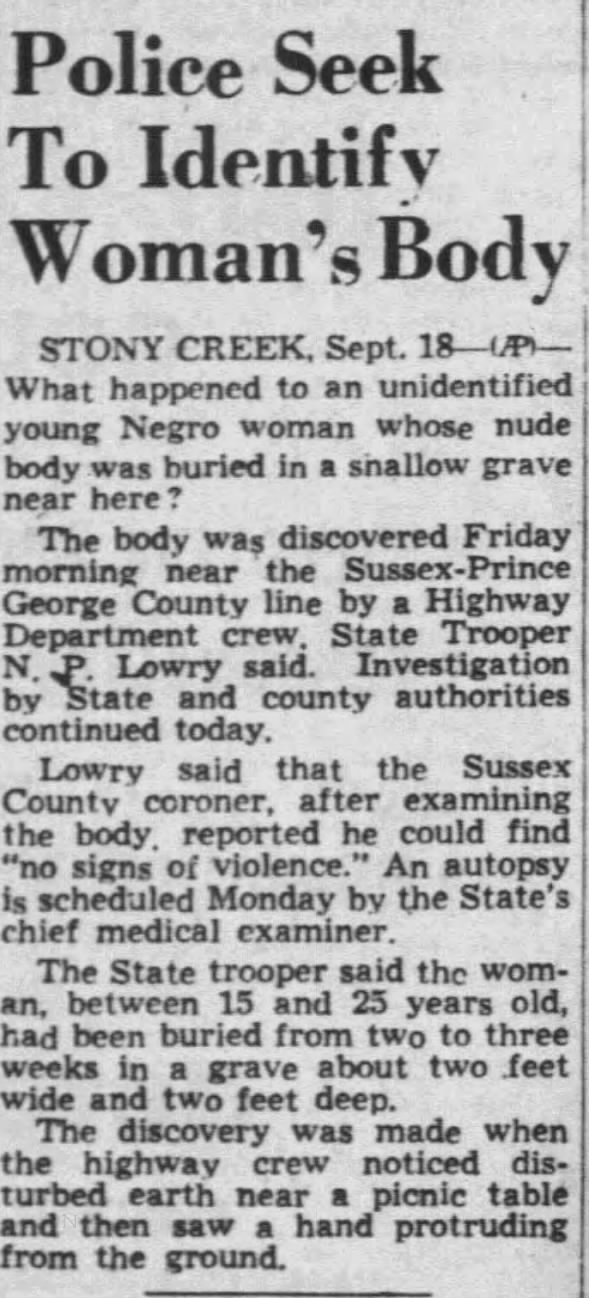
NamUs #UP85529 is a Jane Doe that was found near Stony Creek, Virginia in 1948. Her case was uploaded in October 2021, making for a 73-year interval. It's quite likely that, if she was a murder victim, then there is no justice to be had in this case due to how long ago it was. However, here are all the details that I could find on this Jane Doe.

Age: NamUs estimates an age of 15 to 25 years.

Sex: Female

Race: Black

Height: 5'2" to 5'3" (estimated)

Weight: 130 to 135 pounds (estimated)

Date body found: September 16th, 1948 (a Thursday) according to NamUs. According to the news source I found, the date of discovery was September 17th, 1948 (the source says the body was found on the nearest Friday to the date of publication). When two sources contradict one another, it's not clear which one to go by. It does create potential that the news source is covering a different Jane Doe, however, nearly all the other information lines up. I think the news source and the NamUs profile are covering the same case.

Date of death: NamUs estimates that she had been dead for six weeks. The original journalism in 1948 stated 2-3 weeks. It would be likely that she died sometime between late July and early September of 1948. If you are cross-referencing this case to missing people, then that's the target area for "last seen" dates (but be open to earlier times).

Location of Body: She was buried in what NamUs called a "makeshift" grave. That sounded clandestine in nature. A news report said she was found near Stony Creek, which makes it sound like the outskirts of town. It was near the Sussex-Prince George County Line according to the news source I found.

Who Found the Body: A crew of highway workers.

The date of discovery being either September 16th or 17th is one contradiction. However, it's not too uncommon for a date to be wrong on these matters. Another matter struck me as more substantial.

In the newspaper source, which is below, it is stated that highway workers noticed the Jane Doe when they noticed some disturbed Earth near a picnic table. This disturbed area was her shallow grave, which was described as two feet wide and two feet deep. It is stated in the article that the workers noticed her hand sticking out of the clandestine grave.

Regarding hands, this Jane Doe's NamUs profile states that one or both of her hands were missing from the body. Evidently, only one hand was missing and the other was sticking out of the grave.

The picture I am getting from all this is that someone buried this woman, who was nude, on the side of the highway. Perhaps this person did it near the picnic table so that it would provide a measure of seclusion. 

But why one hand was removed from the corpse is puzzling. Usually, when criminals remove a Doe's hands they are doing it to eliminate the chance of the Doe being identified due to fingerprinting. However, removing one hand and not the other doesn't seem to jive with that. I am thinking that the buried Doe might have been scavenged by an animal and one of her hands was removed that way while the other perhaps was pulled up, allowing for the highway workers to spot her.

NamUs #UP85529
NamUs #UP85529 19 Sep 1948, Sun The Times Dispatch (Richmond, Virginia) Newspapers.com

John or Jane Does With Very Clear Facial Photos -- Remain Unidentified

Author: Shane Lambert
Original Time of publication: January 29th, 2021


On this web page, I highlight cases of Unidentified Persons (UPs) who are deceased. What unifies all the UP profiles on this page is that a great photo of them is provided with their profiles, either soon after death or from a time when they were alive. The photos of the unidentified persons are of good enough quality that these are cases where the only thing that is required to solve them is both media exposure, a person who recognizes the deceased, and is willing to simply state their names. 

Besides the mystery of their identities, where there is a photo of the deceased from a time when they were alive, there is a question as to how the authorities got that photo.

This is a web page that is always a work in progress: I will add to as I come across more cases that fit the category. Minimally, please scroll through this page and look at the faces even if you don't feel like reading that much.

October 1st, 2025

I came across this case tonight, and it fits the pattern of solvable unidentified persons cases due to the recognizable face noted in the records. This John Doe was found nearly half a century ago, yet the clarity of the facial details could still lead to an identification with enough exposure. He is known only as #UP150166.


This Hispanic/Latino male, estimated 35–45 years old, was found deceased on a San Diego beach on June 13, 1978, beneath a boat dock. His recognizable face, along with detailed clothing descriptions (red knit shirt, khaki trousers, faded black Adidas shoes), suggests this case could be solved with the right pair of eyes.

The mystery is why someone with such a distinct appearance—5’11”, 170 lbs, gray-black hair, mustache—remains unnamed after so long. Could he have been a transient or visitor to the area? Tips to NamUs could crack this one.

February 2nd, 2025

I looked at the following case tonight and it also looked solvable. However, a lot of time has passed. But you would think this case would be solved if only enough people looked at the photo. Currently, she is known only as #UP127230.


January 13th, 2025

I worked on this one tonight. It looked solvable but as per October 1st, 2025, the person has yet to be identified.


NamUs #UP76876

January 13th, 2025: Update! This one was solved! At least, they removed the profile (which usually means the person was unidentified.

This fellow was found dead in the Arizona desert on October 26th, 2020. He was believed to have been dead for about 36 hours. His height was measured to be 5'4" and his weight was estimated to be 125 to 135 pounds.

The reason they have a photo of him from life is because they were able to take a fingerprint off of his corpse. The print matched an apprehension from March 2020. The photo is an apprehension photo from that time.

He gave the name Gregorio Cota Valenzuela in March 2020, however, this may be an alias. That detail is something I find strange as I didn't think getting away from the authorities when they are fingerprinting you was as simple as giving a fake name, however, I guess there are scenarios where that is possible.

This individual was found by the USPB (United States Border Patrol). Individuals found in remote desert locations in Arizona by the USPB are often Mexican nationals that may be walking to Phoenix. However, that this person was fingerprinted seven months before he died may suggest that he was in the USA for a long time.

Still, I would not be surprised if he is a Mexican national. If you are working on this case, fluent English and Spanish may be useful in order to look at the missing person websites in Mexico.

Canada's Missing Case reference: 2017073538

January 25th, 2025 update: This case does not seem to be active anymore as the link no longer contains information. It says it was updated on May 10th, 2023.

This case comes from Canada. The man on the right is thought to be an Albertan. He was found deceased in Ontario on October 15th, 2016.

At some point, he identified himself as Mitchell Nelson. At some point, the photo of him must have been taken, maybe by police.

If you visit his UP profile with Canada's Missing using the hyperlink above, then you'll see that they have composite sketches of him too. 

This is truly a strange UP profile. It's the only unidentified person profile I've looked at where they have a composite sketch AND a photo of the UP from when he was alive. There also appears to be a sidelonged photo of him riding a bike and pulling a huge canoe, which is a really weird photo. If they found these photos of him on the John Doe, then why do the sketch?

In another strange twist, this man is given an age range of 40 to 67 years old. I don't see how anyone can look at that photo and see someone who is as young as 40. I see someone who is at least 50 and probably 53 to 63 is I was to give a ten-year guess.


Jane Doe in Des Moines, Iowa Since May 26th, 1980

Author: Shane Lambert
Time of publication: January 10th, 2021

Thu, May 29, 1980 – 3 · Des Moines Tribune (Des Moines, Iowa) · Newspapers.com

Government source and link: NamUs #UP10846

Sex: Female
Race: White
Age: 19 to 25 years old, estimated
Year of death: 1980, estimated
Height and weight: no estimate provided for weight; journalism from 1980 says she was 5'5" to 5'8"
Body found: May 26th, 1980; estimated to have been there about five months or less
Location: Des Moines River, southeast Des Moines, Iowa; south of Carlisle Road near Hubbell Park
Hair: maybe red, not sure
Eyes: not sure
Other: deformity, severe lumbar curvature at L5
Clothing: close to the body a tube top was found (not really summer clothes which might be a clue that this Jane Doe went missing in the winter); also a ring and cross necklace and hairpins

On May 26th, 1980, Maynard David Jr., his younger brother, and Rick Kimmel were walking in the area of Hubbell Park in southeast Des Moines, Iowa. They were taking their dogs to some water in a wooded area when one in their party thought that he saw a skull. It turned out to be the Jane Doe with the details above. A bullet was found near the body.

Tue, May 27, 1980 – 8 · Des Moines Tribune (Des Moines, Iowa) · Newspapers.com


Candidates for ruling out

I have not yet looked at the following cases too closely. However, they are cases that other amateurs or Websleuths might do some research on for this Jane Doe as any one case might be a match.
  • Brenda Sue Black went missing sometime in 1980. Her NamUs profile says she was last heard from on January 1st of that year. However, last-contact dates of January 1st often mean that they don't know what time of year she went missing and just filled in the first day of the year to fill in the data fields. Black is in the height range, she is the right race, she is the right sex, and the right year. There's a remark at NamUs that this person was moving from Ohio to California and that might go through Iowa. No mention of the jewelry.
  • Other pending.

Carbon, Alberta Jane Doe: Unidentified Remains Mystery and a Bizarre Case (1995)

Author: Shane Lambert
Original Time of Writing: January 4th, 2021

January 10th, 2025: A websleuth (kara1218)  recently attempted to match this Jane Doe to a missing person named Julie Ann Derouin.

All articles are subject to editing after the original posting.


Unidentified Jane Doe in Carbon, Alberta

Who: Jane Doe found roadside near Carbon, Alberta, Canada
When: Discovered on April 20th, 1995 or April 21st, 1995
Post-mortem period: Thought to be dead for 10 to 15 years, meaning missing people last seen in April 1980 to April 1985 are all in play. However, missing people outside of this range cannot be ruled out based only on the post-mortem period's estimation.
Ethnicity/Race: Uncertain. Appears aboriginal by the construction; could be other ethnicities for sure but does not look Caucasian. One source says she may have been of north African descent but that dark skin color does not come through in the bust above. Mixed background possible.
Sex: Female
Age at time of death: 22 to 35 years old, estimated. Broadened range 20 to 40.
Height: 5'0" to 5'4" (combined range from Service Canada and the Youtube video below which is of a press conference that was held, in part, for this Jane Doe)
Other: she had suffered from a disease called brucellosis


Case Details and Indigenous Connection

This is a case that doesn't have a lengthy profile with Canada's National Centre for Missing Persons and Unidentified Remains. However, the Youtube video posted above will help deliver some case details.

I thought, at first glance, that this individual was one of the missing aboriginal women of Canada, a group that some think doesn't get a lot of police attention. However, I'm not sure this Jane Doe is actually in any missing person's database. Part of me wonders if no one at all is looking for her.

Be warned, this isn't an article for the weak-stomached. I don't apologize. If you are seeking out articles on missing people or Jane Does then you have to be ready for some topics that aren't exactly those for the pleasure reader.

I think she is aboriginal but my basis for designating her as such is tenuous. Firstly, she was found in the Albertan plains and that area has plenty of aboriginals. Secondly, she looks aboriginal to me in the police recreation but she could be of other groups. I've wondered if Indian reserves of Alberta might be alerted to this case. However, I really have low confidence that this person will be identified. I don't think there's a soul out there that is looking for her.

Websleuths or amateurs looking at this case should know that Carbon, Alberta is tiny. It's a village northeast of Calgary by about an hour. If she was from Carbon then she would have been identified, I think. Her roadside location sounds like a body dump to me and a person doing that would be looking for somewhere far away from where people knew her, I think.

Media Coverage and Grave Site Mystery

It was hard to find news that covered this Jane Doe. However, I believe that the following article from the April 25th, 1995 Calgary Herald might pertain to her. There is a statement in this news article that brings bizarreness into play.

Tue, Apr 25, 1995 – 25 · Calgary Herald (Calgary, Alberta, Canada) · Newspapers.com

Note, that the "last Thursday" that is referenced in the article would actually be April 20th, 1995 as opposed to April 21st, 1995 (the date that Service Canada reports as the date that the Jane Doe was found). Furthermore, the age range in the news article is different.

Both inconsistencies can be explained: dates are often a tad off in reporting and age ranges that are based on estimates can change over time. The reason I think that the reporting pertains to the Jane Doe pictured at the start of this article is just that Carbon, Alberta is puny. I don't think two Jane Does pop up in consecutive days but it's possible.

The news article says something that's very unique when it comes to Jane Does. According to the news article, this Jane Doe "may have been removed from a grave site."

What does that make you think? The RCMP might have been able to study the body and conjectured that it had been serviced by a mortician? That's what I think when I read that. Maybe there was a presence of embalming fluid. However, maybe they had different reasons for believing that she was previously buried. A lot more information is needed about the grave site that this person came from. 

Was it a marked grave?

Was it a clandestine grave?

If it was the latter, then it's hard to think of a way to generate leads. It's also perplexing: why would someone unearth an individual in a clandestine grave and leave her on the side of the highway? If her grave was of a clandestine nature, then one would conjecture that the grave site was a better hiding spot than on the side of the road. However, the article also said that foul play was ruled out. That suggests that her original resting place was not clandestine in nature.

Timeline and Identification Challenges

If it was the former (ie. she was in a marked grave), then leads are possible. The timeline with this Jane Doe could be as follows: 
  • a death between April 1980 and April 1985
  • a burial in a gravesite assumingly near her time of death
  • removal from the gravesite at some point
  • then she ends up roadside near Carbon, Alberta
  • discovered there on April 20th or April 21st, 1995 after laying dead outdoors for maybe 10 to 15 years
If all that is true then this Jane Doe case isn't going to be solved through any conventional means. Conventionally, when an amateur or websleuth is working on a Jane Doe's case, that person would cross reference the Jane Doe against missing person's reports.

That's worked in the past for many cases but if this particular Jane Doe died and was buried in a marked grave, then maybe she wasn't missing at the time of her death. Maybe the family and friends had a funeral for her and had a sense of closure. If that's true then it brings the following into consideration: maybe nobody that encounters this Jane Doe's profile, that actually knew her in life, will ever think to connect her to the person that she/he knew. This truly is a problematic Jane Doe when one considers that she was unearthed from a grave.

In this peculiar case, identifying the Jane Doe might involve looking for an empty grave in the region, one that belongs to a woman who died between the ages of 20 and 40, one who matched the height range, and someone who died between 1980 and 1985. I'm not sure how a Websleuth or amateur investigator goes about checking graves for empty coffins without stepping on a whole bunch of toes. But I do have ideas as to why someone would dig up human remains from a grave.

One understandable reason is exhumation for a legal reason, a historical one, or a scientific one. However, exhumation is not a good explanation in this case so long as you accept the following. Someone in charge of exhuming a body would be someone responsible enough to put it where it belonged afterward. The authorities, if they exhumed this person, wouldn't discard her remains on the side of a highway.

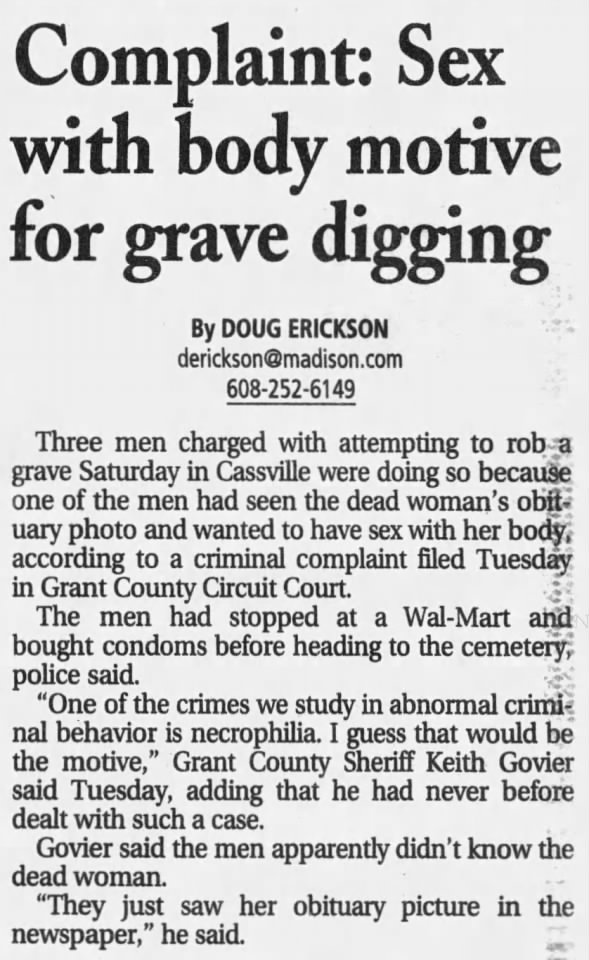
Another reason someone would dig up human remains borders on the bizarre and the grotesque: necrophilia. If you find it difficult to accept that someone would dig up a body for that purpose, then the definitive answer is that such acts are known to have happened before.

Wed, Sep 6, 2006 – 1 · Wisconsin State Journal (Madison, Wisconsin) · Newspapers.com

Furthermore, another reason why someone would take a body from a grave for clandestine purposes is to fake a death. That's believed to have happened before as well.

Wed, Sep 30, 1981 – 69 · Red Deer Advocate (Red Deer, Alberta, Canada) · Newspapers.com

I think another reason someone might dig up a body from a marked grave is one that's less sinister in nature: extreme mourning. Somebody who is psychologically changed due to someone's death might have an insane episode and seek out the remains. I didn't find any historical news article about that but, I think, it can happen. Read the poem "Annabel Lee" by Edgar Allen Poe. It tells a tale of a man who sought out his wife's tomb for comfort.

I really don't see this case as probable to be solved due to a lead from a missing relative. Firstly, there's hardly any news coverage that I could find. Secondly, there is barely anything in her profile. Lastly, I don't think there is anyone looking for her. If her grave was a marked one then the people that knew this Jane Doe might have buried her according to their customs and they might already have closure -- for decades. They might not know at all that she was removed.

The only point to take away is that if you ever come across any news from Alberta about an empty grave then think of this Jane Doe and cross-reference her particulars with that of the relevant grave marker or obituary.

Brucellosis Outbreak in Alberta

In the YouTube video, Staff Sergeant Jason Zazulak of the RCMP made the following statement: 

"She may be or appeared to have been of north African ancestry or possibly of indigenous or mixed ancestry. She was approximately 5-foot to 5-foot-three inches in height...She had suffered from a disease called brucellosis and repetitive fever. Brucellosis is not a disease commonly found in Canada and may suggest that this person was born abroad."

I do not think that this person was born abroad.

Alberta’s 1980s Brucellosis Context

It's important to note that brucellosis might not be a common disease in Canada in modern times. However, the Jane Doe in question is believed to have died in the early 1980s and her remains were found in Alberta. It's important to note, I think, that there was a brucellosis outbreak in Alberta in the 1980s. The balance of my research on this outbreak makes me think that this individual was an Albertan and that she had some kind of exposure to a farm or farm products.

Lethbridge Outbreak and Potential Leads

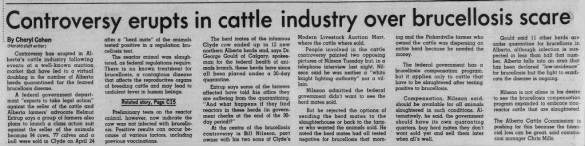
The second snipped article below is interesting. It says that there was an outbreak that affected people in Lethbridge in 1980. Note, that you didn't have to work on a farm to get brucellosis. It seems like any work related to cattle could expose you to the disease. It's also interesting that this outbreak is within the range of the Jane Doe's estimated death.

Wed, May 14, 1980 – 54 · Calgary Herald (Calgary, Alberta, Canada) · Newspapers.com
Sat, Jan 12, 1980 – 42 · Calgary Herald (Calgary, Alberta, Canada) · Newspapers.com

The second snipped article above is interesting. It says that there was an outbreak that affected people in Lethbridge in 1980. Lethbridge is not particularly close to where the Jane Doe was found, however, nor can it be considered out of range for someone who owned a vehicle. According to Google Maps, a drive from Lethbridge to where the body was dumped in Carbon would be just under three hours.

The six employees in the news article might know something about who this person is. They had the disease she had and they may have transmitted it to people they knew. Furthermore, it's not impossible that the Jane Doe was one of the six employees, yet, that would seem like a fluke if it was so.

Note, that you didn't have to work on a farm to get brucellosis. It seems like any work related to cattle could expose you to the disease. It's also interesting that this outbreak is within the range of the Jane Doe's estimated death.

Alberta’s Agricultural Link to Brucellosis

Farms in Alberta are very common. You will find them across a huge range of the province and the province itself is enormous. The only place in Alberta where you won't find many farms would be in the mountain parks on the province's western border.

Accordingly, that she might have worked or lived near cattle or their products isn't necessarily going to be a case-breaker. However, I would reject the opinion that she was of foreign originations based on her exposure to a disease that's not common in Canada. At the time when she lived and in the province where her remains were found, brucellosis was part of life.

Cemeteries Near Carbon, Alberta

Unraveling the Mystery of Saskatoon’s Woman in the Well - Case Solved, Agnes Goodall Pearson Not the Jane Doe

Author: Shane Lambert
Original Time of Writing: January 3rd, 2021; updated February 18th, 2021; updated October 15th, 2024. All articles are subject to editing after the original posting.

September 29th, 2025 update: the woman in the well has been identified as Alice Spence, meaning the theory below is incorrect. I will leave is posted, noting the original publication dates above. Saskatoon Police had an update.


I spent several hours working on the case of Saskatoon's "Woman in the Well" on January 3rd, 2021. This was a woman who was found in a long-abandoned well in 2006, and at that time, she was believed to have been long dead. There was a hotel at the site of this well, known as the Shore Hotel, in decades past.

Mon, Dec 16, 1912 – 69 · Star-Phoenix (Saskatoon, Saskatchewan, Canada) · Newspapers.com

Researching the Shore Hotel generated some names affiliated with the property and even some real-estate news from nearly one hundred years ago. However, while researching the hotel I didn't find anything of interest that connected to this case so I took a different angle on it, an angle that may have yielded something. Firstly, here are the Lady in the Well's specifications.

Unidentified Remains: Saskatoon Jane Doe, the so-called "Lady in the Well" or "Woman in the Well"; reference number 2012020100 with Service Canada's Missing.
Remains found: June 29th, 2006
Date of death: This Jane Doe's date of death is not clear but she is unequivocally believed to have been dead for decades at the time of her discovery; a range is given from 1920 to 1924 in an article that appeared in Victoria's Times Colonist on March 9th, 2007 (immediately below). Others have given different ranges. For my research purposes, I decided that any missing person from pre-1935 would be in play.

https://www.services.rcmp-grc.gc.ca/missing-disparus/case-dossier.jsf?case=2012020100&id=4
https://www.services.rcmp-grc.gc.ca/missing-disparus/case-dossier.jsf?case=2012020100&id=4 Fri, Mar 9, 2007 – 1 · Times Colonist (Victoria, British Columbia, Canada) · Newspapers.com

Ethnicity/Race: White
Sex: Female
Age at time of disappearance: Estimated to be 20 years old to 35 years old
Hair: Brown
Height and weight at the time of disappearance: 5'0" and slim build
Clothing: as pictured below

Forensic work circulated with this case.

The Jane Doe, by contemporary analysis, is considered to have been at least middle-classed in life (she had a gold chain). That is important because sad as it may be, it's a fact of life that the more money your family has the more likely you are to be on the radar when you go missing. I think that's a universal truth and not just for contemporary society.

That the Saskatoon Jane Doe was not a transient was something I considered to be a clue: whoever she was, if she was from the Saskatoon area then there should have been some media coverage of her disappearance in the Saskatoon newspapers around the 1920's. With that in mind, I assumed that any missing person cases from 1910 to 1930 for the Saskatoon area might have been picked over and examined already, at least cases that there are surviving records of.

My assumptions and research led me to think that the Jane Doe simply wasn't a local. Sutherland, the area near Saskatoon where she was found, was a railway stop according to Jeff O'Brien, a man cited as an archivist in an article I read and someone that I have exchanged emails with regarding the Jane Doe (same article as the one snipped below). He pointed out that she could easily have been "anybody riding the rails" in a newspaper article that appeared back in 2006.

Sat, Jul 22, 2006 – 4 · Star-Phoenix (Saskatoon, Saskatchewan, Canada) · Newspapers.com

Cases involving Jane Does that were "riding the rails" a hundred years ago or so is actually something I have experience researching. I actually did some work on a similar case a few years ago. If you are interested in the Lady in the Well from Saskatoon, you might also take interest in the Rahway Jane Doe. She wasn't found in a well several decades after her death but rather she was found in the street the night after her murder. She was thought to have alighted a train in the minutes or hour preceding her death. Like Saskatoon's Lady in the Well, the Rahway Jane Doe remains unnamed.

Lady in the Well: A Traveller to Saskatoon?


When I decided, for the sake of proceeding in a guided way, to assume that The Lady in the Well was someone who didn't come from Saskatoon, I next decided to look for a presumptive person who looked for her. I assumed that the Lady in the Well, the Saskatoon Jane Doe, would have had relatives after her death who would have wondered what became of her.

On this matter, I discovered one "Mrs. A.G. Mcintosh" who was of 4644 Bader Avenue in Cleveland, Ohio in 1938. Mrs. A.G. Mcintosh was also named Isabelle Pearson, someone who appeared in the American census of 1940. A.G. Mcintosh was Isabelle''s husband and the sister of one Agnes Goodall Pearson. It is this latter name that probably belongs to the Jane Doe in Saskatoon, in my opinion. It seems that Isabelle Pearson identified herself under her husband's name (ie. "Mrs. A.G. Mcintosh"), which some wives used to do.

My Procedure for Finding a Potential Match to the Jane Doe


One way people looked for people they lost touch with in the past was through classified ads. I've worked on so many hundreds of missing person cases, either individually or at Websleuths.com, that I know the keywords that appear in classified ads when someone is looking for someone. Phrases like "the whereabouts of" or "anyone knowing" or "anyone with information" or "missing since [year]" are examples of common phrases that appear verbatim in countless classified ads where the poster is looking for someone who is missing. They are not as popular anymore but these kinds of classified ads often appeared under "Missing Persons" columns in the past.

In looking through old classifieds, I started with "missing since 1910" and then explored the hits that came up. Finding nothing I went to "missing since 1911" and so on and so forth -- always with a focus on classified advertisements that appeared in Saskatoon. I would have considered classifieds for Calgary, Winnipeg, Regina, and Edmonton too. Most of the hits were of missing men, especially in the WWI years.

Finally, "missing since 1922" hit something that remains promising. The Lady in the Well might be named Agnes Goodall Pearson. I plugged that name into Google and didn't find any identical previous guess of her name, so I think this is an original guess. Since the original publication of this article, her name has been mentioned in some forums but with links back to me.

A classified advertisement appeared in Saskatoon's Star Phoenix on August 9th, 1938 but the individual who placed the ad, Mrs. A.G. McIntosh of Cleveland, Ohio (ie. Isabelle Pearson), was looking for someone who went missing 16 years earlier -- so in 1922. I will note that 1922 is dead-smack in the middle of the 1920 to 1924 range that was given as the possible year of the Jane Doe's death.

Tue, Aug 9, 1938 – 14 · Star-Phoenix (Saskatoon, Saskatchewan, Canada) · Newspapers.com


Missing person as of August 1938: Agnes Goodall Pearson
Last seen or last contact: sometime in 1922
Age at time of last contact or last seen: about 52 years old (born about 1870)

I will note that the age of the missing person doesn't match up with the estimated age of the Jane Doe. This is a point that has to be dealt with.

The Jane Doe is estimated to be 20 to 35 years old while Agnes was about 52 years old when she went missing. However, age estimates can be way off for Janes Does -- even ones that are found deceased for only a short time. When it comes to the long-deceased, one might think that the estimation process just gets all the more difficult.

I don't think Agnes' age of "about 52" rules her out as this Jane Doe at all. The Lady in the Well was found in an environment that was different than where most human remains are found and she was there for decades and decades. I think that those who gave an age estimate for this Jane Doe were working with facts surrounding her remains that were unique to their careers. Accordingly, I don't know how accurate their guesses are going to be.

One thing that I found interesting about the classified advertisement was that the person who posted it was from Cleveland, Ohio. The advertisement only appears in Saskatoon's Star Phoenix by my efforts. What that makes me think is that Mrs. A.G. McIntosh of Cleveland had reason to believe that Agnes Goodall Pearson went missing in Saskatoon, not further east nor further west. Someone from Cleveland, Ohio wouldn't advertise a classified for a missing person in Saskatoon without good reason.

I have very good reason to believe that the person who placed the advertisement was actually named Isabelle McIntosh. She appears in the 1940 United States Federal Census with the matching address of 4644 Bader Avenue (Bader Avenue can be seen in the original source, below is just a snippet). 

Her husband was named Andrew McIntosh (in fact, he was Andrew Grieve McIntosh). Thus, the "Mrs. A.G. McIntosh" in the classified advertisement from 1938 is the wife of the household. She is writing in her husband's name as many married women used to do.


Here's what I know of Isabelle McIntosh, the lady that placed the classified advertisement:
  • she was born in Scotland in 1887 (she was 53 at the time of the 1940 census); I think she was born in Kilmany, Fifeshire
  • her maiden name was Pearson
  • she is the sister of Agnes Goodall Pearson, the person she was looking for
  • the family was caucasian and Scottish
Ella Ogilvie, widowed, is a 30-year-old daughter with two children, children that might be alive at the time of writing. It would be interesting if one of them knew something about the details of Agnes Goodall Pearson. Did she reply to the advertisement? Did she come for Christmas one year? Or was Agnes' last known communication forever more the year documented in the classified ad (ie. in 1922). That would be expected if she was the Jane Doe in Saskatoon.

Agnes Goodall Pearson: Never Accounted For


I didn't find any other information on Agnes Goodall Pearson using online newspaper databases: the classified ad above is the only thing I note. Furthermore, a Google search (see below) for the quoted name contained no hits in written work on January 3rd, 2021. That search would cover forums and websites for missing people in addition to blogs and news websites. 


The only hit, before the publication of this blog post, that you are reading right now, was for Ancestry.com where I did find evidence of someone named Agnes Goodall Pearson. However, this was someone who died in Scotland in 1915. According to our classified ad, our Agnes Goodall Pearson was alive in 1922.

One way to rule out Agnes Goodall Pearson as the Lady in the Well is to find her, Agnes', grave. If you find a grave of Agnes Goodall Pearson (b. abt. 1870), then it rules her out as the Jane Doe in the well because the Jane Doe was in the well until 2006, not in a grave. I did not find a grave at FindAGrave.com for an Agnes Goodall Pearson, born in 1870, that matched. This is a exercise that could be revisited from time to time.

I did find a grave for an Agnes Pearson that died in 1937 (b. 1869). She was buried in Red Deer, Alberta and this is a small city on the Canadian prairies. I considered the possibility that this was Agnes Goodall Pearson but ruled this out. The Agnes Pearson that died in 1937 married into the name. Her husband, one Nels Pearson, is referenced in the grave marker. Agnes Goodall Pearson, by my research, didn't marry into the Pearson family name but rather she had it from birth through her father.

Regarding an Agnes Pearson that resided in Saskatoon, on that matter, I emailed Jeff O'Brien, Saskatoon archivist. He claimed to have evidence of an Agnes Pearson in and around Saskatoon in the 1910s and early 1920s. However, he could not find a grave for her in the Woodlawn Cemetery. O'Brien said that this was the place where people from Saskatoon were buried if they died before 1950.

Her address in Saskatoon may have been 279 3rd Avenue North according to Jeff O'Brien, Saskatoon Archivist. That address would be from the 1913 Henderson directory. Jeff O'Brien also said "Agnes Pearson is in the 1923 and 1924 Saskatoon Henderson directories living in rooms at the Colonial Apartments, a rooming house at 525 20th Street West." These could be different Agnes Pearsons than the one sought out in the classified advertisement or they could be the same.

I think the person, Agnes Goodall Pearson, that was the target of the classified advertisement was at this link at ancestry.com. She appeared in the 1901 Scotland Census. She has a death date that is unknown according to one profile


Her unknown death date is promising when it comes to corroborating her ID as the Jane Doe in the well. Someone who ended up down a well for decades as a victim of foul play would likely have a death date that's unknown to those who cared for her. In fact, none of the public family trees had her date of death as per the public ones at Ancestry.com. That's a bit of a clue too because it shows that no one has great information on when she died, which is what you'd expect for a missing person.

Right now, what I have on Agnes Goodall Pearson is this:
  • She was definitely born in or around 1870 in Forgan, Fife, Scotland
  • She definitely appeared in the 1901 Scottish Census
  • Her name definitely appears in a newspaper classified ad in Saskatoon, Saskatchewan on August 9th, 1938 with a reference to the year 1922 as her last-heard-from time
  • Possible connection: an Agnes Pearson appears in the Henderson (near Saskatoon) directory in 1913 (could be a different person)
  • Possible connection: an Agnes Pearson appears in the 1923/24 Saskatoon directories (could be a different person)
  • She then disappears from the records (challenge: prove this wrong)
  • She doesn't have a grave marker (challenge: prove me wrong, please)
  • She has no obituary in any newspaper (challenge: prove me wrong, please)
  • Whoever works on her family tree at Ancestry states that the circumstances surrounding her death are unknown -- which is a trademark of a missing person
  • Possible connection: maybe she ended up in the well with her last contact to her sister Isabelle coming in 1922; a lot seems to fit with the assumption and nothing to contradict and yet no smoking gun
Without a grave marker or a proven date of death that rules her out, this missing person remains a candidate as the Woman in the Well.

For further leads, use the name Agnes Goodall Pearson (born in or around 1870 as per her age of 52 in 1922). This woman is never married and was born in Scotland. When did she come to Canada? It seems sometime between 1901 and 1913. Her father is Alexander Pearson and her mother is an Isabella Pearson, an Isabella that's not to be confused with the classified ad poster of the same name. 

If you can, try and find a picture of Agnes Goodall Pearson so that it can then it could be compared, as food for thought, to the sketch of the Jane Doe. But we definitely want to try and rule Agnes out as the Jane Doe. If we can't do that then we can hold on to the opinion that she could be the Jane Doe. 

The main way to rule her out, I think, is to find her documented date of death (ie. an obituary) or gravemarker. With many angles to consider, you can see how there is a lot of work to be done in investigating this lead. Furthermore, I have leads on living relatives if DNA on the Jane Doe in the well is ever available. 

NamUs MP#76322 -- San Bernardino John Doe from October 2020

By: Shane Lambert

Original time of writing: December 9th, 2020 


This individual was found deceased in San Bernardino on October 16th, 2020. 


The picture is taken from NamUs. It is an artist's rendition. At the original time of writing, this was the NamUs description:

"On Friday, 10/16/2020, at 5:07 pm, a 911 call was received reporting an adult Hispanic male transient with a fair complexion in a gutter near the curb in the 900 block of Mill Street, San Bernardino. The San Bernardino County Fire Department and the San Bernardino Police Department responded and confirmed the body deceased at 5:27 pm. There was no identification located on or near the body. The body was approximately 5'10” tall and 217 pounds. The hair on the head was short and brown and the eyes were brown. The face was slightly unshaven. The natural teeth were present. He was wearing a black and white polo shirt and blue shorts."

This is an interesting case to me. There is a description of him as transient and the fact that he was found in a gutter doesn't speak well to affluence. 

However, there are some indicators that he wasn't an unhealthy person in all ways. He had short hair which suggests recent grooming, he had only a "slightly unshaven" face which suggests the same thing, he had "natural teeth" which sounds like the authorities are trying to depict him as a well-taken-care-of person, and he had a brand-name shirt which implies that he had at least some modest money. I guess the artist's rendition might obscure things but he looks like a normal citizen to me instead of a homeless person. Also, at 217 pounds the weight for a 5'10" individual is pretty healthy.

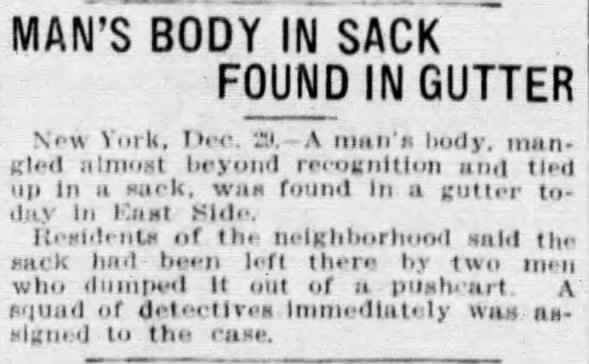
Of course, being found in the curb gutter without ID will make anyone think you are transient. Here's a look at a couple of other cases where a John Doe was found in a gutter. I list such cases because I think history repeats itself. What happened in similar cases in the past could be food for thought for the future.

NamUs #UP11460: a white male in San Francisco is found in a gutter on June 15th, 1985. NamUs description says that there were "drag marks in the street leading up to the subject" and that he was wrapped in a blanket.

There are a lot of cases that I found in newspaper archives using the keywords "unidentified" and "found in gutter." In many of the cases, the individual was thought to have been dumped there.
  Mon, Dec 29, 1913 – 1 · The Chattanooga News (Chattanooga, Tennessee) · Newspapers.com


Questions for the San Bernardino John Doe: 

  1. Were there drag marks? 
  2. Was he wrapped in anything?
  3. Was there any clue as to whether the individual was dumped there or died there?
If you are in the San Bernardino area, then please cross-reference this against the cases you know or the ones that come up.  My thoughts are that this man might have been someone whose economic life went to crap due to the COVID crisis and became transient or that where he was found was simply where someone left him.

NamUs #UP51552 - Dead Man Found After Several Decades

By: Shane Lambert

Time of writing: December 9th, 2020

The following case was interesting to do some research on. It's NamUs #UP51552 and it involves the discovery of human remains that were long deceased.

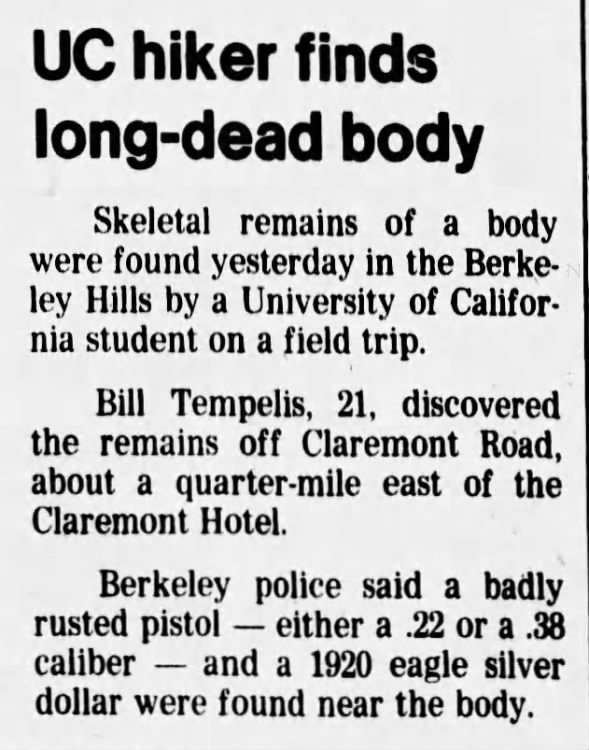
The decedent was found on February 26th, 1978. He was a white male in life and an adult. His height was estimated to be between 5'8" and 5'10" with a weight that could not be estimated. According to NamUs, he was dead since as early as 1940. NamUs also states that the skulls and bones of the man were "found by students who were planting trees in the area."

The date of his death is interesting to debate. NamUs does state that the man was in possession of a 1920 US mint half-dollar (the coin was near the body). Of course, the man having a coin that was, assumingly, his from 1920 doesn't actually mean a lot about his time of death except that it didn't happen before that year. For jewelry, NamUs also stated that the man had a "Yellow metal Elgin pocketwatch." I guess finding the person's time of death wasn't as simple as checking the time.

The news on this case was a little different than what's stated at NamUs. That's not to say that one source is better than the others. But one article said that the body was found by a singular hiker, not tree planters. The source I found was the San Francisco Examiner on Feb 27 1978 (page 32). That source named one "Bill Tempelis" as the discoverer of the body "off Claremont Road." Furthermore, the police described in the article as claiming that "a badly rusted pistol" was near the body, a pistol of .22 caliber or .38. The news article described the coin as a "1920 eagle silver dollar" (article embedded below).

As far as identifying this person goes, the date of the coin is interesting as a clue. However, the pocket watch is probably more of a clue when it comes to conjecture. According to an article at The Atlantic, "By the Great Depression, wristwatch production had eclipsed pocket-watch production; by World War II, the pocket watch was obsolete" (Uri Friedman/May 27th 2015 article at The Atlantic).

The Great Depression happened in the 1930s and the start of the second world war was 1939. NamUs claim the body was there from "as early as 1940" but maybe they are wrong. Could be the body was there as early as 1920. That's the year of the coin and it's the decade where the pocket watch was still a little in style.

When I search for "Elgin Pocket Watch" in newspapers.com, the earliest hit is in the Los Angeles Times on December 15th, 1918 (snipped below). There could be many explanations for that: the brand might not have been popular before then, it might have been new at that time, or maybe they just didn't advertise in newspapers.  However, the decade of the 1920s produced 1279 hits at the time of writing and the 1930s saw more than triple that. The keywords peaked in the 1940s at 6129 hits. When I add the word yellow, the results go down by quite a lot but the same trend is present for popularity.


When it comes to the gun, all the caliber means is how wide the barrel is. A .22 caliber gun is 0.22 inches and a .38 caliber gun is a lot wider. It is significant that they couldn't tell the caliber of the gun. Guns are made of metal -- I think it would take a lot of weathering for a gun to deteriorate. To me, the rusted gun, the coin, and the pocket watch all speak to a man who was dead for several decades as of his discovery in 1978. I would estimate a time of death in the 1920s. In order words -- good luck in identifying this cowboy.

NamUs #UP51552NamUs #UP51552 Mon, Feb 27, 1978 – 32 · The San Francisco Examiner (San Francisco, California) · Newspapers.com

Olga Mauger, Missing Since 1934 -- NamUs #MP27783

By: Shane Lambert
Original time of writing: December 7th, 2020


Olga Mauer has one of the older cases that is still listed at NamUs. She went missing on September 17th, 1934, from the wilderness near Dubois, Wyoming.

She had black hair, her eye color is not listed, she was 21 years old at the time of her disappearance, she was 5'5" to 5'9", and she weighed between 120 and 150 pounds. NamUs says that she "and her new husband went scouting for elk, camping up at Togowotee Pass when she went missing." Below are the key details regarding this missing person, as per what is available at NamUs.

Case Form C:

(1) Missing Person Went Hiking With a Group
(2) Missing Person Separated From Group

Key Details from Olga Mauer's NamUs Profile

Category Details
NamUs Case Number MP27783
Full Name Olga Mauger
Biological Sex Female
Race / Ethnicity White / Caucasian
Missing Age 21 Years
Current Age Deceased - Would be 112 years old
Date of Last Contact September 17, 1934
Missing From Dubois, Wyoming
County Fremont County
Missing From Tribal Land No
Primary Residence on Tribal Land No
NamUs Case Created February 20, 2015
Circumstances of Disappearance Olga Mauger went missing near Togwotee Pass while elk hunting with her new husband.
Height 5' 5" - 5' 9" (65 - 69 Inches)
Weight 120 - 150 lbs
Hair Color Red/Auburn
Left Eye Color Blue
Right Eye Color Blue
Distinctive Physical Features No Known Information
Clothing Riding trousers, a man's shirt, a gray and blue pullover sweater, and a green felt tam
Footwear High-laced boots
Accessories A hand-axe was fastened to her belt; she carried a sack lunch
Transportation No Information Entered

Points That I Found While Researching Olga's Case

  1. The earliest newspaper coverage that I could find of her disappearance was from September 20th, 1934, in the Jackson's Hole Courier (front page; the points below until No. 10 are from that article)
  2. An airplane was used in the search for her
  3. Two-Gwo-Tee Pass is how the area is spelled
  4. There were "scores" of men involved in the ground search
  5. The husband reported her missing at a camp; he said that he left her resting while he pursued "big game"
  6. The searchers believed that they found tracks of the woman's about "eight miles from where she was last seen" but this was later disputed
  7. Olga Mauger had been married just six days earlier
  8. She was only "lightly clothed" and likely would not have survived the night due to the altitude, according to those familiar with the area
  9. She was believed to have had three sandwiches but no blanket
  10. Mr. Mauger was reported to have been in a sleepless state over the ordeal
  11. She went missing on a Monday afternoon; one article said that cries for help were heard from a canyon on the Wednesday night that followed (Casper-Star Tribune/Sept 20 1934/Page 1; points to No. 15 are as per this source)
  12. The husband's name was Carl S. Mauger as per this source. As per another one, it was Carl R. Mauger. The print in these old newspapers can be hard to read and maybe to blame. The middle initial is likely "S," in my opinion
  13. The camp they went to was called the Floyd Stalnacker camp
  14. Carl said that he left her to rest in the forest, but when he returned, he could not find her
  15. No one had any hope of her being alive by the soonest Friday (Casper-Star Tribune/Sept 21, 1934/Page 1; points 17 and 18 as per this same source)
  16. A paper sack of hers was found; she had used it to carry lunch
  17. Her tracks were reportedly found in a wooded area known as Turpin Meadows
  18. The search continued into October, but there were periods when inclement weather caused stoppages (Casper Star-Tribune/Oct 3, 1934/Page 10; Points 20 to 22 are from this source)
  19. There were reports that she had been found, but these were not true
  20. The county attorney said he intended to question the husband, a man who stayed in the frontier area during the entire search; the husband claimed that he had not been arguing with his wife
  21. The period that he claimed to have left his wife alone in the forest was a mere 20 minutes, which was later seemingly contradicted
  22. Olga Mauger had a doppelganger in Bridgeport, Nebraska, that had to be ruled out as the missing woman (Casper Star-Tribune/Oct 14 1934/Page 11)
  23. The husband was held in jail as per an article in the October 9th 1934 Casper Star Tribune (Page 10); he had the unfortunate luck of resembling a man with a warrant out for his arrest, a man with the name Carl Mager as opposed to Carl Mauger; Mauger didn't have the birthmark that Mager had
  24. Heavy snow in the region ended all hope of finding her
  25. In 1941, Carl Mauger filed for divorce from his missing wife. They married on September 11th, 1934, and she disappeared on September 17th of that year as per the Casper Star-Tribune, May 6/1941, Page 5.
  26. This same source said that no trace of the missing woman was ever found. It also said that the search was intensive but was affected and hindered by snow.
  27. A major piece on the disappearance was published in the San Francisco Examiner on Nov 23 1941 -- page 81
  28. It says that the husband married Olga's "rival after seven years of waiting"
  29. Bloodhounds were used in the search, as per the SF Examiner
  30. Olga's younger sister believed that the missing person had a motive to disappear
  31. Olga's maiden name was Schulz
  32. The balance of the Nov 23, 1941, piece is that there should be suspicion around the husband because of his other romantic interest and suggestions of friction in the days after the wedding between Carl and Olga
  33. Olga was wearing tan breeches, lace boots, a blue shirt, and a green and grey pullover tam. She had a little hatchet in a belt and a paper bag with sandwiches.
  34. In this source, Carl is cited as stating he had returned much later than 20 minutes, the time he had promised to return.
  35. Indian trackers were employed to apply "their special talents." These were people who were believed to have the skill to tell whether a stone had been turned recently or years earlier.
  36. A Casper Star-Tribune article on the 20th anniversary of the disappearance said no more was known of her fate than the day she disappeared. This is pretty much true as of the time of writing this article as well.
What confused me with this scene is that Olga and her husband Carl were on a big-game hunting expedition. I've assumed that Carl had a gun. I've wondered, on that note, if simply firing this into the air or firing a blank might have helped his wife find him in the immediate aftermath of her disappearance. However, I found nothing that conclusively said that he had a gun with him as they were on a scouting mission to find elk, perhaps intending to hunt them at another time.

Down and Out in the Canadian Rockies

A BLEAK GLIMPSE INTO RESORT TOWN LIFE FROM A WORKER'S PERSPECTIVE

Get your copy of this engaging ebook now

Available on Amazon for Kindle or as a physical copy

Theories and Suspicions Surrounding Her Disappearance

There was suspicion surrounding the husband, but my personal feeling was that he did not kill her. The one article that cast him poorly for marrying his wife's rival was not convincing. Anyone might wish to remarry if his or her spouse is missing for seven years, especially under the conditions that Olga went missing. That the next wife was a rival of hers only speaks to his affections for both women, not to something diabolical. Furthermore, I found no mention of a murder-for-life-insurance motive.

But one interesting point of view that would look to increase the husband's guilt was made by one of the 20 Indian trackers who were asked to lend their skills to the search. I think it's important to point out that these Indians were people who weren't assimilated like modern Indians. These were people who would have been raised by Indians who actually lived off the land, and, in 1930, I think these Indians would have had a lot of the outdoor skills that their ancestors had. That they were sought for their tracking abilities speaks to a level of authority that they had in the region.

These people said that the footprints that were found eight miles away were NOT Olga Mauger's. What's also interesting is that these Indians said that Carl Mauger's path away from his wife would have kept him in full view of her sitting place from the moment he left her to the moment he claimed he turned around.

If true, that's something powerful to consider: the scene the Indians described was rugged and difficult terrain but wide open for viewing (September 23rd 1934 Casper Star-Tribune):

"The Indians said the footprints found eight miles from the spot where Mauger said he last saw his wife, were not those of the missing woman. They also pointed out that, although the country is rugged, it is open and that Mauger was in full view of the place, where he claimed he left his wife until he reached a small path where he said he turned around and retraced his steps."

I don't think the footprints eight miles away were those of the missing woman's. That's a huge distance to hike. In fact, some hikes in uneven terrain of that length would take an already-tired individual all the sunlight hours at the time of year that Olga went missing.

If the husband is to be treated as a suspect, then it calls into question the last time someone other than him saw his wife. They did camp alone, away from a group that was also in the area.

But the scenario the husband offered as an explanation isn't a bad one in my view. His wife grew tired before him, which makes perfect sense given the differences in physical abilities between the sexes. He wanted to get up the peak and said he would be 20 minutes to return. It ended up taking him much longer, which jives with my personal hiking experience. Points that appear close in wide-open terrain actually can take a long time to reach.

What if he took an hour to return or more? Does Olga get mad waiting, or does she think that she has to go get help out of fear that something happened to him? If she can't navigate her way back to the camp, then she is lost with little food as the evening looms.

Furthermore, her screams might have been heard, and her lunch bag was found -- in my mind, those circumstances both mitigate the suspicion that a reasonable person might direct toward the husband.

What Happened to Olga Mauger? Theories Explored

Olga might have panicked when her husband didn't return, attempted to make her way back to their camp, and got lost. She then suffered from exposure to the elements. This opinion might not totally jive with the Indians' point of view, though, because according to their assessment, the two people never would have been out of view of one another in the wide-open area. How, then, could they become separated? A counterpoint to that calls into question the strength of the eyes of the two people and exactly how far they were from one another. If Olga loses sight of her husband just for a few moments, then it might have been enough to cause her to panic.

People claimed that they may have heard her screams come from a canyon at night -- the third night that she was missing. Surely, this would be a time when she would be most desperate and near her life's end. I do believe that they did hear screams because they would echo in a canyon. Furthermore, since canyons are the low points in a region, it's where the night-time air would be the least frigid and thus most attractive to someone facing the hardships of the mountain nights.

Why Olga Mauger’s Remains Were Never Found

She couldn't live forever with no food or heat. There were snowstorms in the area, meaning that a dead body could get covered up. Natural areas swallow up a lot of evidence.

Also, animals move bodies or parts around, including to secret spots like underground dugouts or dens. Lastly, if the area had avalanches then they could move her body to low points that one would not think to search, even after the spring melt of the next season. When someone dies in a forest, there are, in fact, loads of ways that the body can still be moved around.

Chances are, in my opinion, that Olga is within a couple of miles of her last-known location, long dead. Her remains might not be intact, but something of her is there.

That the area was scoured over by hundreds of people doesn't mean that they couldn't miss her. Many people are found not far from where they went missing, years after their disappearance, despite extensive searches taking place.

Featured Post

Ten Missing People Found Because of Climate Change

By : Shane Lambert Original publication date : August 6th, 2026 AI-generated image (ChatGPT) Climate Change, Global Warming, Snowmelt, and E...

Best of MPC (as selected by the site's author)