Showing posts with label British Columbia. Show all posts

Patricia Flynn Missing Since 1982: The Unsolved Yarrow, BC Case

Patricia Flynn Missing Since 1982: Yarrow, BC Unsolved Case

Patricia Elizabeth Flynn: Missing Since 1982

Birthdate range: March 25, 1943 through March 24, 1944

  • Calculated using her age on the date she went missing; useful for identifying her in a family tree or any such records

Case Details

Patricia Flynn was 38 years old when she went missing from her home in Yarrow, British Columbia, in March 1982. Yarrow is in the Chilliwack area of British Columbia, located south of the Trans Canada Highway and near Cultus Lake. According to the Royal Canadian Mounted Police (RCMP), Patricia was last seen on Wednesday, March 24, 1982, running into the forest from her family residence. She was wearing only a nightgown and slippers. However, newspaper articles from the time suggest other sightings.

An immediate search of the surrounding area began and continued for several days, but Patricia was not found. Eventually, the search was called off. The case is recorded by the Chilliwack RCMP under File #1982-4030. Patricia has never been located, and the circumstances surrounding her disappearance remain unknown.

If you are looking for some case details, I recommend visiting Paul Henderson's post about the disappearance, as he appears to have dug into some newspaper articles. As described, the RCMP said she was last seen running into the forest wearing slippers and a nightgown. In my opinion, that evokes themes of mental health and self-harm, but the RCMP seemed to have taken some criticism over their search efforts for this missing person.

Inappropriate Footwear in Missing Persons Cases

Being barefoot in public or wearing footwear that is not appropriate is a recurring theme in missing persons cases. In Flynn's case, she was wearing only slippers when she went outside.

The early spring in Chilliwack would not be a warm time of year yet, although I could not find an exact temperature for the day she was last seen. I would not think that someone would survive 24 hours with only slippers and a nightgown outdoors in that region in late March. The daily high might be around 12C with a low around 2-3C at that time of year (personal estimate).

Why is inappropriate footwear so commonly associated with missing persons cases? It can reflect a lot of things, like sudden flight, disorientation, distress, or other matters.

In some of my blog posts, I've suggested that inappropriate footwear (including no footwear) reflects a call for help, as someone out in public with inappropriate footwear would actually draw attention from concerned onlookers. Furthermore, I've thought that in some cases someone leaving with inappropriate footwear would be doing so because they don't want someone they live with to know that they've left their residence.

Why the Case Was Revisited

In 1982, DNA was still being developed for police work and procedures. As a result, the RCMP says that no DNA was obtained from Patricia or either of her parents. The RCMP's 2025 investigation noted that Patricia had no brothers, sisters, or children, and both of her parents died within two years of her disappearance. Investigators' notes indicated that the Flynn family had relatives "back East," although police said it was unclear exactly where those relatives were located.

Latest Update I Could Find

The most recent public update I could find concerning Patricia Flynn's disappearance is an RCMP appeal published on May 15, 2025. The Chilliwack RCMP was seeking the public's assistance in identifying surviving family members who may share familial DNA with Patricia.

According to police, obtaining familial DNA could allow investigators to compare it with unidentified persons in Canada and internationally. The RCMP said that such a comparison could be key to advancing the investigation into Patricia Flynn's disappearance.

I have not been able to find a more recent public update confirming that Patricia Flynn has been located, that her remains have been identified, or that the DNA investigation has produced a match. Therefore, based on the information publicly available to me, her case remains unresolved.

Source: Royal Canadian Mounted Police — Police Seeking Family of historical missing person Patricia Flynn , Chilliwack RCMP, May 15, 2025, File #1982-4030.

The RCMP page is part of the British Columbia RCMP web archives and has not been updated since it was archived. The archived release states that the information was last modified on May 20, 2025.

Brian Douglas Faughnan: Missing in Whistler Since July 2002

Missing Person Fact Sheet: Brian Douglas Faughnan

Name: Brian Douglas Faughnan
Age at Disappearance: 35
Born: June 6th, 1967
Date Missing: July 12th, 2002 (Friday)
Location: Whistler, British Columbia, Canada
Sex: Male

Ethnicity: Caucasian
Height: 6'0"
Weight: Approximately 185 lbs.
Hair Color: Looks brown/blonde in photo
Eye Color: Not specified; likely wearing glasses (clear or prescription sunglasses)
Distinctive Characteristics: Not noted in provided sources

Clothing and Accessories:

  • Possibly wearing a lightweight bright red windbreaker or a darker red jacket.
  • Likely wearing shorts, but if wearing pants, possibly Columbia Trekker Convertible Pants in "fossil" color (grey-beige).
  • May have been wearing a denim baseball cap, particularly in sun-exposed areas.
  • Carrying a yellow 50 L Mountain Equipment Co-Op backpack, possibly with a climbing or ice axe lashed to it.
  • Source

Occupation: Aerospace engineer and science fiction screenwriter from Montreal.
Family: Brothers John and Steven Faughnan mentioned.
Government Source: RCMP Reference File 02-4306

Transportation

No vehicle details provided. Brian may have been hitchhiking to the Rainbow Mountain trailhead, as speculated by his family, but no confirmation exists.

All-New Amazon Kindle Paperwhite (16 GB)

Experience the fastest Kindle ever with a 7" glare-free display and weeks of battery life. Perfect for reading anytime, anywhere!

 Shop Now on Amazon

As an Amazon Associate, I earn from qualifying purchases.

Case Overview

Last Known Location: Brian Douglas Faughnan was last seen leaving the Shoestring Lodge in Whistler mid-morning on Friday, July 12th, 2002, after asking for directions to the Rainbow Mountain trailhead. This sighting was on video footage at 9:57am that morning, according to an online source (Brian Faughnan - Summary).

That makes the lodge his last-known location and it was located at 7124 Nancy Greene Drive. In modern times, that would be near Nester's Market on the Sea-to-Sky Highway. The lodge does not appear on Google Maps, to my knowledge, as the intersection only went back to September 2007.

The lodge has been closed for quite a number of years. But it looks like it was a hostel or on the budget-friendly side for sure. I am thinking "Shoestring" might have been a play on "shoestring budget." An article from 2007 in Pique Newsmagazine referenced the closure and budget orientation (Vivian Moreau/July 28th, 2007).

The online source suggested other places are possible areas where Brian was last seen. This included a conversation with a man named Steve, who operated the tour bus that Brian was with. Furthermore, the same article suggests Brian may have gone to a place called Wild Willy's (probably Whistler Village). I think this was a ski shop but for summertime Whistler tourists, maybe it offered services to hikers. There are no definite or confirmed sightings after he left the lodge, to my knowledge, and it’s unknown if he reached the trails.

Comparing Brian Faughnan’s Disappearance to Paula Jean Welden’s Case: History Repeats Itself?

At the heart of Brian Douglas Faughnan’s disappearance in Whistler, British Columbia, in 2002, lies a striking parallel with another missing hiker from across the decades and across the continent. Paula Jean Welden's case shares eerie similarities to Brian's. For readers familiar with Brian’s story, Paula’s case offers a haunting comparison, particularly in their shared dependence on guidance before embarking on their journeys. 

Central to Brian’s last-known activities was his reliance on directions and this shows an apparent disorientation from the outset of his hiking plans. Paula Jean Welden was like this as well and her sustained disappearance for nearly 80 years as of 2025 casts a grim shadow over Brian's case.

Paula Jean Welden was an 18-year-old college student who vanished on December 1st, 1946, while attempting to hike the Long Trail near Glastenbury Mountain, Vermont. Unfamiliar with the area, she relied on directions from others: a man named Lou Knapp dropped her off near Route 9 around 2:45 PM, and another man named Ernie Whitman guided her toward the trail around 4:00 PM, just before sunset.

Like Brian, Paula’s dependence on external guidance highlights a critical vulnerability. Brian needed directions to the Rainbow Mountain trail network and even just The Valley Trail, which runs throughout Whistler. He was lost from the start—not just physically but in his planning. He did not appear ready to tackle a challenging trip in the rugged Coast Mountains, where harsh weather and remote terrain could easily overwhelm a solo hiker.

Both cases also raise the specter of hitchhiking-related disappearances. Paula was known to have hitchhiked the day she disappeared but she survived that part of her day. 

Similarly, Brian’s family speculated he might have been abducted while hitchhiking to a trailhead, given his lack of confirmed transportation after leaving the Shoestring Lodge. While no evidence confirms abduction in either case, the hitchhiking element introduces a shared risk of encountering danger en route.

But, in my opinion, Paula and Brian’s reliance on directions underscores their unfamiliarity with their environments, amplifying the perils of solo hiking. Brian’s apparent disorientation mirrors Paula’s struggle to locate her trailhead, suggesting both were ill-prepared for the challenges ahead. For Brian, this initial confusion paints a bleak picture of his chances in the unforgiving Coast Mountains, much like Paula’s likely fate in Vermont’s frozen wilderness, leaving both cases as enduring mysteries of hikers lost to the unknown.

Brian Douglas Faughnan: Youth Hostel Connections

The "youth hostel" tag does not appear with a lot of missing people on my website. However, I can think of a couple of cases where a missing person's case was associated with one.

Elisa Lam was last seen on footage at the Cecil Hotel in Los Angeles, which offered hostel-like dorms in some rooms. Also, Angela Hartmann was a backpacker in western Canada who used hostels and has been missing for decades. I think they are a bit riskier to use because the cheaper the place, the bigger the chance is of meeting someone on the clandestine side.

A Captivating Short Story, Thematically Connected to Missing Persons, to Grip Your Imagination

Prologue

As the author of this blog, Shane Lambert, I typically focus on topics surrounding missing people, unsolved mysteries, forensics, and the societal issues that intersect with these topics. However, I’ve decided to share a short story of mine, "On Being Indistinguishable," on this platform, despite it being a departure from my usual nonfiction content.

I feel this story is thematically resonant with the blog’s core focus on missing persons and society, partly because it involves hitchhiking. Through the lens of a well-meaning driver who picks up a hitchhiker, the narrative explores the complexities of hitchhiking, particularly from the driver’s perspective.

It delves into the tension of being perceived as suspicious, simply for being a man offering a ride to a vulnerable woman, and the broader societal prejudices that shape such encounters. I hope this fictional piece sparks reflection on trust and safety, but mainly it's meant as social criticism of how philanthropy can crumble in a society that lacks both of those things.

On Being Indistinguishable

I lost my resort-town job in Jasper, Alberta, in early October 2010. But entering unemployment didn’t bother me that much, as I had some money in the bank and I knew I would qualify for employment insurance. As I prepared to leave town, my thoughts were only on the immediate future, and my hopes were high that I would enjoy a long and scenic drive between the Canadian Rockies and the West Coast, my home. It was only when I decided to stop for a hitchhiker that I opened the door for some unwanted drama in what otherwise could have been an enjoyable day.

I left Jasper on the Yellowhead Highway just after dawn on a Wednesday. The morning was crisp in the fall, and the air felt fresh. As I drove, I listened to the CBC radio for a short time before the signal cut out. I’m sure that was due to the remoteness of the area and maybe even the mountainous terrain.

When I was about 30 kilometers out of town, I spotted an anomaly in the distance on my side of the road. As I neared this blip, I realized that it was a young woman. She was standing a little over the yellow line with her neck stretched out as she stood still and faced the traffic in my lane. It was an odd scene, really, to see a young woman standing in a remote location with no other cars around so early in the morning. Her right thumb was pointed upwards, the universal request for help in the form of a free ride.

I couldn't help but wonder how she had arrived at such a desolate point on the highway, especially at such an early hour. She couldn't, I thought, have walked there from the nearest hotel, which was back in Jasper. In my mind, that meant that she must have exited a vehicle near where she stood.

With that assumed, I considered it relevant that there wasn't an intersection near this stretch of highway. It meant that the hitchhiker's former driver could not have executed a turn, one that could have terminated the two parties' shared route. Whoever her previous driver was seemed to carry on west while simply leaving this west-traveling passenger behind.

As I neared the roadside woman, I speculated that maybe the hitchhiker and her former driver had parted in an unfriendly manner. It even crossed my mind that perhaps she was a hitchhiker or ridesharer who had just fended off an attack of some sort, maybe from an overly amorous male. It was this exact thought that was heavy on my conscience when I asked myself: "Should I stop or should I drive on?"

When I answered that question, I felt annoyed with myself. I wanted an uneventful day as I drove and, to that end, ignoring a stranded traveler seemed like the right thing to do.

Yet, at the moment of truth, I found that I simply wasn't able to abdicate my conscience. Instead, I half-heartedly eased off of the gas pedal when I neared the lone woman. I glanced at her as I slowly passed her and then I came to a complete stop about ten meters down the road from where she stood. When I glanced at her, her head had been stooped down to stare back at me and the look on her face was one of grave concern.

The woman was slender, I thought that she appeared to be about 21 years old, and she carried a large red backpack. I felt that she could only be feeling vulnerable given her predicament. Despite some annoyance with the situation, I resolved that I would act extra nice to her given that I was a stocky man in my late twenties.

I leaned over to the passenger-side window to lower it. When I did so, I looked at her reflection in the side door mirror as she approached the vehicle. At this point, I saw her pause. Then, in a few fleeting seconds, the young woman took a picture of my vehicle's rear with her cell phone's camera. She then strode forward to my open window.

"So where ya headed?" I asked her with a forced smile when she reached the open window.

"Where you headed?" she countered with a slight scowl.

After a short pause, I replied, "Vancouver Island."

With her lips pressed together, she opened the car door as though to enter. However, instead of getting in immediately, she first inspected the interior of the passenger-side door. With it swung open, she pushed the lock down and then tugged on the inside handle. After the lock popped back up, she began to remove her large backpack.

"Wudder you doing?" she asked curtly, her eyes wide like an owl's, as I reached down and pulled the trunk-release lever.

I paused, a bit stunned by what I interpreted as suspicion.

"Well I thought ya might put yer bag in the trunk," I replied.

She then pointed to the leg space in front of the seat.

"I'll keep it up here," she asserted while scrutinizing me.

I expected that she'd change her mind given how squashed the inside of the car would be. Regardless, before I could carry on down the highway I had to exit my vehicle to close the trunk.

After lifting it up and then slamming it shut I caught a glare from the hitchhiker, a paralyzing look that lasered through the back window of my car. Whatever she was thinking, she definitely meant business as her wide eyes focused on me. As a matter of instinct, I flashed my bare hands at my new passenger to make sure she could see that I wasn't holding anything. She did not reciprocate, as I could see that she had her left hand deep in her backpack.

I'd only known the hitchhiker for a minute, but it was clear that she wasn't sure whether or not I was helping her out of the goodness of my heart. Firstly, she'd snapped my license plate, perhaps to identify me if I assaulted her. Secondly, she'd assured herself that the door handle worked from the inside, possibly protecting herself against a planned trap. Lastly, she had carefully watched me as I'd closed my trunk, maybe out of fear that I was getting a weapon. If I wasn't mistaken, then the hitchhiker was concerned that I might have been out to harm her.

At first, my perception of what I considered to be overt suspicion was hard to accept: she was the one who had effectively asked for my help with the thumb-up signal on the side of the highway. Yet, I did realize that I had suspected, with basically no evidence, that her former driver had treated her poorly. It seemed that we, the hitchhiker and I, both had a prejudice against people who picked up hitchhikers.

I knew that many had associated the Yellowhead Highway in Western Canada with several cases of missing and/or murdered women, women who were last seen hitchhiking somewhere between the Rocky Mountains and Prince Rupert. Such were the numbers of these cases that writers, locals, and news agencies often referred to this stretch of the Yellowhead Highway as the "Highway of Tears." That I viewed myself as 'Mr. Nice Guy' while picking up a hitchhiker in this stretch of the highway without reflecting on how other people might see me was a mistake. In an attempt to appear friendly, I tried to initiate some small talk.

"Odd spot t' be at this time," I commented as I shoulder-checked, "with not much traffic."

"I had a ride earlier," the young woman quietly replied, confirming what I'd suspected.

I would have asked what ended her earlier ride but did not feel welcome to do so. In fact, the hitchhiker and I barely spoke on the road ahead, and I didn't even ask what her name was. Nor did I pester her about her destination as I assumed she would simply tell me when she wanted out of the car.

As I drove, I maintained a speed that was slower than the limit to avoid any chance of a fine. As a result, a few speeding vehicles passed us on the Yellowhead Highway before I turned south toward Valemount.

I noticed when these cars passed, that the hitchhiker paid close attention to each of them. It was only in these moments that the unpleasant vibe around her changed.

In one instance, the hitchhiker reached across the space between my chest and the steering wheel and gave the driver of a passing car a friendly peace sign. She behaved in a similar manner when two other vehicles passed us. The behavior would have seemed odd except that it lined up with my belief that she'd regarded me as a man who had questionable intentions.

"She wants to be seen," I thought to myself.

I decided that her hitchhiking method involved making sure her drivers knew that others had seen her in their cars. In this way, perhaps she probably thought that she could deter criminal acts by any so-inclined person who picked her up. Although her fears of me were unwarranted, I still felt that the young woman was being smart. Based on her knowledge of how dangerous hitchhiking could be, she'd evidently developed a method that, as far as I could see, would generally increase her survival chances as she took part in an often dangerous activity.

She might have been interesting to talk to if she hadn't been so quietly nervous. It was this palpable nervousness that started to bother me. As we drove toward Valemount, I secretly hoped that her journey in my vehicle would end in the short term.

But I had already resolved not to kick her out as I assumed her previous driver had. The same conscience that compelled me to stop for her would prevent me from sticking her roadside so long as I could tolerate the situation. Whether this was an admirable characteristic worthy of plaudits or merely me being the source of my own drama is debatable.

Maybe there’s no difference.

"I need a bathroom break real bad," she remarked when we were in the midst of Valemount's businesses.

I guessed from that admission that she would not be ending her trip with me in the small British Columbian town but would instead carry on. I further surmised that she was selling the urgency of her need for the bathroom so as to put the maximum pressure on me to cooperate.

I stopped at a gas station, one that had an adjoined restaurant, and parked in one of the outer-fueling stalls. Then I rolled down my window to take in some fresh air. On her way to the restroom, the hitchhiker, despite her claim that her need for the restroom pressed, ever-so-calmly interacted with three people.

As she spoke amidst the refueling vehicles, she again made her interpersonal interactions clear to me. For a few moments, she would face the person she was conversing with but, in the next few moments, she would turn her head a little and talk while looking at me.

With each of the three people she spoke to, the young woman communicated three points. To each, she stated that her name was Danielle; to each, she claimed that she was a hitchhiker heading to Vernon; and with each, she pointed at me, made judgmental eye contact with me, and stated that I was a driver who had picked her up.

The surface messages, I thought, were meant for the people she spoke to: her words contained clear information about her identity. While this information would help locate her if she went missing, I thought that there was a deeper message for me. After all, no one wants to end up on a missing person's website.

"I'm telling these people to remember your face," she seemed to be saying to me, "to remember your car. They know you might be the guy, that guy, and they know you were with me -- that you picked me up. If you dare harm me one of them will remember you."

When each person she spoke to glanced my way, I vouched for myself with a smile. But a feeling of horror grew in my throat when one bearded and middle-aged man in a blue cap returned both a grimace and rolled eyeballs that I felt reflected skeptical thought.

Moments later, with Danielle in the station, I observed this man's reflection in my mirrors. He walked around the rear of my car and casually glanced in the direction of my plate. He kept his back turned to me, but it looked like he entered some information into a cell phone.

In the context of my accidentally suspicious behavior, I could only wonder if the guy was hell-bent on heroism. I feared that, with an anonymous tip to the police, he might allege that he knew of a creep who had lured a helpless woman into his car near The Highway of Tears. That 'tip' could make someone with power and egregious discretion think that I might have been the man who lurked invisible to all -- all, except for the women who had disappeared in the area while hitchhiking.

Next, a sturdy 40-something-year-old woman walked out of the gas station's restaurant and approached my car. Her stride had such a determination to it that I prepared to be treated like Ted Bundy himself.

"So is Danielle rude to you too?" the woman asked with a smile that surprised me.

After a moment of confusion, I conjectured that this was the person who had dropped Danielle off on the side of the highway before I'd arrived on the scene back near Jasper. She must have observed us from a restaurant window. That she was a middle-aged woman refuted my earlier assumption of an overly amorous male motorist.

"She behaves a bit oddly," I confirmed with a nod. "How d'ya know 'er?"

"Well," she huffed, "I picked 'er up coming out of Jasper this mornin.' Bu' she almost bear-sprayed me when I reached into the armrest compartment for a piece of a gum! After that, I kicked her out straight away!"

She gave a nod that validated her decision and then left me alone with a wave of her hand. A moment later, I glanced at Danielle's backpack and noticed a bulge near the top of it.

When I ran my hand over this bulge it felt like it could have been a can of mosquito repellent. But I also knew that it must have been this object that her left hand was near when I'd returned from the trunk -- and I wasn't a mosquito.

Five minutes later, my ever-so-favorite person returned.

"Sorry fer taking so long, but I'm getting such a great connection here that I decided to touch base with some friends," she said while holding up her cell phone. "Can we pose fer a pic?"

I knew that declining would be tantamount to an admission of intent to kill. I had to cooperate in order to avoid a false accusation.

"Sure," I said unenthusiastically.

She then held her camera aloft while we both faced it, me through the driver-side window and her just outside of it. A few moments later, she held the phone square to my face. This action revealed that the picture of us was online at a popular social media website.

I could have left things alone, however, I had petty revenge on my mind. All of her unwarranted suspicions, even as I tried to do her a favor that she'd effectively asked for, had affronted me. I thought that I would burst her bubble with a reference to the picture of the back of my car, a picture she probably thought that she took on the lowdown as she approached my vehicle.

"I'm sure you already posted the pic of my plate," I snipped.

I stared at Danielle with the left side of my mouth turned downward. With bewildered eyes and clenched teeth, her head nodded a few millimeters, a minuscule confirmation that she had posted my plate online.

I shrugged my shoulders and chuckled.

"Rats!" I said sarcastically as I snapped my fingers in the air in front of me.

If she thought that she was operating below my radar, she no longer thought that and maybe that offended her. But I thought that she would sense my sarcasm and just get back in the car. Instead, Danielle glared at me for a few moments more. Next, she took a quick look at the highway and strode a few paces from me. During the next several moments, she kept her back turned and her arms folded across the top of her abdomen.

I began to think that part of her wanted to try her hitchhiking skills with another driver. When she retrieved her bag from the front seat, I took it as confirmation that she would do that. But, before I switched gears from 'P' to 'D', she opened the back door and placed her bag on the passenger-side backseat. It was an action that could only mean that she wanted leg space more than she wanted to be near her can of bear spray.

"Hey thanks," I said sarcastically.

She had a slight smile and squinted eyes as she put her seatbelt on.

After we started traveling again, we were both silent for a long time. But it was more of a comfortable silence than an awkward or tense one. In fact, my hitchhiker was so relaxed that she actually fell asleep for a bit. It would have been the perfect time to kill her, if I was so inclined.

When she woke up, Danielle acted softly toward me for the first time. She spoke openly about some of her fears when it came to people -- men and women alike -- who picked up hitchhikers. After she addressed this topic, I felt a little less insulted: part of what had bothered me must have been an incorrect belief that she'd treated me with suspicion only because I was a male.

During the balance of our time together, I learned that Danielle lived off of the small earnings of a coffee-shop barista. Her romantic interest, a woman named Cara, worked in Jasper at a hotel that stayed open year-round. They both took turns hitchhiking the route between Jasper and Vernon on their days off in hopes of keeping their relationship alive.

"Thanks pal," Danielle said pleasantly when she exited my car at a major junction in Kamloops.

That ended my direct association with her.

But, unfortunately, even after Danielle left, the maladjusted invisible lurker remained where he'd been since shortly after Jasper. I realized this and sped away in hopes of making an evening ferry bound for Vancouver Island. I had to be fast just in case his visible form picked Danielle up next and mutilated her.

For those that don't watch the crime shows or operate missing persons websites...

If the invisible lurker on the Yellowhead Highway did pick her up next, then she could start to decompose that Wednesday in a drainpipe. Eventually, someone would stop to take a leak there and spot her remains. After the public urinator’s interrogation, there would be pencil-behind-the-ear half-scientists later on who would try to determine the time of her death. The smarty-pants people would already have looked into who saw her last. One of these self-professed geniuses would raise his or her pointer finger into the air and say "Aha!" when he or she viewed Danielle's falsely incriminating social media posts.

"Why on Earth," he or she would say to another with quizzical eyebrows, "I say to you good fellow 'Why on Earth!' would the decedent -- as the last thing she ever did online -- have been so determined to post this man's license plate for all her friends and family to see?"

And then when the photos made the news the man from the gas station would re-enter my life...

"Oh yes! I saw her in Valemount with that creep! I'll say this about her for sure: she was behaving really oddly! I'll testify to that if you want!"

But -- and this was key -- if I got to the ferry quickly, then the time-stamped ferry receipt could prove exculpatory. There was a chance that the receipt could establish that I couldn't have been at the scene of the carrion feast at a time relevant to the investigation.

Some would hate me anyway but I knew there were some people with power that at least partly cared about justice. With such a person in mind, I contentedly risked a high fine to get that receipt stamped as quickly as possible.

"NO HITCH-HIKING PICKUP IS ILLEGAL," the roadside signs often said en route.

That seemed to give the police the authority to search the cars of Good Samaritans and serial killers alike. I left small pieces of my concern for the well-being of hitchhikers beside those signs until my concern for others was all gone.

"You shouldn't help anyone anymore," a very quiet and resigned voice said.

I figured that since it could be difficult, at times, to differentiate between someone who was trying to help another person and someone who was the scum of humanity, that I shouldn't be either. Whether this conclusion came from a voice of reason or from a whispering devil on my shoulder -- one that was placed" there by the man I invited into my life when I stopped to pick Danielle up -- remains a valid question.

Recommended Reading on the Topic of Ted Bundy

For a deeper dive into the real-life dangers of hitchhiking, check out this recommended book.

The Stranger Beside Me by Ann Rule is a gripping true crime masterpiece. As a former colleague of Ted Bundy, Rule unveils his chilling double life as a serial killer. With insider insights, she recounts his crimes, trials, and the haunting realization of his true nature. A must-read!

As an Amazon Associate, I earn from qualifying purchases.

Verna Susan Bjerky -- Missing Since May 2nd, 1982

Missing Person: Verna Susan Bjerky


Details from a government source (might be paraphrased): On May 2nd, 1981, Verna Bjerky was seen for the last time hitchhiking from Hope to Kamloops, British Columbia. She carried roller skates over her shoulder and was seen getting into a vehicle with a lone occupant. Verna has not been seen or heard from since.

Last contact: A local boy saw her on May 2nd, 1981 (Saturday) at about 4 PM. Presumably, this was the person who saw her enter a vehicle. A friend of Verna's had seen her at about 1 PM in nearby Hope, BC.

Last location: Yale, BC is often listed as her last-known location, however, most of the early journalism suggested she was seen closer to Hope, BC, on the edge of town near the Trans Canada Highway.

Age when Verna Susan Bjerky disappeared: 16 (near her 17th birthday but she was 16 when last seen)
DOB: May 10th, 1981
Sex: Female

Height in Inches: 61-62
Weight in pounds (lbs): 110 - 115
Ethnicity: White/Caucasian
Hair color: Long blonde hair with short bangs
Eye Color: Hazel
Scar or distinctive characteristic: Gap between front teeth, scar on her left rib cage

Mother: Clare Chrane

Clothing and articles: $7 (there were no loonies or twoonies at that time in Canadian history), a handbag, a leather coat, blue denim pants, a red shirt with white flowers, a grey cotton sweatshirt, canvas brown "North Star" shoes, a blue and red cotton vest, and she carried rollerskates (these skates had her name on them "Verna Bjerky"). She may have had a knife as a friend claimed she gave her one the day she disappeared.

August 14th, 1997. The Vancouver Sun.

Her rollerskates and purse appear to have been found in or near the Freaser River near Highway 7. I think that the date they were found was October 19th, 1981.


Link to Government Source (Canada's Missing): 2014001314 (right click to open)
Websleuths discussion page: Verna Susan Bjerky (right click to open)

BMI means body mass index. It is meant to describe someone's healthy body weight relative to their height. It is only food for thought because it does not account for all body types.

Verna Susan Bjerky had a BMI of 20.78. She was at a healthy weight by BMI standards at the time of her disappearance.

Commentary and Research

By: Shane Lambert 
Original time of writing: February 5th, 2025

Has Verna Susan Bjerky been found?

Verna Susan Bjerky has been missing since Saturday, May 2nd, 1981. She's among the missing people in North America who were last seen hitchhiking. Verna's missing person case had a lot of journalism, both back in the 1980s and even journalism coverage from 2024. I will review the details of her case as per the journalism that covered it.

The first newspaper clipping that I found that pertained to this case was a classified advertisement. Someone placed an ad in the Vancouver Sun on May 20th, 1981. This would have been eighteen days after Verna was last seen. If I am not mistaken, someone who cared about her wanted to find a clue to what happened to her by locating the roller skates that she had with her. The classified ad below appeared in the "Lost" column.


The first instance of journalism I found appeared on May 27th, 1981 in The Hope Standard. The town of Hope is located a couple of hours east of Vancouver. According to this article, the last person to see her was a local boy who saw her leaving Hope and walking toward the Trans Canada Highway. Based on this, you would think she would have been last seen within a couple kilometers of these coordinates: 49.39163243453994, -121.46069332795696. 

There was a bus strike wtih Greyhound that made the young woman reliant on hitchhiking for transportation. She was planning on going to Kamloops for one day to visit her boyfriend.


Her chosen route might strike some as strange. Most people who travel from Hope to Kamloops might take the No. 5 highway, known as the Coquihalla Highway. However, this highway was not completed until later in the 1980s. If you are looking at modern maps, then picture the highways without the No. 5 route.

In the journalism from 1981, Verna's case was often mentioned in conjunction with numerous other missing children (whether younger or teenagers).


In journalism after 1981, the name "Clifford Olson" is often mentioned in conjunction with Verna Susan Bjerky. Olson, who died in 2011, was a Canadian serial killer who focused on killing children. Verna disappeared during a small time frame when Olson was on a rampage in the region.

A friend of Verna's claimed that she and Verna had hitched a ride together in late April 1981 and that Clifford Olson was the driver. There was the suggestion that Olson tried to poison or drug each of them but failed (the friend, Cathy Lamberton, felt like peanuts they were gifted might have been tampered with). They were dropped off in Kamloops, BC safe and sound. Based on this, if Verna's path crossed with Olson's on May 2nd, she might have accepted a ride from him, with some comfort, based on her safe passage in an earlier trip.

Commentary and Opinion

That Verna's friend claimed that they had survived an encounter with Clifford Olson in the days before the disappearance probably is not a coincidence. I think she likely did meet up with him again while hitchhiking and that it cost her her life.

As for finding her, I think it might be futile if her body was dumped into the Fraser River. Her belongings were found near this river and it is the longest river in British Columbia. With the force of the river and flooding, something as small as a human body can end up anywhere in the region. Furthermore, the shifting of sediment could bury a body such that only a change geological event would reveal it.

If she ended up somewhere else, then the gap in her teeth is a clue. This can be cross-referenced to any Jane Doe descriptions.

The last thing I wanted to mention with this case is just how the strike involving Greyhound bus lines played a role. It's enough to suggest that bus line transportation in Canada should be considered an essential service as it's infinitely safer to be a bus than hitchhiking.

The Province. February 26th, 1981.

Missing People in Dawson Creek, BC: Review of The Fifth Estate's Episode

By: Shane Lambert
Original time of writing: February 3rd, 2025

The Fifth Estate, the legendary Canadian television show, published an interesting episode on YouTube not too long ago on the topic of missing people. Titled "Why are people vanishing in Dawson Creek, BC?" the episode was uploaded to YouTube on October 11th, 2024.

It covers a spat of crime, which includes seemingly clandestine disappearances, in the small city (big town?) of Dawson Creek, British Columbia. The related stories have made the news in online media as well (related CBC news coverage).

The Fifth Estate: Missing People in Dawson Creek, BC

The documentary-style television program touches on a range of issues related to missing people. In the case of Dawson Creek, there was the suggestion that the town's spike in economic activity was a factor in the increase in crime in the area.

I had a lot of thoughts on this. Firstly, I don't think that a strong economy necessarily increases crime.  I think impoverished communities have tons of crimes occurring, crimes that simply never enter official statistics.

Along these lines, I do think a strong economy could lead to better detection of crime in that same community. Mainly, I think if an area sees an improved economy, there will then be increased budgets for policing in the area, as taxation fuels these services.

But I also think that the bigger the 'clean' economy is then the bigger the local black market is. From this perspective, you could see how crimes related to illicit activities would increase in correlation to the strength of the local economy.

What has reportedly happened, as told by The Fifth Estate, is that Dawson Creek has seen economic growth due to the oil and gas industry. This has spawned a "deadly turf war over drugs" which has led to murders, missing people, police investigations (or lack thereof), vigilantism, and public outcry.

I didn't mind this episode and liked that it connected economic growth to violence. It's a reminder that money isn't everything and that Canada is a society overrun with social problems that even people who are gainfully employed are affected by.

I felt that the police got off a little easy in the episode. I also thought that they could have explored the notions of "worthy" and "unworthy" victims a bit more. It seems that some members of Canadian society are more likely to have their missing person cases examined than others. This need not come down to issues of race or class in all cases: I think if you are hanging around with clandestine individuals, then you will be lower on the priority list if you go missing than someone who avoids a high-risk lifestyle.

But I do think the episode is worth watching. You should be able to glean a lot of risk factors about missing people and what happens in the aftermath. It is embedded below with an exit link here if the embedding should glitch or fail in the future: exits to YouTube's channel for The Fifth Estate.


Kristofer Shawn Couture -- Missing From Chilliwack Since 2019

Details from Canada's Missing**: 

"Kristofer Couture drove his vehicle from Alberta to the lower mainland in British Columbia to find work and had cut off ties from his family. Kristofer worked construction for a short period of time while living in his vehicle near Maple Ridge, British Columbia. Kristofer also frequented a gym in Burnaby, British Columbia. Kristofer was last seen leaving the Royal Columbian Hospital in New Westminster, British Columbia on January 26, 2019. His unoccupied vehicle was seen the following day parked at the Elk Mountain Trail in Chilliwack, British Columbia. Kristofer was reported missing on May 17, 2019 and his vehicle was found parked at the same location."


Missing Person: Kristofer Shawn Couture
Last-contact date: January 26th, 2019
The area where the MP was last seen: Chilliwack, British Columbia
Link to government source: MP @ Canada's Missing 

VITAL DETAILS

Ethnicity: Caucasian
Sex: Male
Age at time of disappearance: 25 years old
Birthdate: Kristofer Shawn Couture was born between January 27th, 1993, and January 26th, 1994 based on his reported age at the last date of reported contact.
Hair: Brown
Eyes: Brown
Scar: Below left eye (not clear in picture)
Height/weight: 5'8" according to a poster, 5'11" according to Canada's Missing; 194 pounds
Tattoos: Kristofer Shawn Couture did not have any tattoos associated with his profiles. If you know that the missing person did have tattoos, then please post a remark at the end of this blog post on the matter.
Popular hashtag: This blog post is part of a "trail hiking series" of posts on this blog. In these cases, the missing people are mentioned in conjunction with a trail or hiking area in reference to their disappearances. This blog post also has "car found person missing" as a tag. This tag describes situations where a person's vehicle is found but the owner or driver remains unaccounted for.

Kristofer Shawn Couture, a missing person, was last heard from on January 26th, 2019 when he was 25 years old. According to Canada's Missing, he was last seen leaving a hospital in New Westminster, the Royal Columbian Hospital.

Couture's case has been mentioned in conjunction with a fitness center that he frequented. This was the Goodlife center at 3433 North Road in Burnaby. The trail that his car was found near in Chilliwack is called the Elk Thurston Trail.

His vehicle was found on January 27th but it was not moved until May 6th. PleaseBringMeHome.com reports that the vehicle had been broken into between January 27th and May 6th. It's possible that clues, in this case, were thus interfered with.

This individual has now been missing for about 2 years as of the original publication date of this blog post. According to AllTrails.com, the "Elk Mountain Trail to Thurston Mountain is a 14.6 kilometer moderately trafficked out and back trail located near Chilliwack, British Columbia, Canada that features a great forest setting and is rated as difficult."

If Kristofer Couture was using this trail on January 26th, 2019, then he was using it a little out season: "The trail is primarily used for hiking and running and is best used from July until October."

The following video was taken at the trail a few months after Kristofer's disappearance. His vehicle (2003 Saturn ION, light blue with Alberta plates) may, in fact, have been in the area as these Youtubers made their video. As you can see from the April 2019 video below, winter/spring hiking of this trail requires a willingness to brave difficult footing. Accordingly, someone who was hiking alone may have been partaking in a risky adventure.

Reviews of the Elk Thurston Mountain trail dated December 17th, 2018, and January 4th, 2019 both mention challenging if not dangerous conditions. Brittany Pawliuk reviewed the trail as follows about five weeks before Kristofer disappeared:

"Did this hike with my bestie today and I gotta say, waist deep snow is not a whole lot of fun to hike in, especially when you don’t have the proper gear! But it was an amazing experience, and an even more amazing view ☺️ 

We were hiking for a total of about 7 hours today. after you reach elk (which is straight ice on the way up be careful), it turns into knee high snow and then thigh high, and then waist high the closer you get to Thurston!! We made it within 1 km of Thurston and had to turn around due to the snow and not having proper gear and day light."

Furthermore, a review from about three weeks earlier mentioned carrying an "avalanche shovel." This reviewer claimed that spiked shoes were required for the trail in January of 2019. 

Trail hiking will always present some dangers. In Kristofer's case, we have to wonder if he was lost in an avalanche. I'm not sure if all of these occurrences are documented but I am guessing that they are not. However, if someone finds a reference to an avalanche in the area at about the time of his disappearance then what would be interesting to note.

A hiking expert who seemed to know something about the Mount Thurston Trail made these statements at besthikesbc.ca:

"Disclaimer: Winter hiking (snowshoeing) involves significantly more risk than summer hiking. Hikers should be prepared with appropriate education, training and equipment for all possibilities, including but not limited to avalanches. A mistake such as going off trail, getting lost or injured can be far more dangerous in winter than summer. You are responsible for your own safety, and while I am happy to give my opinion on this website as to the avalanche risk of a specific hike, do not take this as fact and please do your own research. Everybody has different risk tolerances and mine might be different to yours."

In addition to the chance that Kristofer Couture fell victim to an avalanche, in my opinion, we have to wonder what it means for someone to go missing when they were last seen at a hospital. This is a venue where people often receive news that they don't necessarily want to hear. It's possible that Kristofer was despondent.

While I did read that many volunteers and family searched the trail and the area where Kristofer's vehicle was found, he was also a very fit individual as evidenced by his dedication to going to the gym. If he was really fit, then he could have gone deep into the woods. That would serve to make the search area for this missing person quite large. 

The time of day that he was last seen is also relevant in this case, however, I couldn't find it. I note that on January 26th, 2019, the sunset in Chilliwack was at about 453pm.

As for similar cases at this blog, Kristofer's case reminded me of the case of Wynn Lindsey. Lindsey disappeared in Hawaii in 2015. He was a really fit individual whose car was found near a trailhead. The two cases are not related but I do like comparing and contrasting similar cases as food for thought.

Please share this article to social media using hashtags that are related to where the missing person went missing from, which is Chilliwack, British Columbia.

Author: Shane Lambert (Vancouver, Canada)
All articles are subject to editing after the original posting.
Shane Lambert (Vancouver, Canada) is not a Private Investigator, however, he is currently studying to be one as of March 2021.
If you like this blog, then you can join the affiliated Facebook group: MPC Facebook Group
Website hashtag: #MPCSL

*For BMI values, I use the UPPER or HIGHER ranges that are given for height and weight.
**Text might be paraphrased. If taken verbatim, then grammar or spelling errors are not necessarily corrected from original sources.
Disclaimer: Whenever possible, government sources are preferred for getting the details of a missing persons case. However, any source that the article writer deems reputable may be used.

['Missing person Facebook Group', "Canada's Missing", 'CharleyProject.org Kristofer Shawn Couture', 'DoeNetwork Kristofer Shawn Couture', 'Kristofer Shawn Couture missing person', 'what happened to Kristofer Shawn Couture', 'missing Chilliwack person', 'missing British Columbia person', 'missing Chilliwack man', 'missing British Columbia man', 'missing Chilliwack men', 'missing British Columbia men', 'missing man Chilliwack', 'missing man British Columbia', 'missing from Chilliwack', 'missing from British Columbia', 'Chilliwack missing persons', 'British Columbia missing persons', 'Kristofer Shawn Couture missing from British Columbia', 'disappearance of Kristofer Shawn Couture', 'foul play', 'missing since', 'has not been seen', 'whereabouts of', 'missing person', 'missing persons database', 'theories', 'what happened to Kristofer Shawn Couture']


The Van That May Have Taken Michael Dunahee: Could It Be a 1981 Chevrolet P30? Artificial Intelligence Weighs In!

Missing person: Michael Wayne Dunahee

Last-contact date
: March 24th, 1991 at about 1230pm; reports surfaced in 2022 of a woman named Norma seeing him twice later that day. It's hard to know what to treat as accurate in situations like these, but the 1230pm time is not disputed.

Updated theory as of March 2025: New Blog Post

Last seen: Victoria, British Columbia on Vancouver Island

It is not disputed that he was at the Blanshard Elementary School playground. The school is no longer there but was at 950 Kings Road and the now-gone playground is on the southwest side of the lot. I would say these Google Maps coordinates are close to the abduction point: 48.437708, -123.360528. Street views on Google Maps only go back to 2009.

The second sighting is taken much more lightly. But it would place him in the custody of a woman 18-25 at a back alley near Wark Street, a little later in the day. Wark Street is a very short road in Victoria extending just two blocks from north to south (Google Maps: Wark Street's northern tip). Wark Street forms a T-intersection at the school on Kings Road.


Link to Government Source
: Canada's Missing
Ethnicity/Race: White
Sex: Male
Age at time of disappearance: 4 years old
Hair: Blonde, short
Eye color: Blue
Height and weight at the time of disappearance: 3'0" and 51 pounds
Clothing: White Teenage Mutant Ninja Turtles shirt, colorful rugby pants, blue canvas sneakers, blue cloth jacket with red lining and red cuffs.

Not the actual clothes.Grok's response to my request for an image of the clothing as described above.


Michael Dunahee: One of Canada's Best Known Missing Person's Cases


Few missing person cases in Canada's history have generated as much lasting interest as the case of Michael Dunahee. If you, the reader, are among the contingent of people who will undoubtedly look back at the case in March, when the anniversary comes, remember to take a moment to look at the composite sketches and the drawing of the van that Michael was thought to have been lured into. 

A young child (ten years old) said she saw Michael go into a vehicle. This is a witness whose insight into what happened that day can be debated. Children are frivolous and they never make great witnesses. However, there were multiple witnesses who claimed that they saw the brown van, according to a 2022 news article (Hana Nae Nassar/March 8th, 2022/CityNews).

In fact, the Wikipedia page for Michael's disappearance says that there were no witnesses. I think that shows that some discount the child-witness.

In mentioning it, I am not saying it should be taken as fact, but, for me, I think that the child-witness should still be mentioned as food for thought and awareness. So many years have passed since the disappearance that there can't be any harm in keeping an open mind.

Thu, Mar 24, 2011 – 1 · Times Colonist (Victoria, British Columbia, Canada) · Newspapers.com

Child's Drawing of the Suspect Vehicle

The picture of the van that the young girl drew does not look like that common of a vehicle model. The drawing of the van looks like a small bus or a vehicle that would be used for services like airport transfers.

By my research (from 2021), the vehicle would resemble the Chevrolets in the "P30" and/or "step van" series. These vehicles were on the road in 1991 and seemed to go back several decades with new models hitting the market perhaps annually.

The following is an enlargement of the picture that the girl drew.
 

The full-length door on the side is the biggest clue as to the model in my opinion. While I couldn't find a great non-copyrighted photo, I recommend that the reader go to Google Images and search for "Chevrolet P30 step-van" and then look at the models from 1991 and prior. My top guess for the year, make, and model would be a 1981 Chevrolet P30 Grumman Step Van.

Grok 'Thinks' It IS a 1981 Chevy Step Van


In 2025, I ran the picture through Grok, which is X's artificial intelligence. When I asked what vehicle it was, Grok first stated that it was a 1991 Chrysler Town and Country Minivan. However, I think I had inadvertently limited it to 1991 when I said it was a 1991 drawing.

I decided to ask directly if the vehicle was a Chevrolet Step Van and got the following answer: 

"Based on the analysis, the drawing is most likely of a Chevrolet Step Van, possibly from the mid-20th century, given its boxy shape, three-side-window configuration, and wood-like appearance, which may reflect artistic shading or custom features. While other vehicles like minivans or station wagons were considered, the utilitarian design and forward-control layout align most closely with a step van. This identification reflects the era's use of step vans for delivery and the possibility of custom modifications, fitting the drawing's 1991 creation date as a nostalgic or artistic representation."

For the record, my opinion that it was a Chevy Step Van predated my entry into Grok by four years as the original publication date is February 13th, 2021 for this blog post. I also asked if it was a 1981 Chevrolet P30 Grumman Step Van, which has been my top guess for the last four years, and Grok answered in the affirmative.

"Based on the analysis, the drawing is most likely of a 1981 Chevrolet P30 Grumman Step Van, possibly with custom features like additional windows, given its boxy shape, three-side-window configuration, and wood-like appearance, which may reflect artistic shading or modifications. While other vehicles like minivans or station wagons were considered, the utilitarian design and forward-control layout align most closely with a step van. This identification reflects the era's use of step vans for delivery and the possibility of custom modifications, fitting the drawing's 1991 creation date as a nostalgic or artistic representation."

As a control, I asked if the drawing was of a Volkswagen Beetle, an airplane, or a school bus. Grok answered in the negative, an indicator that the software behind the AI is not just spitting out answers in a biased way. Instead, Grok suggested that it was a step van or minivan. 

"Based on the analysis, the drawing is most likely not a Volkswagen Beetle, an airplane, or a school bus. It seems to depict a van or small truck, possibly a step van or minivan, with a boxy shape, two windows, and a wood-like appearance, which doesn't align with the typical features of the given options. An unexpected detail is that the drawing might represent a customized vehicle, not fitting standard categories, which wasn't among the choices but fits the description better."

I'm not sure what the wood-like appearance meant, except that the color is brown. AI is always just food for thought. File it under "take it or leave it" but I think the chance that the vehicle is of a Chevy Step Van should be noted by anyone interested in this case.

Real-life Footage or Photos of Chevy Step Vans


As far as usable photos go (ie. the photographer allows his/her photo to be used), I found the following. Firstly, I embedded a video below of a 1982 model from Youtube.


The picture below is of a 1997 Chevrolet P30. This is a model that came into the market several years after Dunahee's 1991 disappearance. It was hard to find a user-friendly picture of the models that I wanted to use, which is why I used the 1997 model.

But the earlier models had that long door that you see in the child's drawing. I think it's that feature that is most credible in the drawing, along with the color of the vehicle. The disappearance happened in the early afternoon, and color is easier for the human eye to detect at midday.

Furthermore, the front windows are viewable when taking a side-longed view of the vehicle. This is the kind of vehicle that you might expect to be camperized, used as a food truck, or used for roadside lodging. To me, it suggests that the person who abducted Dunahee was transient or lodged in campgrounds RV parks.

Wikipedia photo by Mr. choppers.

There was an alleged Dunahee sighting in New Jersey in the weeks after Michael disappeared. A shopper at a convenience store named Harry Krusch claimed he saw Michael on April 4th, 1991 in a place called Maple Shade, New Jersey.

An article with the composite sketch of the man who was allegedly in Michael's company is below. I will say that I never really thought much of this alleged sighting of Michael. However, it's also important to remain open-minded. Note, that the composite sketch involved with this alleged sighting is of a black man while the former sketch was of a white person.

Tue, Apr 16, 1991 – Page 21 · Courier-Post (Camden, New Jersey) · Newspapers.com


Author: Shane Lambert (Facebook profile)
Twitter: @UncoolNegated (Twitter)
Pinterest: Missing Person Board
Original Time of Writing: February 13th, 2021

All articles are subject to editing after the original posting.
I am not a Private Investigator, however, I am currently studying to be one as of February 2021.
Website hashtag: #MPCSL

Delmer Paul Bonnetrouge -- Missing Since 2015 From Northwest Territories

Author: Shane Lambert (link opens to my Facebook profile)
Twitter: @UncoolNegated (link to Twitter)
Pinterest: Missing Person Board
Original Time of Writing: February 2nd, 2021


All articles are subject to editing after the original posting.
I am not a Private Investigator, however, I am currently studying to be one as of February 2021.

Missing person: Delmer Paul Bonnetrouge
Last-contact date: April 22nd, 2015 (reported April 21st, 2015 at the CBC)
Disappeared from: Fort Providence, Northwest Territories

Link to Government Source: Canada's Missing
Ethnicity/Race: Indigenous
Sex: Male
Age at time of disappearance: 35 years old
Hair: Black, short
Eye color: Brown
Height and weight at the time of disappearance: 5'9" and 174 pounds

This individual was reported missing by his family. He, Delmer Bonnetrouge, was facing charges related to sex offenses in and around the time of his disappearance according to a CBC article. That could bring speculation into the case regarding judicial fleeing.

It seems that his life was not stable at the time of his disappearance. However, a CBC article on this case stated the following:

"The RCMP told CBC there is no evidence Bonnetrouge's disappearance is related to the charges and they are treating his case as a missing persons investigation."

Early tips on this case focused on Hay River (CBC News). 

At the time of writing, his Facebook page had a posting on January 28th, 2014. These postings can be deleted, however, I found nothing that suggested online activity since his disappearance (that's unlike some other cases I have worked on).


Abigail Patrice Andrews -- Missing From Fort St. John Since April 2010

Author: Shane Lambert
Original Time of Writing: January 10th, 2021
All articles are subject to editing after the original posting.


Missing person: Abigail Patrice Andrews
Last-seen date: Evening-time on April 7th, 2010 (Wednesday) (about 6pm by one source but there was a phone call an hour later)
Last-seen location: She was last seen in Fort St. John's walking from her apartment on 99th avenue toward a friend's house on 98th avenue; she used 94th street
Link to Government Source: Canada's Missing 2013000114
Ethnicity/Race: White looking but was Metis (mixed aboriginal and white)
Sex: Female
Age at time of disappearance: 28 years old (b. 1982)    
Hair: Brown/dark brown, shoulder-length/long
Eye color: Hazel
Height and weight at the time of disappearance: 6'0" and 201 lbs
Personal effects: Pink blackberry cellular, GUESS brand purse that was leather and purple/lavender/mauve
Other: she was about three months pregnant at the time of her disappearance but not yet showing
Tattoo: Lower Back, Tribal Art
Foreign Object: Chest, Surgical implants (serial numbers available)
Deformity: Right Index Finger, Previously broken and healed in a deformed position
Teeth: Good, used a dental-pallet retainer

Abigail Patrice Andrews went missing on April 7th, 2010 in Fort St. John, a small city in central BC but closer to the Alberta side of the province. Her brother received text messages on the night of her disappearance but those that knew her did not think that the messages came from her. There's a suggestion in this case, that someone was in control of her phone and sent out communications in order to befuddle the facts of her disappearance.

In the journalism that was very early for this missing person's case, Abigail Patrice Andrews is considered dead. Her family reported her missing to the police on April 9th.

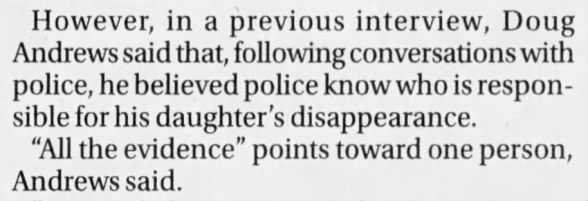
In the snipping below, the "Andrews" that is cited is her father. Mr. Andrews also said that the people she associated with lead to her downfall. The two places she worked, according to her profile at Canada's Missing, were FSJ Fashions and The Frontier Bar and Grill. Mr. Andrews did not seem to think that the latter was a healthy environment.

Wed, Apr 14, 2010 – 11 · The Province (Vancouver, British Columbia, Canada) · Newspapers.com

The RCMP searched the landfill for her remains, according to an April 15th, 2010 article in The Province. They did not name a suspect at that time but the father, in particular, seemed to think there was only one. In news from 2013, I did find that the RCMP had a suspect but he was not named.

Thu, Apr 15, 2010 – 16 · The Province (Vancouver, British Columbia, Canada) · Newspapers.com

A re-enactment was performed in 2013. It doesn't show much except an actress walking on the street. However, it provides a backdrop for the discussion of the case with family members and RCMP making statements in the Youtube video.


Featured Post

Linda Leola Grover - Missing Since 2001 (Redirect to new website)

New Website: Missing Persons Commentary Missing Persons Commentary has a new home. This article, along with new case research a...

Best of MPC (as selected by the site's author)