Showing posts with label highway. Show all posts

Natanis Merasty Missing: What Happened to the 24-Year-Old Woman?

Natanis Merasty: Missing from Edmonton, Alberta

Case Summary from Canada's Missing

File number: 2025024076 : Case summary below is a paraphrase of information published by Canada's Missing.

Natanis Merasty, 24, travelled from Saskatchewan to Edmonton, Alberta, on Friday, May 2, 2025. She stayed at the Continental Inn on Stony Plain Road with a group of individuals. In the early morning hours of Monday, May 5, 2025, Natanis left the Continental Inn. Edmonton Police Service later released surveillance footage showing her movements that morning, including her arrival at a nearby 7-Eleven at approximately 2:55 a.m.

Natanis has not been in contact with her family since that time. Police consider her disappearance suspicious.

Missing Person

Natanis Merasty
Natanis Merasty
Be careful with assumptions about stills taken from video footage. In this image, she does look sad or distressed. However, stills can lead to false impressions like that. An inference that she was sad or distressed may or may not be true.
Name: Natanis Merasty
Age at disappearance: 24
Birthdate range based on age: May 6, 2000 – May 5, 2001. Canada's Missing lists her birth year as 2001.
Gender: Female
Bio group: Indigenous (Peter Ballantyne Indian Reserve)
Height: 175 cm (5 ft 9 in, another source says 5'"8)
Weight: 77 kg (170 lb, another source says 180 pounds)
Build: Medium
Eyes: Brown
Hair: Brown, long
Last known location: 7-Eleven at 156 Street and 107 Avenue in Edmonton, Alberta.
Date last seen: Monday, May 5, 2025, at approximately 2:55 a.m., based on surveillance footage from the 7-Eleven.
Backpack: Black, cross-body
Jewelry: Stud earrings
Jewelry: Silver, aluminum or stainless-steel necklace
Pants: Black leggings
Shirt: Grey and black, with black long sleeves
Shoes: White Nike brand
Scars: Self-harm scars on the legs and arms
Tattoo: Possible cross tattoo on either forearm
Tattoo: Left hand: rose and vine with the initials "DJM"

Timeline

The following timeline is based on information released by the Edmonton Police Service and reported by Global News on July 18, 2025.

An important distinction should be made between Natanis herself and her vehicle. The May 5 surveillance footage establishes Natanis's presence at the Continental Inn and 7-Eleven. Later entries concern reported sightings or movements of her vehicle and do not establish that Natanis was inside it.

  1. Monday, May 5, 2025 — 1:22 a.m.: Natanis is captured on CCTV at the Continental Inn, 16625 Stony Plain Road, Edmonton. She is observed driving away in her 2007 black Hyundai Tucson with Saskatchewan licence plates.
  2. Monday, May 5, 2025 — approximately 1:30 a.m.: Natanis's vehicle returns to the Continental Inn.
  3. Monday, May 5, 2025 — 2:37 a.m.: Natanis's vehicle leaves the Continental Inn again.
  4. Monday, May 5, 2025 — approximately 2:55 a.m.: Natanis is captured on CCTV at a 7-Eleven at 156 Street and 107 Avenue in west Edmonton. She leaves the store at approximately 2:55 a.m. This is the last reported surveillance-camera sighting of Natanis.
  5. Monday, May 5, 2025 — later: Natanis's vehicle is reported in the Edmonton, Sherwood Park, Buck Lake, Nordegg and Lake Louise areas.
  6. Tuesday, May 6, 2025: The vehicle travels through British Columbia.
  7. Wednesday, May 7, 2025: The vehicle travels by ferry to Nanaimo, British Columbia.
  8. Friday, May 9, 2025: Natanis is reported missing by her family to the RCMP in Saskatchewan after they had not heard from her for four days.
  9. Saturday, May 10, 2025: The vehicle returns to the Edmonton area.
  10. Monday, May 12, 2025: The vehicle is observed west of Lloydminster. Police later stated that the vehicle was still black on this date.
  11. Thursday, May 15, 2025: Natanis's vehicle is found abandoned on James Smith Cree Nation in east-central Saskatchewan. By this point, the vehicle has been repainted silver. 
  12. Thursday, May 22, 2025: Edmonton Police Service takes over the investigation.
Online speculation:
There are theories about the vehicle, the Vancouver Island trip, the repainting, who might have been driving, and why the vehicle ultimately appeared on James Smith Cree Nation.

The hotel provided security footage to the RCMP, according to hotel management's response to a review I read for The Continental Inn. The review does not specifically name Natanis Merasty, but I am confident that it pertains to her.


Last seen on 7-11 Footage

"Last seen on 7-11 footage" is more common than you might think. 7-11s are open 24 hours, and they are open during the clandestine hours of night, as sometimes the only businesses that are open in an area.

Furthermore, 7-11s are typically heavily cammed. They also have inexpensive products, which will make them popular at any time of day or night. Furthermore, 7-11s are also usually very well located at important intersections or along highways.

As a night owl myself, I can also state that 7-11s often have dodgy people loitering in them or around the entrances at night. The following is "take it or leave it" because this is opinion only, but 7-11 parking lots, entrance ways, bathrooms, or counter space are places where you find, let's say, less trustworthy people in the shadow of night. 

Emma Fillipoff, Nick Stevens, Zachary Vidal, and Alexis Ware are people who are or were missing where 7-11 footage was either their last sighting or the footage was, at least, among their final known footsteps. If you follow missing persons cases, watch how often 7-11 footage pops up. In fact, 7-11 clerks who work the night shifts probably see quite a lot.

Natanis Merasty's Vehicle

Natanis was driving a 2007 black Hyundai Tucson with Saskatchewan licence plates while she was in Edmonton. It's not clear who is driving the vehicle when it is spotted outside of Edmonton.

AI-generated likeness of a 2007 black Hyundai Tucson. Likeness only.
AI-generated likeness of a 2007 black Hyundai Tucson. This image is not Natanis 


This is a still of the actual vehicle. Plate says 286 NTX. Taken from APTNNews.

Questions About the Vehicle Route

The publicly available information does not provide an exact route between every reported location where the vehicle is noted to have been. The route from the Edmonton area to Nanaimo that the vehicle took is therefore incomplete. The reported locations also pertain to the vehicle's movements.

In my opinion, one unusual aspect of the movement is from Sherwood Park through Buck Lake and Nordegg toward Lake Louise. This is not necessarily the most direct route from the Edmonton area toward the Lower Mainland. Other possible routes exist, including routes through Jasper and Kamloops or south through Calgary.

Speculation: One possible explanation is that the driver deliberately avoided some of the major highway corridors. If that were the case, minimizing public exposure could have been one possible reason. However, there is no public evidence establishing that the driver was attempting to avoid detection, and this should be regarded only as my hypothesis.

Another possibility is that the route was determined by circumstances that are not publicly known. The available timeline does not identify who was driving the Tucson during the later sightings, nor does it establish why the vehicle travelled through those particular areas. I think amateur investigators working on this mystery could document any highway closures in western Canada during the relevant time frame, particularly if that was between Sherwood Park and greater Vancouver.

Possible Route Through the Rockies

If the vehicle travelled from Nordegg toward Lake Louise, one possible route would have taken it west on the David Thompson Highway toward Saskatchewan River Crossing and then south toward Lake Louise through Banff National Park. This is only one possible reconstruction; the published police timeline does not provide the exact roads used, just vehicle locations.

The unusual nature of the reported route is worth noting, but there may be explanations that are not publicly known. I do have expertise on western Canada as a former author of a travel guide for the region. Additionally, I have worked in Nordegg, Jasper, Banff, and Canmore, and know the highways well.

Vehicle on Vancouver Island

The published timeline says the vehicle travelled by ferry to Nanaimo on Wednesday, May 7, 2025, and that the vehicle was back in the Edmonton area on Saturday, May 10, 2025. The public reporting does not provide the exact time of the May 10 Edmonton-area sighting. Consequently, the exact date on which the vehicle left Vancouver Island cannot be established from the published timeline alone.

When did the vehicle leave Vancouver Island?

Possible ferry-departure window: May 7, May 8, May 9, or, theoretically, May 10. May 10 is heavily constrained because the vehicle was already reported back in the Edmonton area that day. There are similar constraints on the vehicle leaving Vancouver Island on May 7 because that is the day the vehicle arrived there. In my assessment, May 8 or May 9 appears more plausible, but this is an inference.

Several ferry routes could theoretically have been used to leave Vancouver Island, including Nanaimo (Departure Bay) to Horseshoe Bay and Nanaimo (Duke Point) to Tsawwassen. Other, less likely possibilities also exist, like the island-hopper route from Crofton to Tsawwassen via Salt Spring Island. Also, there is a route from Port Hardy to Prince Rupert. The publicly available case information does not identify the ferry terminal or sailing used by the vehicle.

Speculation: In my opinion, if the driver was intentionally choosing less direct routes, it would be premature to assume that the most geographically efficient ferry route was used. The unusual mainland route described above is one reason the precise ferry route should not be assumed without additional evidence.

It is also important not to confuse the vehicle's movements with Natanis's whereabouts. The fact that the Tucson reached Vancouver Island and subsequently returned to Alberta does not establish that Natanis accompanied it on either journey.

What Is Known — and What Remains Unknown

  • Natanis was captured on surveillance footage at the 7-Eleven at approximately 2:55 a.m. on May 5, 2025.
  • Her vehicle was subsequently observed in multiple locations across Alberta, British Columbia and Saskatchewan.
  • The vehicle travelled by ferry to Nanaimo on May 7.
  • Between May 7 and May 10 inclusive, the vehicle took a ferry off of Vancouver Island.
  • The vehicle was back in the Edmonton area on May 10.
  • The vehicle was observed west of Lloydminster on May 12.
  • The vehicle was found abandoned on James Smith Cree Nation on May 15. It had been repainted and was now silver.
  • The public timeline does not establish who was driving the vehicle during its later movements.
  • The public timeline does not establish Natanis's whereabouts after her last confirmed surveillance sighting.
  • The exact method investigators used to reconstruct every vehicle sighting has not been publicly explained in the sources cited here.

Hotels in Nanaimo: Call to Action for Employees

In my opinion, a possible lead may still exist in Nanaimo. People who work at budget hotels or motels may wish to check whether their property recorded the Saskatchewan licence plate belonging to Natanis Merasty's 2007 Hyundai Tucson around May 7th, 8th, and 9th, in 2025. If the plate appears in a registration card, parking or vehicle record, then that information could potentially help establish where the Tucson was during its time on Vancouver Island. Any potentially relevant record should be preserved and handled delicately rather than altered or discarded, and provided directly to the appropriate investigators.

Registration cards and similar documents may contain personal information, so they should not be photographed, published online or shared publicly; they should be handled confidentially and turned over to investigators through an appropriate channel.

This is a still of the actual vehicle. Plate appears to say 286 NTX. Taken from APTNNews.

Case Information

  • Canada's Missing case reference: 2025024076
  • Edmonton Police Service case: CA250409080
  • Missing from: Edmonton, Alberta
  • Last confirmed sighting: Monday, May 5, 2025
  • Reported missing: Friday, May 9, 2025

Official Sources

Information on this page is based on publicly available police, Government of Canada and news-media records. Statements identified as speculation or hypothesis are the author's analysis and are not presented as established facts. Case information may change as the investigation develops. Last checked August 24, 2026.

The Corvette Predator: A Theory of Premeditation in the Disappearance of Robin Ann Graham (1970)

The Corvette Predator: Speculation on the Disappearance of Robin Ann Graham

By: Shane Lambert

On Sunday, November 15th, 1970, 18-year-old Robin Ann Graham vanished from the U.S. Highway 101 southbound lane near the Santa Monica Boulevard off-ramp in Los Angeles, California. She left behind a locked 1969 Chevrolet Nova and a mystery that lingers over five decades later. Below are her case details, followed by a theory on what might have happened to her that night. In this theory, I test whether it makes sense that a 'helpful' stranger might have actually been stalking her.

Case Details: Robin Ann Graham's Disappearance

Category Details
Missing PersonRobin Ann Graham
Biological SexFemale
Race / EthnicityWhite / Caucasian
Last Seen TimeNovember 15th, 1970, between 2 AM and 2:45am (Saturday-night/Sunday-morning)
Missing Age18 Years
Current Age72 Years
Height5'6" (66 Inches)
Weight125 lbs
Hair ColorBrown
Eye ColorBrown
Last Known LocationU.S. Highway 101 southbound near the Santa Monica Boulevard off-ramp in Los Angeles, California 90029 (Google Maps)
CircumstancesLast seen by a CHP officer on U.S. Highway 101 southbound near the Santa Monica Boulevard off-ramp at about 2:00 a.m. on November 15th, 1970.
ClothingRed blouse, blue jeans, dark blue corduroy jacket
FootwearRed clog shoes
AccessoriesLeather purse
TransportationBoyfriend’s car (1969 Chevrolet Nova); she drove it alone.
SourceNamUs Case #MP32285 (NamUs has the November 14th date wrong. She was last seen after midnight that night, in the wee hours of November 15th, 1970).

Recapping Previous Research on This Missing Person

I researched Robin Ann Graham's disappearance several years ago. The blog post was titled "Women With Car Troubles Go Missing." It reviewed several cases of women who went missing after experiencing car troubles. The table below includes some of the cases I covered.

Name Last Known Location Last Seen Age at Disappearance Car Trouble Details Case Details
Robin Graham U.S. Highway 101 near Santa Monica Boulevard offramp, Los Angeles, CA November 14, 1970, ~2:30 AM 18 Ran out of gas, stalled on highway Last seen with a man (white male, 25-26, dark or blond hair) near a 1958-1960 light blue Corvette. Car found locked and abandoned. Possible abduction after gas siphoning.
Kathleen Johns Highway 132 near Interstate 5, Modesto, CA March 22, 1970 Not specified Tire problem flagged by a man, tire fell off after "fix" Man offered help, drove her and her child; possible Zodiac Killer involvement. Escaped harm (implied).
Rose Tashman Hollywood Freeway at Highland Avenue offramp, Los Angeles, CA May 18, 1969 Not specified Flat tire Disappeared after car breakdown; body found in Hollywood Hills, Mulholland Drive. Unsolved murder.
Cindy Lee Mellin Buenaventura Shopping Center parking lot, Ventura, CA January 20, 1970 19 Flat tire being changed by an unidentified male Last seen with man fixing tire; car found on jack with flat tire still attached. Father found car.

There have not been any major developments with Robin's case since I published that previous article in February 2018. The timeline I've constructed below for her disappearance is based on my research for that article. As always seems to be the case, details will vary between some sources. However, the timeline for Robin's disappearance is pretty tight.

Robin Ann Graham's Approximate Timeline: The Night She Disappeared

On Saturday, November 14th, 1970, 18-year-old Robin Ann Graham’s night began with a typical young-adult blend of work and socializing. She was a Pierce College student and worked part-time at Pier 1 Imports, located at 5711 Hollywood Boulevard.


She likely finished her shift in the late afternoon or early evening. After work, Robin spent the evening with friends in Hollywood, a popular spot for young people in 1970. The exact location of their hangout isn’t documented, to my knowledge, but it was likely a casual venue appropriate for Saturday night upper teens.

Around midnight, a friend dropped Robin off at the Pier 1 Imports parking lot, where Donald Alford’s 1969 Chevrolet Nova was parked. Donald was Robin's boyfriend, and she had borrowed his car, apparently for most of the day. In charge of the Nova, she began her drive home to Lemoyne Street in Sherman Oaks, a 10-15 mile trip via the Hollywood Freeway (aka U.S. Highway 101).

AI's image of a 1969 Chevrolet Nova. I don’t know what color the car was that Robin drove.

At approximately 2:00 a.m. on Sunday, November 15th, the Nova ran out of gas on the southbound lane of Highway 101 near the Santa Monica Boulevard off-ramp. This ramp was one that she could have used to get to her home on Lemoyne Street. However, I think she could have driven further as well and used a different exit.

For those who want to visit this location online, the area only goes back to September 2008 on Google Maps. That's nearly 38 years after Robin disappeared in November 1970. It stands to reason that it would only give a general sense of the area after all that time.

Stranded, Robin used a freeway call box to phone home. She reached her 14-year-old sister, but their parents, who had gone out that evening, were still out.

Not an actual picture of Robin. Depicts what a highway call box is. These devices were somewhat common. You will still see them in public, but portable devices are so common now that they have become relics.

At about this time, a California Highway Patrol officer spotted Robin near the Nova she was driving. He advised her to wait there, and then the officer left. This is the point in the night when the most suspicious person of the evening entered the picture.

Mr. Corvette: The Suspicious Stranger

AI prompt for a late 1950s Corvette that's light blue with a hardtop with primer. Sometimes the suspect vehicle is described as green.

Sometime between 2:00 and 2:30 a.m., a dark-haired man in his mid-twenties approached Robin in a light blue 1958-1960 Chevrolet Corvette hardtop (the year of the car is debatable). I will call this person Mr. Corvette (a moniker), named after the car he drove. His true identity is unknown.

It seems that Robin was reasonably safe until Mr. Corvette entered the picture. She was without gas at a dangerous time of night in a city where nowhere is perfectly safe. But family had been alerted to her problem, and a patrolman was aware of her as well. Her chances of surviving her car problems seemed quite high.

The face is random and not meant to depict the man's likeness. AI generated based on his clothes, hair, height, and vehicle. He has been described as blonde but most sources say dark haired.

The time frame associated with Mr. Corvette's advance is the last time Robin Ann Graham has been seen. He has been described as a Caucasian male, dark-haired, 5’8”, aged in his mid-20s, and wearing both bell-bottoms and a white turtleneck. This description came from the patrolman on the highway.

When he, the patrolman, came near Robin again, he saw Mr. Corvette talking to Robin. She had previously told the patrolman that she had called for help, and he assumed Mr. Corvette was that help.

Importantly, Mr. Corvette’s car was parked behind Robin’s. This is something I will deem important later.

By 2:45 a.m., Marvin Graham (Robin's father) and a friend arrived. By modern maps, the drive between the Grahams' residence and the location of Robin’s car would have been just under 20 minutes. I think the drive time would have been about the same in 1970. When they arrived, they found the Chevy Nova locked and abandoned.

Robin vanished in the 45-minute window between 2 AM and 2:45 AM. For a narrower window, the time frame between 2:30 AM and 2:45 AM is close to 'ground zero.' Her disappearance, with Mr. Corvette as the last known contact, remains one of LA’s enduring missing person mysteries.

What Robin Might Have Been Thinking After Her Car Stalled

If we look at the disappearance from Robin’s point of view, what information does she have?

She can’t operate the Chevy Nova any longer. She would be looking at a two-hour walk at a dangerous time of night if she leaves on foot. Yes, she has reached home by phone, but she only contacted her 14-year-old sister, who cannot help her directly.

As the minutes pass, Robin has to wonder if her sister has fallen asleep without alerting her parents to the problem. She also has to wonder if the patrolman will be back or if he might have happened on any other event that will consume his time.

When faced with what was presumably a ride offer from Mr. Corvette, Robin likely had to balance the chance that he had criminal intentions against her alternative: sitting roadside for who knows how long. She wasn’t in a great position, but whether that was due to misjudging her gas or Mr. Corvette causing the whole situation is something I will turn to now.

Women With Car Troubles: A Pattern in 1970s California

Women with car troubles went missing or were murdered a lot in the 1970s and earlier in the USA. This is a point often made when looking back at murders and missing women during that time frame. Vehicle sabotage was a known modus operandi among men who targeted women.

A typical scene would go like this: (1) A man would tamper with a woman’s vehicle and disappear. (2) The same man would then arrive on the scene and offer to help. (3) But instead of helping, he would disappear the woman in what came to be known as the Good Samaritan’s Ruse.

With all the vehicle sabotage that happened in conjunction with missing women at that time, the point with Robin Ann Graham's disappearance is that we can ask one pointed question: "Did Mr. Corvette siphon Robin’s gas?" Brushing this question aside would be disregarding all the cases where vehicle sabotage was a known or suspected MO.

Regarding Mr. Corvette, we need to look at a related report. A man matching Mr. Corvette’s description approached another woman in Los Angeles a few weeks later. That woman did not go with him, but she said she was approached after her car ran out of gas.

After Robin Disappeared: Woman #2

Weeks after Robin disappeared, in late November or early December 1970, another woman ran out of gas on an LA freeway. A man driving a Corvette pulled up and offered to help.

The woman felt he was pushy and refused the ‘help.’ She didn’t realize her experience was relevant to another incident until she learned of Robin’s case. This report linked the same description of a man and his car to both incidents.

Not a whole lot is available about this second woman's experience. The cases could involve different people when it comes to the identity of the men involved. But two women, two freeway stalls, one distinctive Corvette, and similar descriptions of a man—it’s hard to call it chance in a fairly narrow time frame.

The theory I want to explore is that Mr. Corvette’s modus operandi was right out of the Good Samaritan’s Ruse. How plausible would it be to siphon the gas from Robin’s car, follow her route, and then arrive where she is out of gas?

It might sound easy, but when I put together this theory, I could see that this would actually be hard. At the end, I felt this was a possibility to be aware of, as opposed to something I had a ton of confidence in.

How the Gas Siphoning Ruse Could Have Worked

From what I gleaned from Robin’s case details, the Chevy Nova that belonged to her boyfriend may have been parked at her workplace for several hours. This creates a large time frame where someone could have siphoned her gas. If the tank were full, it would only take 12-13 minutes to do the job.

However, there’s a problem with gas siphoning as a modus operandi. If you leave the tank bone dry and plan to stalk the female driver, they won’t be leaving the original point because of the empty tank. This could leave the target in the company of her friends.

If you plan to leave them enough gas to drive a little ways, how do you know how much gas to remove? The gas siphoner would need some information on how full the tank was to begin with to leave just the right amount where they stall between Point A and Point B. This is a problem with the theory.

In dealing with this problem, I think a gas siphoner could do this: empty the tank bone dry and then refill half a gallon. That much gas would allow someone to drive 9-10 miles.

From my research, anti-siphoning mechanisms weren’t built into vehicles until the late 1970s models. A 1969 Chevrolet Nova’s 20-gallon tank was easy to siphon. There was no locking cap, so all it would take is a hose and suction. Draining it dry would have taken 12-13 minutes at 1.5 gallons per minute. Adding back in half a gallon means the entire job could be done in fewer than 15 minutes, and it seems the vehicle sat where it was for hours on November 14th, 1970. (sources pending)

If Mr. Corvette drained Robin’s tank to ensure it was empty. He could then add half a gallon back, and he would then know exactly how much gas she had. With this information, he could predict her stall point within a certain range.

He doesn’t actually have to tail her, which could draw attention to himself. However, he would need to know things about Robin, like where she lived and her likely route home. In short, he’d have to be more than a casual stalker—someone with at least a short-term interest in his target.

The act of siphoning gas wouldn’t be that risky. It looks like nothing more than petty theft. No one suspects murder from a gas can.

He could’ve hit the 1969 Chevrolet Nova at Pier 1’s lot that day, monitored the car, then, a short time after it left, he could have cruised the freeway later in pursuit along her route home. At 2:30 a.m., he finds Robin, offers help, and she accepts due to the uncertainties she feels, believing that accepting help from a stranger is a better choice than just sitting roadside at that late hour on a Saturday night. Once she enters his car, she is at his mercy.

Maybe he killed Robin and found it easy. Yet, in some ways, he almost got caught. Her father was minutes away, and the patrolman was watching. Whether he realized that at the time isn't clear.

The experience with the second woman might’ve scared him off. She saw through him, alerted cops, and maybe he then realized his ruse would crumble.

Unfortunately, Woman #2 is anonymous. That she didn’t identify the man suggests he was a stranger to her. If we mirror the two cases, that would mean he was a stranger to Robin as well.

Of course, this is all speculative theory. In cases like this, which are old and ice-cold, all you want is a theory that fits the known facts. I’ve discussed why this theory fits and how it could have played out.

For one finer point, Mr. Corvette’s car was seen parked behind Robin’s. That’s a bit different than parking after her. The former means he had made a decision to stop a little sooner. He didn’t drive past her, pull to the side after seeing her, and then make his offer to help.

That he was behind her suggests he knew he was going to stop as soon as he saw her. If you think about it, that seems to align with someone operating in a premeditated way. 

Countertheory: Mr. Corvette Drives Around Looking for Vulnerable Women

A countertheory that still focuses on Mr. Corvette would hold that he simply drove around looking for vulnerable women. Fuel efficiency in 1970 was nowhere near what it is today, and 24-hour gas stations weren’t too common.

Maybe it was more plausible to drive around back then and hope to happen on a stranded female motorist. However, I don’t believe this. I don’t think there’s anything about a stranded vehicle that says "Attractive 18-year-old female college student" more than "ugly old man."

I guess I’ve shown my cards.

I do think the two sightings of the man I’ve dubbed Mr. Corvette are related. I know that women’s vehicles were often targeted in California in that era. Mr. Corvette could have had a gas-siphoning variant of this MO that could have been done if he simply knew something about his target’s schedule on the target day/night.

But it's this latter point about timing that makes the theory of gas siphoning a bit difficult. If Mr. Corvette siphoned Robin's car, he would then be camping on it for quite a while as she socializes with her friends in Hollywood.

Furthermore, there is a timing to think about it at the point of abduction. If he followed her route after she started to drive, then why did he arrive at the point where she ran out of gas at about 2:30am? She is thought to have stalled at about 2AM. That would mean he trailed her from quite a distance.

Of course, the timing in this case is not exact. If Robin stalled at about 2am, then that could easily mean 2:10am. If the highway patrolman saw her with Mr. Corvette at about 2:30am, then that could mean 2:20am. That would tighten matters but it's presumptive to assume the different times tighten the time frame instead of loosening it.

I would say this is a theory to be aware of, but it's one that I have low confidence in. I do know that readers at my blog read a lot about true crime and unsolved mysteries. If you ever come across a case involving a known gas siphoner who siphoned gas as part of an MO to disappear women, then please share that with me. I didn't find such a case myself.

Kimberly Jane Britts: Car Found on Highway, Woman Missing Since April 6, 1985


Missing Person: Kimberly Jane Britts


Details from a government source (might be paraphrased): Her unattended vehicle was located on Interstate 64 eastbound ramp at Route 616 in Albemarle County. Signs of red stains in the vehicle and Britts has never been located. Britt was temporarily living at a farm in Goochland County (central coordinates for the county: 37.6806° N, 77.8853° W).

Last contact: April 6th, 1985 (Saturday)
Last location: Charlottesville, Virginia, according to NamUs. If the location of her car is to be taken as her last known location, then it would be at Route 616 and Interstate 64. Route 616 is also known as Black Cat Road on modern Google Maps..
Age when Kimberly Jane Britts disappeared: 21
DOB: Between April 7th, 1963 and April 6th, 1964
Sex: Female
Height in inches: 62
Weight in pounds (lbs): 103
Ethnicity: Caucasian
Hair color: Brown, shoulder length, straight, and combed back
Eye Color: Brown
Scar or distinctive characteristic: Round dime-size circular scar on the middle of the forehead; additional scar
Car: Maroon and red Honda Civic Hatchback with plate FBY426

This is not the actual car. It's an AI generated image based on vehicle descriptions.

Link to Government Source: MP11604 (right-click to open)

BMI means body mass index. It is meant to describe someone's healthy body weight relative to the individual's height. It is only food for thought because it does not account for all body types. Kimberly Jane Britts had a BMI of 18.84. She was at a healthy weight by BMI standards at the time of her disappearance.

Clothing and Accessories:

At the time of her disappearance on April 6th, 1985, Kimberly Jane Britts was believed to be wearing a pullover shirt, blue jeans, a gold and diamond wedding ring set, and a gold chain necklace. She was also carrying a burgundy Aigner purse featuring a handle and a zipper. According to the reports for her, this purse went missing.

Source: The Charley Project.

Commentary and Research

By: Shane Lambert
Original time of writing: March 10th, 2025

Has Kimberly Jane Britts been found?

At the time of writing, Kimberly Jane Britts was still missing. Furthermore, there is not much online in terms of recent news. The online hits for her are the usual suspects: Charley Project, Facebook posts, Wiki pages, and niche websites.

What stood out with this case is that her car was found, her purse was missing, and there was blood in the car. When last seen, she had said she was leaving for a short time with plans to return. She left in her vehicle but has never been seen again.

Good Samaritan's Ruse: What's Happened to Female Motorists Before

The location of the vehicle is interesting. If it had been found at a mall, store, or airport, then different speculation or conjecture would result. In these scenarios, she's more likely to have been abducted at a place of business or while using the public sidewalk.

But the vehicle was found on the side of the highway and therein lies a bit of a mystery. How do you abduct someone from a moving vehicle?

Abductors in other cases have done it with a ruse. They alert the driver of the vehicle to a false alarm, encourage her to pull over, and then commit their crime at that point.

The scene involving Kathleen Johns in the film Zodiac depicts a Good Samaritan's Ruse. A mysterious man honks at a female motorist, she pulls over believing there's an emergency, he makes a false claim about the state of her vehicle, he then sabotages her vehicle while claiming to help her, and then he offers the woman a ride. When she accepts, she is then in his custody.


I think a lot of times when a missing woman's vehicle is found roadside or especially highwayside, some kind of Good Samaritan's Ruse has played out. There are other scenarios, like the vehicle being ditched there or simply something else happening. But I've covered the ruse at other blog posts on this site, which the reader can review.

Further reading: Women With Car Troubles Go Missing

If your car is operating perfectly fine from your perspective, then don't take the word of a stranger who shows up claiming the opposite. I guess it would only be natural to inspect the vehicle at some point, but I would get to a visible spot.

Kimberly Jane Britts: A Deeper Dive

The Connecticut River Valley Killer (CRVK) stands out as an intriguing figure to Kimberly Jane Britts’ disappearance on April 6th, 1985, due to his confirmed activity during that precise time frame and his habit of targeting women on highways.

This unidentified serial killer, linked to at least seven murders between 1978 and 1988, was active around Britts’ vanishing, with murders of Bernice Courtemanche on May 30, 1984, in Claremont, New Hampshire, and Eva Marie Morse on July 10, 1985, in Charlestown, New Hampshire (New Hampshire DOJ, ongoing updates). These killings, 13 months apart, frame April 1985, suggesting he was operational when Britts vanished (Wikipedia, last updated 2023).
By Murder, She Told - https://www.murdershetold.com/episodes/jane-boroski, CC BY-SA 4.0, https://commons.wikimedia.org/w/index.php?curid=133649378

Connecticut River Valley Killer: A Highway Predator Linked to Britts?

Primarily known for crimes in New Hampshire and Vermont—400–500 miles north of Virginia—the CRVK’s whereabouts are untracked during gaps between his suspected murders. The stretch between Courtemanche’s disappearance in Claremont and Morse’s in Charlestown leaves his location unknown for 13 months, a window where travel to Virginia isn’t impossible. Serial killers like Ted Bundy roamed widely, and the CRVK’s anonymity means a southern detour in 1985 can’t be ruled out, despite his northern base.

Online, the association between the CRVK and Britts’ case is rare but not absent. While major platforms like Websleuths and Reddit focus heavily on the CRVK’s New England victims, a few users on Reddit’s r/UnresolvedMysteries have speculated about broader connections, including Virginia cases, though Britts’ name isn’t explicitly tied to him often.

The Charley Project and NamUs detail Britts’ disappearance without mentioning the CRVK, and no recent news links them directly. However, the highway context and timing have sparked occasional armchair detective theories, though these lack evidence and remain niche discussions.

His method heightens his relevance: he attacked women on highways, often with brutal stabbings. Courtemanche and Morse were hitchhikers, nabbed along Route 12, but his scope widened. Jane Boroski survived a 1988 stabbing at a rest stop, and Barbara Agnew, a motorist, was killed near a highway on January 10, 1987. Britts’ car, abandoned on I-64 at Route 616, fits this pattern—a lone woman, possibly ambushed.

The red stains in Britts’ vehicle, presumed blood, align with the CRVK’s MO. Courtemanche and Morse were stabbed to death, their remains found near Claremont and Unity, New Hampshire, with frenzied knife attacks. Stabbing fits better than bludgeoning. Though his range is distant, his active period, highway focus, and style—active between May 30, 1984, and July 10, 1985—make him a fascinating candidate in Britts’ unsolved case.

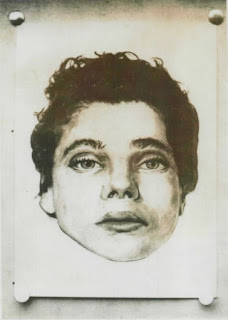
NamUs #UP84926 - Hillsboro Jane Doe Found in December 1961

By: Shane Lambert

The Hillsboro Jane Doe (NamUs #UP84926) is a young woman who was found dead in December 1961. I researched her case and below are the details that I think amateur investigators and writers should be aware of with this case.


NamUs description: "Remains found off the side of a rural highway in a ditch. Believed to have been dumped there late 12/15/61 or early 12/16/61. Multiple injuries consistent with being beaten noted."

Date body found: December 16th, 1961 (Saturday) at 3:48am in the morning. From the news articles I read from the journalism at about the time of her death, a "sex fiend" was thought to have killed her. However, in subsequent days she was thought to have not been sexually molested.

18 Dec 1961, Mon The Bee (Danville, Virginia) Newspapers.com

Location of the body: NamUs says she was found in a rural highway ditch. From what I gathered, she was found a mile south of Hillsboro in a honeysuckle thicket and was presumptively thrown there from a car. This discovery sounded like it resulted from a body dump.

18 Dec 1961, Mon The Bee (Danville, Virginia) Newspapers.com

Date/time of death: The Jane Doe was thought to be dead for two hours when discovered at 3:48am on the morning of December 16th, 1981. Thus, her estimated time of death would be 1:48am on the same date but could have been earlier.

Cause of death: NamUs said she had been beaten. According to The Bee out of Danville, Virginia, an autopsy revealed the cause of death to be "a subdural hematoma and a brain hemorrhage" (Dec 16, 1961; page 25).

18 Dec 1961, Mon The Bee (Danville, Virginia) Newspapers.com

Age: 15 to 18 years old as per both NamUs the journalism at the time of the body's discovery

Sex: Female

Race: White/Caucasian

Height and weight: 5'1" and 95 pounds, according to NamUs. 5'0" to 5'2" and 85 to 100 pounds is what I gathered as a range from other sources. Qualitatively, she was called "slender" or only slightly built.

Hair: Brown or dark brown, short, and slightly curly according to NamUS.

Eyes: Brown

Fingerprints: Sent to the FBI

Clothing and accessories: 

  1. She was found wearing a pullover navy-blue cotton t-shirt type short sleeve shirt with elastic neck and sleeve ends. The label in the neckband said "Jamie." 
  2. She wore a white-cloth brassiere with a safety pin on the posterior portion near the elastic hooks. The label said, "Habson Creation, 100% cotton, Sanforized, size 36-B" (Sanforized means preshrunk, meaning that it was shrunk before being sold). Size 36-B would not be very busty. 
  3. She wore turquoise-blue corduroy pedal-pusher female pants (called "slacks" in the Bee Hive article) with a back zipper, a button, and a right-rear pocket; it had an imitation leopard-skin corduroy cloth black and white design running down the lateral seam margins as well as the cuffs. 
  4. Other clothing that was associated with this Jane Doe was found near the body: a hip-length white coat with a back one-half belt with brass-type buttons; the material is herring-bone type weave. In the pockets of the coat: 2 white cotton socks. 
  5. I also found a newspaper article that said she was wearing a light-color jacket.
  6. A small and empty pocketbook was found near the body.

17 Dec 1961, Sun The Times Dispatch (Richmond, Virginia) Newspapers.com

NamUs #UP85529 - Stony Creek Jane Doe Found in September 1948

By: Shane Lambert

NamUs #UP85529 is a Jane Doe that was found near Stony Creek, Virginia in 1948. Her case was uploaded in October 2021, making for a 73-year interval. It's quite likely that, if she was a murder victim, then there is no justice to be had in this case due to how long ago it was. However, here are all the details that I could find on this Jane Doe.

Age: NamUs estimates an age of 15 to 25 years.

Sex: Female

Race: Black

Height: 5'2" to 5'3" (estimated)

Weight: 130 to 135 pounds (estimated)

Date body found: September 16th, 1948 (a Thursday) according to NamUs. According to the news source I found, the date of discovery was September 17th, 1948 (the source says the body was found on the nearest Friday to the date of publication). When two sources contradict one another, it's not clear which one to go by. It does create potential that the news source is covering a different Jane Doe, however, nearly all the other information lines up. I think the news source and the NamUs profile are covering the same case.

Date of death: NamUs estimates that she had been dead for six weeks. The original journalism in 1948 stated 2-3 weeks. It would be likely that she died sometime between late July and early September of 1948. If you are cross-referencing this case to missing people, then that's the target area for "last seen" dates (but be open to earlier times).

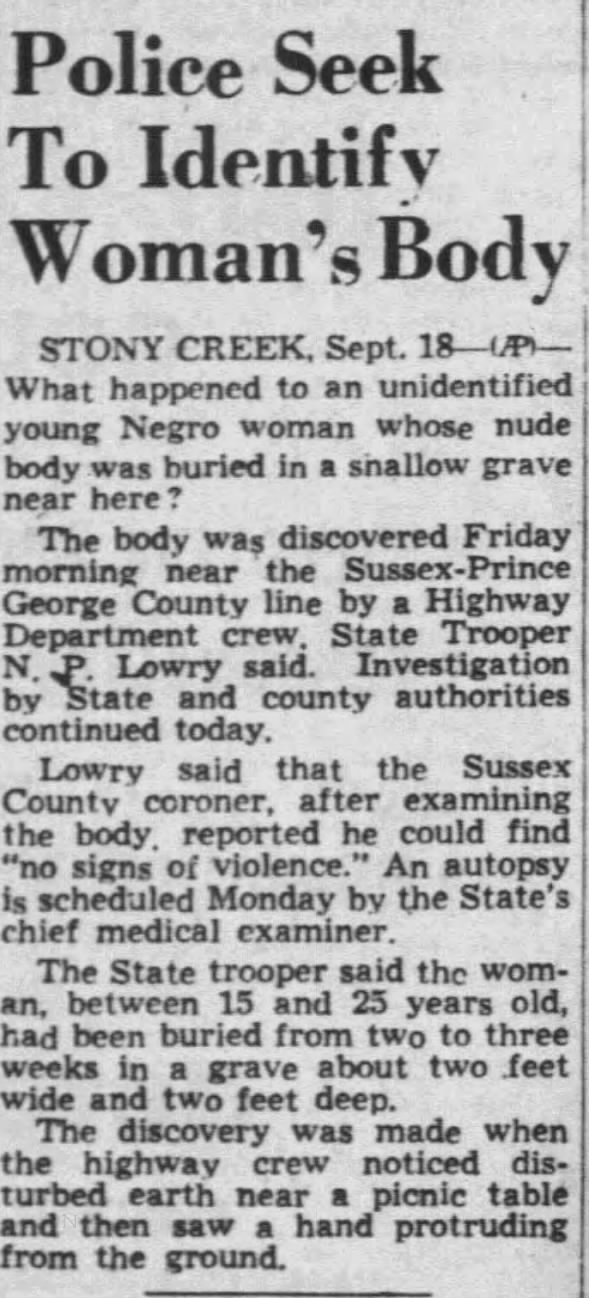
Location of Body: She was buried in what NamUs called a "makeshift" grave. That sounded clandestine in nature. A news report said she was found near Stony Creek, which makes it sound like the outskirts of town. It was near the Sussex-Prince George County Line according to the news source I found.

Who Found the Body: A crew of highway workers.

The date of discovery being either September 16th or 17th is one contradiction. However, it's not too uncommon for a date to be wrong on these matters. Another matter struck me as more substantial.

In the newspaper source, which is below, it is stated that highway workers noticed the Jane Doe when they noticed some disturbed Earth near a picnic table. This disturbed area was her shallow grave, which was described as two feet wide and two feet deep. It is stated in the article that the workers noticed her hand sticking out of the clandestine grave.

Regarding hands, this Jane Doe's NamUs profile states that one or both of her hands were missing from the body. Evidently, only one hand was missing and the other was sticking out of the grave.

The picture I am getting from all this is that someone buried this woman, who was nude, on the side of the highway. Perhaps this person did it near the picnic table so that it would provide a measure of seclusion. 

But why one hand was removed from the corpse is puzzling. Usually, when criminals remove a Doe's hands they are doing it to eliminate the chance of the Doe being identified due to fingerprinting. However, removing one hand and not the other doesn't seem to jive with that. I am thinking that the buried Doe might have been scavenged by an animal and one of her hands was removed that way while the other perhaps was pulled up, allowing for the highway workers to spot her.

NamUs #UP85529
NamUs #UP85529 19 Sep 1948, Sun The Times Dispatch (Richmond, Virginia) Newspapers.com

Ronald and Theresa Yakimchuk -- Missing Since June 1973 on a Road Trip

Author: Shane Lambert
Original Time of Writing: January 21st, 2021
All articles are subject to editing after the original posting.


Missing person #1: Ronald Yakimchuk
Last-seen date: June 5th, 1973; might be June 1st, 1973
Last-seen location: Brandon, Manitoba
Last-contact: June 12th, 1973. A postcard from Dryden, Ontario (sent by wife)
Link to Government Source: Canada's Missing
Ethnicity/Race: Caucasian
Sex: Male
Age at time of disappearance: 27
Hair: Brown
Eye color: Brown
Height and weight at the time of disappearance: 6'0" and 150 pounds, which would look very lean
Cenotaph: Findagrave


Missing person #2: Theresa Yakimchuk
Alias: Terry Pettit (Terry is a derivative of Theresa, Pettit is likely the maiden name)
Last-seen date: June 5th, 1973; might be June 1st, 1973
Last-seen location: Brandon, Manitoba
Last-contact: A postcard from Dryden, Ontario (June 12th, 1973)
Link to Government Source: Canada's Missing
Ethnicity/Race: Caucasian
Sex: Female
Age at time of disappearance: 23
Hair: Blonde
Eye color: Blue
Height and weight at the time of disappearance: 5'4" and 121 pounds

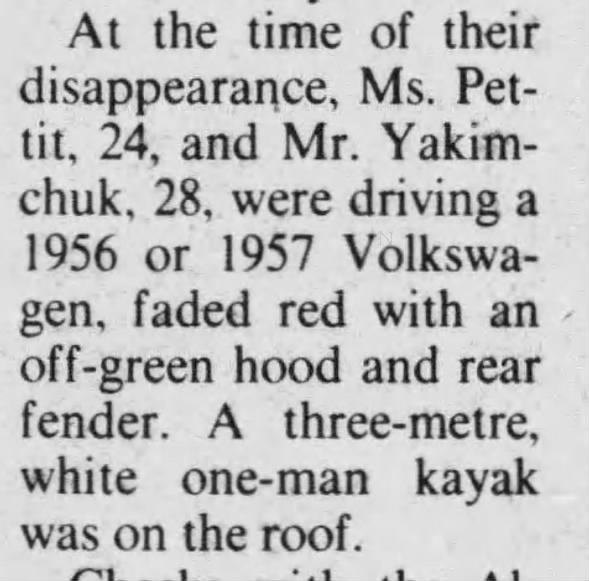
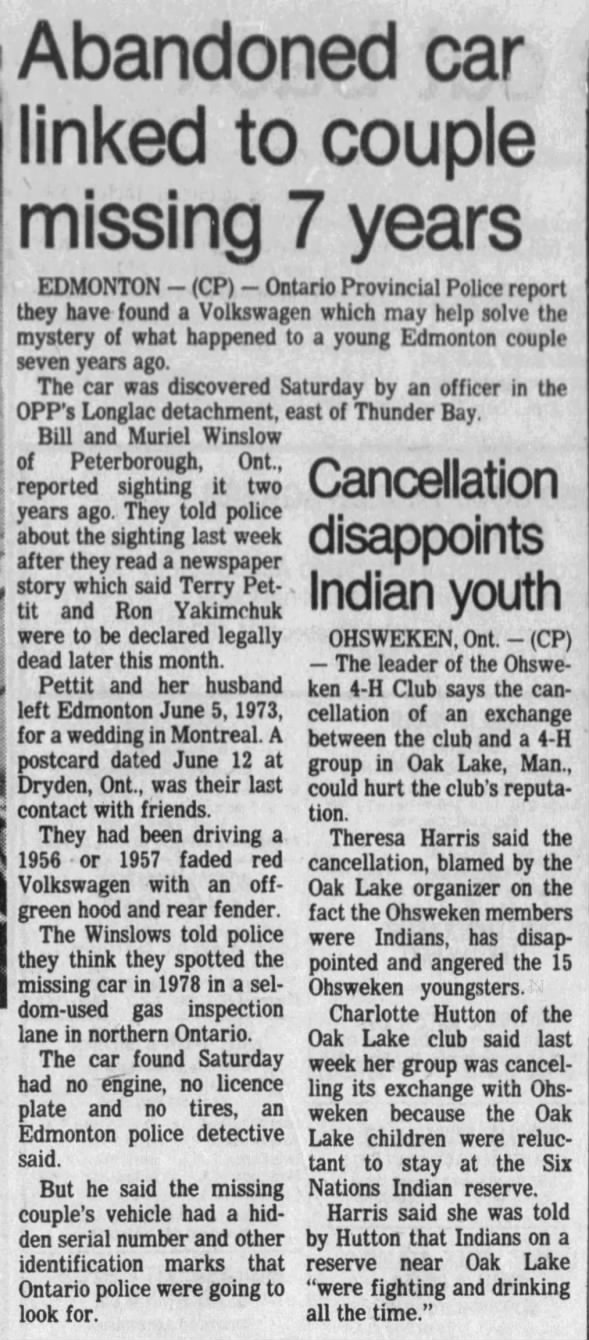
Ronald and Theresa Yakimchuk were from Edmonton, Alberta. They traveled east in the spring of 1973 using a "faded red" Volkswagen Beetle "with an off-green hood and rear fender." This vehicle also had a three-meter-long and white kayak affixed to the top of it.

Mon, Jun 9, 1980 – 4 · Edmonton Journal (Edmonton, Alberta, Canada) · Newspapers.com

There is some inconsistency between the historical journalism that covered this case and modern government database information. The vehicle in question might be anywhere from 1956 to 1959 (plate: Alberta, CA3-262). The picture below is the last one taken of the missing couple and it shows their vehicle as well.


The missing people were traveling to Montreal to attend a wedding. However, they never made it to that wedding.

The date of the wedding that they were planning on attending was called "mid-June" in an article in the June 9th, 1980 edition of The Edmonton Journal. Another source says the exact date of the wedding was June 16th, 1973 (Nov 17 2007 Edmonton Journal). They sent a postcard on June 12th, 1973 from a town called Dryden, Ontario.

Search Area or Incident Location: Disappearance Event Focus, Dryden to Montreal


Presumptively, something happened to them between Dryden and Montreal between the dates June 12th and June 16th. In fact, the area between Dryden and Ottawa is more probable.

The couple visited someone known as "an associate" in Brandon, Manitoba. I believe that this visitation might be the last physical sighting of them.

Furthermore, Canada's Missing says they went missing on June 1st but some journalism on this matter says they left Edmonton on June 5th, 1973. If that is true and if they visited associates in Brandon, Manitoba, then you would have to think they were last seen on at least June 7th, 1973, as the drive from Edmonton to Brandon is not one that most drivers would complete in a day.

Complicating this case is the lack of clarity regarding the missing couple's travel plans. While they did want to attend a wedding, they "planned to travel indefinitely after that." A news piece on this missing couple from 2023 stated that they were planning to start a new life in the Maritimes.

The family did not start to worry about their well-being until a few months after they were last seen. Furthermore, the police didn't help with this case until seven months after they went missing, as per the source below.

Mon, Jun 9, 1980 – 4 · Edmonton Journal (Edmonton, Alberta, Canada) · Newspapers.com

Unredeemed Cash Draft Should Be Considered a Huge Clue as to Whereabouts


One important detail, in this case, has to do with a banking matter. Terry Pettit (ie. Theresa Yakimchuk) purchased a "cash draft" from her bank account in Edmonton and, from what I'm gleaning from the journalism, she planned to redeem it in Ottawa. However, this was not done.

For that reason, I would limit the focus area to in-between Dryden and Ottawa. They sent the postcard from Dryden so they were there. If they made it to Ottawa, it stands to reason that Theresa would have cashed the bank draft.

Monetary assets are rarely treated in a frivolous matter. In my opinion, when something like a cash draft, money order, paycheque, or personal check goes uncashed in a missing person's case, it should always be considered extremely relevant. For that reason, I do not think they made it to Ottawa.

I think a "cash draft" might be called a "money order" in more modern lingo. Back then, I think it would have been called a cashier's cheque or a bank draft. It's like a cash that cannot bounce because the funds for it are already guaranteed, much like a loaded VISA debit card in contemporary times.

Ottawa, as a potential destination, is important in this case. One early report having to do with this case said the missing people had friends there. These friends never met the couple that summer (Edmonton Journal Jan 22 1974).

Mon, Jun 9, 1980 – 4 · Edmonton Journal (Edmonton, Alberta, Canada) · Newspapers.com

Couple Considered Dead as of 1980


The opinion of family and police on this matter, in 1980, was that the Yakimchuks had somehow died.

Leads have not been numerous, but in 2007 it was reported that someone claimed to have seen them in July 1973. According to this person, she and her husband saw the Yakimchuks highway-side near Parry Sound, Ontario in what would have been late-July of 1973.

The witness described a Volkswagen Beetle, a man that looked like Ronald, a woman that looked like Theresa, a third man, and Alberta license plates.

This sighting did not make a lot of sense to me for a few reasons. I think something happened to them between June 12th and June 16th, 1973. So the late-July 1973 sighting does not make a lot of sense. Also, a route through Parry Sound would not be the most efficient one between Dryden and Ottawa. Lastly, a 34-year gap between the sighting and the reporting date leaves some questions about the person's memory. As per the description below, the kayak on the roof is missing, which simply suggests that it's a different vehicle and different people.

Sat, Nov 17, 2007 – 3 · Edmonton Journal (Edmonton, Alberta, Canada) · Newspapers.com

Note: in the article above, "CFB Shilo" would be a Canadian military base near Brandon, Manitoba.

Even with Alberta plates, the area around the Great Lakes in Ontario is popular enough for tourism that it would not be surprising to see plates from any part of Canada, especially during the summer months.

If the kayak had been on the vehicle, then that would have been a much more convincing sighting. I wouldn't discount this sighting, but it is not convincing to me. It's something that those who are interested in this case need to be familiar with. But my feeling is that something else needs to align with this alleged sighting before it can be taken too seriously.

Remember, the missing people did not make their wedding target in Montreal for June 16th. They sent no communications after the Dryden postcard. Furthermore, Theresa did not redeem her cash draft in Ottawa. I still think that a highway mishap befell this couple somewhere between Dryden and Ottawa.

Dryden Location Means They Had Plenty of Time to Get to Montreal


These were 20-somethings who seemed to be interested in growth via travel at a young point in their lives. They might have explored the back areas of Ontario -- not just the main tourist spots near the main highways. If they were in Dryden on June 12th, then they were close enough to Montreal that they had a few days of free time before the wedding.

That their vehicle has never been found is a major point in this case. However, I did read one article from 1980 that suggested that their vehicle had been found. I did not find a follow-up article to this.

Tue, Jun 17, 1980 – 54 · The Gazette (Montreal, Quebec, Canada) · Newspapers.com


Car Not Found, People Still Missing


There are lots of missing persons cases where the vehicle is found but the driver and passengers remain missing. It seems that finding a vehicle is a lot easier than finding the primary subjects of searches. In fact, "car found person missing" is one of the most common tags on this website.

That the Yakimchuks' vehicle has never been found could mean that the vehicle went missing with the passengers. This is something that has happened numerous times.

One case that this reminded me of is the missing-person case of Janet Farris. In 1992, she was driving from Vancouver Island to a wedding in Alberta. Like the Yakimchuks, she never made the wedding. She was never heard from again and nor was her car ever found -- until 201,9 when it was pulled out of a lake in the Revelstoke area.


Notable Cases of Missing Persons Found Submerged with Their Vehicles


NameDisappearance DateLast Known LocationCar DetailsDiscovery DateSubmersion Location
Janet FarrisAugust 1992Vancouver Island, BC, Canada1969 Plymouth BarracudaAugust 2018Griffin Lake, BC, Canada
David Hannah1983Bath, Ontario, CanadaUnspecified carMay 2023Lake Ontario, near Amherstview
William MoldtNovember 7, 1997Lantana, Florida, USAWhite 1994 Toyota CelicaAugust 2019Pond near housing development
Donna Graves & SonJanuary 18, 2013Ottawa, Ontario, CanadaDodge DartJanuary 20, 2013Ottawa River, Ottawa, Canada

Reported: CBC News
Larry Anderson2004Murray, Utah, USALeased car (make unspecified)February 2025Flaming Gorge Reservoir, Utah

Reported: CBS News
  • Janet Farris: Confirmed as a 1969 Plymouth Barracuda, per CBC reporting referenced in your blog.
  • David Hannah: Car details aren’t widely specified in public reports (e.g., Kingston-area news); it’s simply noted as "his car."
  • William Moldt: Identified as a white 1994 Toyota Celica in police and news accounts from 2019.
  • Donna Graves: Reported as a Dodge Dart in Ottawa police statements from 2013.
  • Larry Anderson: Described as a leased car in Utah news, with no make or model detailed in early 2025 reports.

Missing people in their vehicles are sometimes found in roadside bushes. But Ontario is well known for having thousands of lakes. It can be hard to picture a car going off of the highway and ending up in a deep part of a lake as you might picture the shallow depths stopping the car's momentum. However, cars can go off highways and submerge at significant enough depth to be hidden for decades.

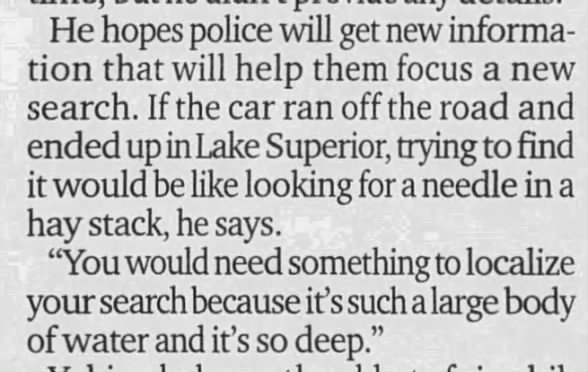
One officer who worked on this case seemed to think that the car and the missing people may have entered Lake Superior -- at least, he acknowledged the possibility. I align my own hunches with his.

I would think Lake Superior and any other water not far off the main route between Dryden and Ottawa would be part of the search area. Unfortunately, the area is so immense that the manpower is not likely to be afforded to cover all the possible areas.

Sat, Nov 17, 2007 – 3 · Edmonton Journal (Edmonton, Alberta, Canada) · Newspapers.com

But make no mistake -- this is a case that Websleuths and amateur investigators can help with. There was a case in 2019 that was solved when a Google Earth user found a submerged car using that software. The car was located in a small body of water, not far from shore, and inside the car was a missing person who had been there for decades.

Many rivers might have submerged a car that was driven off of a bridge. However, if everyone who reads this took ten minutes to use Google Earth to search the shallow depths of lakes and rivers that come close to highways, then it might yield results in the long run. I don't know what color the car would be now, but maybe a kayak might still be affixed to the top -- maybe not. That's the direction I think this search should go in when it comes to amateur contributions.

If you are researching this case, then it may be fruitful to use "Ron Yakimchuk" or "Terry Pettit" as your keywords. Those are the names that turned up hits in the newspaper archives that I looked at.

Other details:
  • Their car was not in good condition
  • Lt. Col Sid Stephen was the last person to see them near Brandon, Manitoba
  • He warned them about dangerous stretches en route to Montreal
  • Someone found what appears to be a VW Beetle buried in their backyard; it will be interesting if leads develop (see the Websleuths forum)

Prediction: They Will Be Found


I don't think there's a police budget in Ontario big enough to search every highway-side body of water. But my prediction for this case is that they will be found by a random citizen or dedicated volunteer because these people aren't on the clock. Fishermen, swimmers/divers with new underwater technology, or magnet fishers are all the kinds of people who might find a submerged vehicle, whether while looking for it or accidentally.

Timeline of Ronald and Theresa Yakimchuk’s Disappearance


DateEvent
Early Spring 1973Ronald and Theresa plan a trip east from Edmonton, Alberta, in their VW Beetle.
June 1st, 1973Official disappearance date per Canada’s Missing (RCMP); contested, may be a June 5th departure.
June 5th, 1973Depart Edmonton, per journalism.
June 5th–7th, 1973Last seen in Brandon, Manitoba, by Lt. Col. Sid Stephen; he warned them about dangerous routes.
June 12th, 1973Theresa sends postcard from Dryden, Ontario (last contact).
June 12th–16th, 1973Disappear between Dryden and Ottawa; miss Montreal wedding on June 16th.
June 16th, 1973Wedding date in Montreal they fail to attend.
Late July 1973Unverified sighting of a similar VW Beetle near Parry Sound, Ontario (no kayak).
Late 1973Family begins worrying after months of no contact.
January 1974Police investigation begins, seven months after disappearance.
1980Family and police presume couple dead; unconfirmed report suggests vehicle found.

Featured Post

Linda Leola Grover - Missing Since 2001 (Redirect to new website)

New Website: Missing Persons Commentary Missing Persons Commentary has a new home. This article, along with new case research a...

Best of MPC (as selected by the site's author)