Carbon, Alberta Jane Doe: Unidentified Remains Mystery and a Bizarre Case (1995)

Author: Shane Lambert
Original Time of Writing: January 4th, 2021

January 10th, 2025: A websleuth (kara1218)  recently attempted to match this Jane Doe to a missing person named Julie Ann Derouin.

All articles are subject to editing after the original posting.


Unidentified Jane Doe in Carbon, Alberta

Who: Jane Doe found roadside near Carbon, Alberta, Canada
When: Discovered on April 20th, 1995 or April 21st, 1995
Post-mortem period: Thought to be dead for 10 to 15 years, meaning missing people last seen in April 1980 to April 1985 are all in play. However, missing people outside of this range cannot be ruled out based only on the post-mortem period's estimation.
Ethnicity/Race: Uncertain. Appears aboriginal by the construction; could be other ethnicities for sure but does not look Caucasian. One source says she may have been of north African descent but that dark skin color does not come through in the bust above. Mixed background possible.
Sex: Female
Age at time of death: 22 to 35 years old, estimated. Broadened range 20 to 40.
Height: 5'0" to 5'4" (combined range from Service Canada and the Youtube video below which is of a press conference that was held, in part, for this Jane Doe)
Other: she had suffered from a disease called brucellosis


Case Details and Indigenous Connection

This is a case that doesn't have a lengthy profile with Canada's National Centre for Missing Persons and Unidentified Remains. However, the Youtube video posted above will help deliver some case details.

I thought, at first glance, that this individual was one of the missing aboriginal women of Canada, a group that some think doesn't get a lot of police attention. However, I'm not sure this Jane Doe is actually in any missing person's database. Part of me wonders if no one at all is looking for her.

Be warned, this isn't an article for the weak-stomached. I don't apologize. If you are seeking out articles on missing people or Jane Does then you have to be ready for some topics that aren't exactly those for the pleasure reader.

I think she is aboriginal but my basis for designating her as such is tenuous. Firstly, she was found in the Albertan plains and that area has plenty of aboriginals. Secondly, she looks aboriginal to me in the police recreation but she could be of other groups. I've wondered if Indian reserves of Alberta might be alerted to this case. However, I really have low confidence that this person will be identified. I don't think there's a soul out there that is looking for her.

Websleuths or amateurs looking at this case should know that Carbon, Alberta is tiny. It's a village northeast of Calgary by about an hour. If she was from Carbon then she would have been identified, I think. Her roadside location sounds like a body dump to me and a person doing that would be looking for somewhere far away from where people knew her, I think.

Media Coverage and Grave Site Mystery

It was hard to find news that covered this Jane Doe. However, I believe that the following article from the April 25th, 1995 Calgary Herald might pertain to her. There is a statement in this news article that brings bizarreness into play.

Tue, Apr 25, 1995 – 25 · Calgary Herald (Calgary, Alberta, Canada) · Newspapers.com
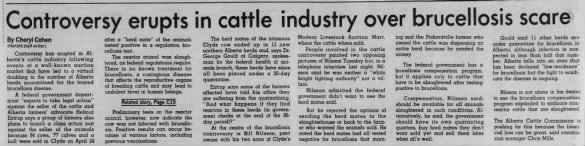
Note, that the "last Thursday" that is referenced in the article would actually be April 20th, 1995 as opposed to April 21st, 1995 (the date that Service Canada reports as the date that the Jane Doe was found). Furthermore, the age range in the news article is different.

Both inconsistencies can be explained: dates are often a tad off in reporting and age ranges that are based on estimates can change over time. The reason I think that the reporting pertains to the Jane Doe pictured at the start of this article is just that Carbon, Alberta is puny. I don't think two Jane Does pop up in consecutive days but it's possible.

The news article says something that's very unique when it comes to Jane Does. According to the news article, this Jane Doe "may have been removed from a grave site."

What does that make you think? The RCMP might have been able to study the body and conjectured that it had been serviced by a mortician? That's what I think when I read that. Maybe there was a presence of embalming fluid. However, maybe they had different reasons for believing that she was previously buried. A lot more information is needed about the grave site that this person came from. 

Was it a marked grave?

Was it a clandestine grave?

If it was the latter, then it's hard to think of a way to generate leads. It's also perplexing: why would someone unearth an individual in a clandestine grave and leave her on the side of the highway? If her grave was of a clandestine nature, then one would conjecture that the grave site was a better hiding spot than on the side of the road. However, the article also said that foul play was ruled out. That suggests that her original resting place was not clandestine in nature.

Timeline and Identification Challenges

If it was the former (ie. she was in a marked grave), then leads are possible. The timeline with this Jane Doe could be as follows: 
  • a death between April 1980 and April 1985
  • a burial in a gravesite assumingly near her time of death
  • removal from the gravesite at some point
  • then she ends up roadside near Carbon, Alberta
  • discovered there on April 20th or April 21st, 1995 after laying dead outdoors for maybe 10 to 15 years
If all that is true then this Jane Doe case isn't going to be solved through any conventional means. Conventionally, when an amateur or websleuth is working on a Jane Doe's case, that person would cross reference the Jane Doe against missing person's reports.

That's worked in the past for many cases but if this particular Jane Doe died and was buried in a marked grave, then maybe she wasn't missing at the time of her death. Maybe the family and friends had a funeral for her and had a sense of closure. If that's true then it brings the following into consideration: maybe nobody that encounters this Jane Doe's profile, that actually knew her in life, will ever think to connect her to the person that she/he knew. This truly is a problematic Jane Doe when one considers that she was unearthed from a grave.

In this peculiar case, identifying the Jane Doe might involve looking for an empty grave in the region, one that belongs to a woman who died between the ages of 20 and 40, one who matched the height range, and someone who died between 1980 and 1985. I'm not sure how a Websleuth or amateur investigator goes about checking graves for empty coffins without stepping on a whole bunch of toes. But I do have ideas as to why someone would dig up human remains from a grave.

One understandable reason is exhumation for a legal reason, a historical one, or a scientific one. However, exhumation is not a good explanation in this case so long as you accept the following. Someone in charge of exhuming a body would be someone responsible enough to put it where it belonged afterward. The authorities, if they exhumed this person, wouldn't discard her remains on the side of a highway.

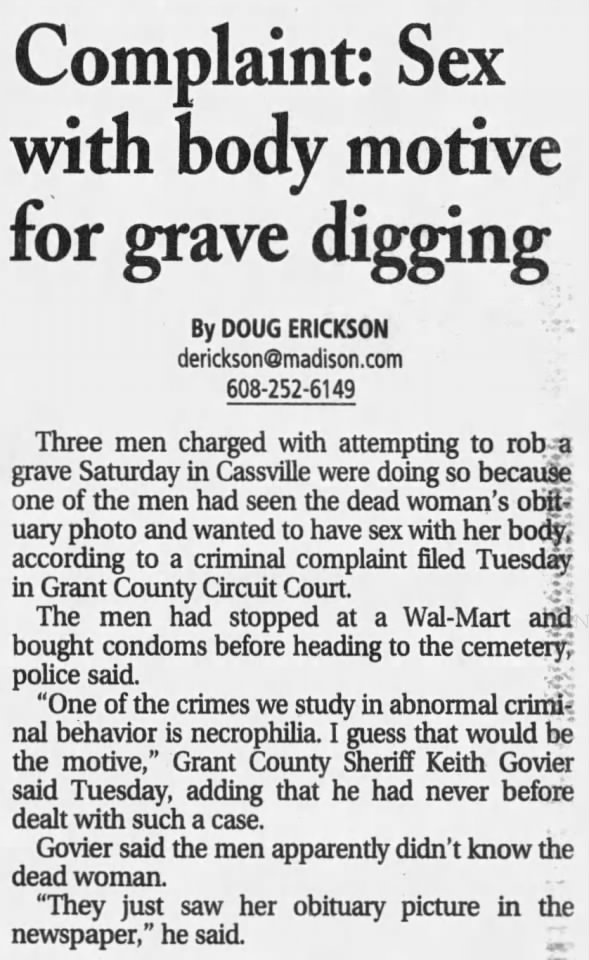
Another reason someone would dig up human remains borders on the bizarre and the grotesque: necrophilia. If you find it difficult to accept that someone would dig up a body for that purpose, then the definitive answer is that such acts are known to have happened before.
Wed, Sep 6, 2006 – 1 · Wisconsin State Journal (Madison, Wisconsin) · Newspapers.com

Furthermore, another reason why someone would take a body from a grave for clandestine purposes is to fake a death. That's believed to have happened before as well.

Wed, Sep 30, 1981 – 69 · Red Deer Advocate (Red Deer, Alberta, Canada) · Newspapers.com

I think another reason someone might dig up a body from a marked grave is one that's less sinister in nature: extreme mourning. Somebody who is psychologically changed due to someone's death might have an insane episode and seek out the remains. I didn't find any historical news article about that but, I think, it can happen. Read the poem "Annabel Lee" by Edgar Allen Poe. It tells a tale of a man who sought out his wife's tomb for comfort.

I really don't see this case as probable to be solved due to a lead from a missing relative. Firstly, there's hardly any news coverage that I could find. Secondly, there is barely anything in her profile. Lastly, I don't think there is anyone looking for her. If her grave was a marked one then the people that knew this Jane Doe might have buried her according to their customs and they might already have closure -- for decades. They might not know at all that she was removed.

The only point to take away is that if you ever come across any news from Alberta about an empty grave then think of this Jane Doe and cross-reference her particulars with that of the relevant grave marker or obituary.

Brucellosis Outbreak in Alberta

In the YouTube video, Staff Sergeant Jason Zazulak of the RCMP made the following statement: 

"She may be or appeared to have been of north African ancestry or possibly of indigenous or mixed ancestry. She was approximately 5-foot to 5-foot-three inches in height...She had suffered from a disease called brucellosis and repetitive fever. Brucellosis is not a disease commonly found in Canada and may suggest that this person was born abroad."

I do not think that this person was born abroad.

Alberta’s 1980s Brucellosis Context

It's important to note that brucellosis might not be a common disease in Canada in modern times. However, the Jane Doe in question is believed to have died in the early 1980s and her remains were found in Alberta. It's important to note, I think, that there was a brucellosis outbreak in Alberta in the 1980s. The balance of my research on this outbreak makes me think that this individual was an Albertan and that she had some kind of exposure to a farm or farm products.

Lethbridge Outbreak and Potential Leads

The second snipped article below is interesting. It says that there was an outbreak that affected people in Lethbridge in 1980. Note, that you didn't have to work on a farm to get brucellosis. It seems like any work related to cattle could expose you to the disease. It's also interesting that this outbreak is within the range of the Jane Doe's estimated death.

Wed, May 14, 1980 – 54 · Calgary Herald (Calgary, Alberta, Canada) · Newspapers.com
Sat, Jan 12, 1980 – 42 · Calgary Herald (Calgary, Alberta, Canada) · Newspapers.com

The second snipped article above is interesting. It says that there was an outbreak that affected people in Lethbridge in 1980. Lethbridge is not particularly close to where the Jane Doe was found, however, nor can it be considered out of range for someone who owned a vehicle. According to Google Maps, a drive from Lethbridge to where the body was dumped in Carbon would be just under three hours.

The six employees in the news article might know something about who this person is. They had the disease she had and they may have transmitted it to people they knew. Furthermore, it's not impossible that the Jane Doe was one of the six employees, yet, that would seem like a fluke if it was so.

Note, that you didn't have to work on a farm to get brucellosis. It seems like any work related to cattle could expose you to the disease. It's also interesting that this outbreak is within the range of the Jane Doe's estimated death.

Alberta’s Agricultural Link to Brucellosis

Farms in Alberta are very common. You will find them across a huge range of the province and the province itself is enormous. The only place in Alberta where you won't find many farms would be in the mountain parks on the province's western border.

Accordingly, that she might have worked or lived near cattle or their products isn't necessarily going to be a case-breaker. However, I would reject the opinion that she was of foreign originations based on her exposure to a disease that's not common in Canada. At the time when she lived and in the province where her remains were found, brucellosis was part of life.

Cemeteries Near Carbon, Alberta

Unraveling the Mystery of Saskatoon’s Woman in the Well - Case Solved, Agnes Goodall Pearson Not the Jane Doe

Author: Shane Lambert
Original Time of Writing: January 3rd, 2021; updated February 18th, 2021; updated October 15th, 2024. All articles are subject to editing after the original posting.

September 29th, 2025 update: the woman in the well has been identified as Alice Spence, meaning the theory below is incorrect. I will leave is posted, noting the original publication dates above. Saskatoon Police had an update.


I spent several hours working on the case of Saskatoon's "Woman in the Well" on January 3rd, 2021. This was a woman who was found in a long-abandoned well in 2006, and at that time, she was believed to have been long dead. There was a hotel at the site of this well, known as the Shore Hotel, in decades past.

Mon, Dec 16, 1912 – 69 · Star-Phoenix (Saskatoon, Saskatchewan, Canada) · Newspapers.com

Researching the Shore Hotel generated some names affiliated with the property and even some real-estate news from nearly one hundred years ago. However, while researching the hotel I didn't find anything of interest that connected to this case so I took a different angle on it, an angle that may have yielded something. Firstly, here are the Lady in the Well's specifications.

Unidentified Remains: Saskatoon Jane Doe, the so-called "Lady in the Well" or "Woman in the Well"; reference number 2012020100 with Service Canada's Missing.
Remains found: June 29th, 2006
Date of death: This Jane Doe's date of death is not clear but she is unequivocally believed to have been dead for decades at the time of her discovery; a range is given from 1920 to 1924 in an article that appeared in Victoria's Times Colonist on March 9th, 2007 (immediately below). Others have given different ranges. For my research purposes, I decided that any missing person from pre-1935 would be in play.

https://www.services.rcmp-grc.gc.ca/missing-disparus/case-dossier.jsf?case=2012020100&id=4
https://www.services.rcmp-grc.gc.ca/missing-disparus/case-dossier.jsf?case=2012020100&id=4 Fri, Mar 9, 2007 – 1 · Times Colonist (Victoria, British Columbia, Canada) · Newspapers.com

Also by Shane Lambert
Down and Out in the Canadian Rockies
A Worker's Odyssey in a Canadian Rockies Resort Town
Ethnicity/Race: White
Sex: Female
Age at time of disappearance: Estimated to be 20 years old to 35 years old
Hair: Brown
Height and weight at the time of disappearance: 5'0" and slim build
Clothing: as pictured below

Forensic work circulated with this case.

The Jane Doe, by contemporary analysis, is considered to have been at least middle-classed in life (she had a gold chain). That is important because sad as it may be, it's a fact of life that the more money your family has the more likely you are to be on the radar when you go missing. I think that's a universal truth and not just for contemporary society.

That the Saskatoon Jane Doe was not a transient was something I considered to be a clue: whoever she was, if she was from the Saskatoon area then there should have been some media coverage of her disappearance in the Saskatoon newspapers around the 1920's. With that in mind, I assumed that any missing person cases from 1910 to 1930 for the Saskatoon area might have been picked over and examined already, at least cases that there are surviving records of.

My assumptions and research led me to think that the Jane Doe simply wasn't a local. Sutherland, the area near Saskatoon where she was found, was a railway stop according to Jeff O'Brien, a man cited as an archivist in an article I read and someone that I have exchanged emails with regarding the Jane Doe (same article as the one snipped below). He pointed out that she could easily have been "anybody riding the rails" in a newspaper article that appeared back in 2006.

Sat, Jul 22, 2006 – 4 · Star-Phoenix (Saskatoon, Saskatchewan, Canada) · Newspapers.com

Cases involving Jane Does that were "riding the rails" a hundred years ago or so is actually something I have experience researching. I actually did some work on a similar case a few years ago. If you are interested in the Lady in the Well from Saskatoon, you might also take interest in the Rahway Jane Doe. She wasn't found in a well several decades after her death but rather she was found in the street the night after her murder. She was thought to have alighted a train in the minutes or hour preceding her death. Like Saskatoon's Lady in the Well, the Rahway Jane Doe remains unnamed.

Lady in the Well: A Traveller to Saskatoon?


When I decided, for the sake of proceeding in a guided way, to assume that The Lady in the Well was someone who didn't come from Saskatoon, I next decided to look for a presumptive person who looked for her. I assumed that the Lady in the Well, the Saskatoon Jane Doe, would have had relatives after her death who would have wondered what became of her.

On this matter, I discovered one "Mrs. A.G. Mcintosh" who was of 4644 Bader Avenue in Cleveland, Ohio in 1938. Mrs. A.G. Mcintosh was also named Isabelle Pearson, someone who appeared in the American census of 1940. A.G. Mcintosh was Isabelle''s husband and the sister of one Agnes Goodall Pearson. It is this latter name that probably belongs to the Jane Doe in Saskatoon, in my opinion. It seems that Isabelle Pearson identified herself under her husband's name (ie. "Mrs. A.G. Mcintosh"), which some wives used to do.

My Procedure for Finding a Potential Match to the Jane Doe


One way people looked for people they lost touch with in the past was through classified ads. I've worked on so many hundreds of missing person cases, either individually or at Websleuths.com, that I know the keywords that appear in classified ads when someone is looking for someone. Phrases like "the whereabouts of" or "anyone knowing" or "anyone with information" or "missing since [year]" are examples of common phrases that appear verbatim in countless classified ads where the poster is looking for someone who is missing. They are not as popular anymore but these kinds of classified ads often appeared under "Missing Persons" columns in the past.

In looking through old classifieds, I started with "missing since 1910" and then explored the hits that came up. Finding nothing I went to "missing since 1911" and so on and so forth -- always with a focus on classified advertisements that appeared in Saskatoon. I would have considered classifieds for Calgary, Winnipeg, Regina, and Edmonton too. Most of the hits were of missing men, especially in the WWI years.

Finally, "missing since 1922" hit something that remains promising. The Lady in the Well might be named Agnes Goodall Pearson. I plugged that name into Google and didn't find any identical previous guess of her name, so I think this is an original guess. Since the original publication of this article, her name has been mentioned in some forums but with links back to me.

A classified advertisement appeared in Saskatoon's Star Phoenix on August 9th, 1938 but the individual who placed the ad, Mrs. A.G. McIntosh of Cleveland, Ohio (ie. Isabelle Pearson), was looking for someone who went missing 16 years earlier -- so in 1922. I will note that 1922 is dead-smack in the middle of the 1920 to 1924 range that was given as the possible year of the Jane Doe's death.

Tue, Aug 9, 1938 – 14 · Star-Phoenix (Saskatoon, Saskatchewan, Canada) · Newspapers.com


Missing person as of August 1938: Agnes Goodall Pearson
Last seen or last contact: sometime in 1922
Age at time of last contact or last seen: about 52 years old (born about 1870)

I will note that the age of the missing person doesn't match up with the estimated age of the Jane Doe. This is a point that has to be dealt with.

The Jane Doe is estimated to be 20 to 35 years old while Agnes was about 52 years old when she went missing. However, age estimates can be way off for Janes Does -- even ones that are found deceased for only a short time. When it comes to the long-deceased, one might think that the estimation process just gets all the more difficult.

I don't think Agnes' age of "about 52" rules her out as this Jane Doe at all. The Lady in the Well was found in an environment that was different than where most human remains are found and she was there for decades and decades. I think that those who gave an age estimate for this Jane Doe were working with facts surrounding her remains that were unique to their careers. Accordingly, I don't know how accurate their guesses are going to be.

One thing that I found interesting about the classified advertisement was that the person who posted it was from Cleveland, Ohio. The advertisement only appears in Saskatoon's Star Phoenix by my efforts. What that makes me think is that Mrs. A.G. McIntosh of Cleveland had reason to believe that Agnes Goodall Pearson went missing in Saskatoon, not further east nor further west. Someone from Cleveland, Ohio wouldn't advertise a classified for a missing person in Saskatoon without good reason.

I have very good reason to believe that the person who placed the advertisement was actually named Isabelle McIntosh. She appears in the 1940 United States Federal Census with the matching address of 4644 Bader Avenue (Bader Avenue can be seen in the original source, below is just a snippet). 

Her husband was named Andrew McIntosh (in fact, he was Andrew Grieve McIntosh). Thus, the "Mrs. A.G. McIntosh" in the classified advertisement from 1938 is the wife of the household. She is writing in her husband's name as many married women used to do.


Here's what I know of Isabelle McIntosh, the lady that placed the classified advertisement:
  • she was born in Scotland in 1887 (she was 53 at the time of the 1940 census); I think she was born in Kilmany, Fifeshire
  • her maiden name was Pearson
  • she is the sister of Agnes Goodall Pearson, the person she was looking for
  • the family was caucasian and Scottish
Ella Ogilvie, widowed, is a 30-year-old daughter with two children, children that might be alive at the time of writing. It would be interesting if one of them knew something about the details of Agnes Goodall Pearson. Did she reply to the advertisement? Did she come for Christmas one year? Or was Agnes' last known communication forever more the year documented in the classified ad (ie. in 1922). That would be expected if she was the Jane Doe in Saskatoon.

Agnes Goodall Pearson: Never Accounted For


I didn't find any other information on Agnes Goodall Pearson using online newspaper databases: the classified ad above is the only thing I note. Furthermore, a Google search (see below) for the quoted name contained no hits in written work on January 3rd, 2021. That search would cover forums and websites for missing people in addition to blogs and news websites. 


The only hit, before the publication of this blog post, that you are reading right now, was for Ancestry.com where I did find evidence of someone named Agnes Goodall Pearson. However, this was someone who died in Scotland in 1915. According to our classified ad, our Agnes Goodall Pearson was alive in 1922.

One way to rule out Agnes Goodall Pearson as the Lady in the Well is to find her, Agnes', grave. If you find a grave of Agnes Goodall Pearson (b. abt. 1870), then it rules her out as the Jane Doe in the well because the Jane Doe was in the well until 2006, not in a grave. I did not find a grave at FindAGrave.com for an Agnes Goodall Pearson, born in 1870, that matched. This is a exercise that could be revisited from time to time.

I did find a grave for an Agnes Pearson that died in 1937 (b. 1869). She was buried in Red Deer, Alberta and this is a small city on the Canadian prairies. I considered the possibility that this was Agnes Goodall Pearson but ruled this out. The Agnes Pearson that died in 1937 married into the name. Her husband, one Nels Pearson, is referenced in the grave marker. Agnes Goodall Pearson, by my research, didn't marry into the Pearson family name but rather she had it from birth through her father.

Regarding an Agnes Pearson that resided in Saskatoon, on that matter, I emailed Jeff O'Brien, Saskatoon archivist. He claimed to have evidence of an Agnes Pearson in and around Saskatoon in the 1910s and early 1920s. However, he could not find a grave for her in the Woodlawn Cemetery. O'Brien said that this was the place where people from Saskatoon were buried if they died before 1950.

Her address in Saskatoon may have been 279 3rd Avenue North according to Jeff O'Brien, Saskatoon Archivist. That address would be from the 1913 Henderson directory. Jeff O'Brien also said "Agnes Pearson is in the 1923 and 1924 Saskatoon Henderson directories living in rooms at the Colonial Apartments, a rooming house at 525 20th Street West." These could be different Agnes Pearsons than the one sought out in the classified advertisement or they could be the same.

I think the person, Agnes Goodall Pearson, that was the target of the classified advertisement was at this link at ancestry.com. She appeared in the 1901 Scotland Census. She has a death date that is unknown according to one profile. 


Her unknown death date is promising when it comes to corroborating her ID as the Jane Doe in the well. Someone who ended up down a well for decades as a victim of foul play would likely have a death date that's unknown to those who cared for her. In fact, none of the public family trees had her date of death as per the public ones at Ancestry.com. That's a bit of a clue too because it shows that no one has great information on when she died, which is what you'd expect for a missing person.

Right now, what I have on Agnes Goodall Pearson is this:
  • She was definitely born in or around 1870 in Forgan, Fife, Scotland
  • She definitely appeared in the 1901 Scottish Census
  • Her name definitely appears in a newspaper classified ad in Saskatoon, Saskatchewan on August 9th, 1938 with a reference to the year 1922 as her last-heard-from time
  • Possible connection: an Agnes Pearson appears in the Henderson (near Saskatoon) directory in 1913 (could be a different person)
  • Possible connection: an Agnes Pearson appears in the 1923/24 Saskatoon directories (could be a different person)
  • She then disappears from the records (challenge: prove this wrong)
  • She doesn't have a grave marker (challenge: prove me wrong, please)
  • She has no obituary in any newspaper (challenge: prove me wrong, please)
  • Whoever works on her family tree at Ancestry states that the circumstances surrounding her death are unknown -- which is a trademark of a missing person
  • Possible connection: maybe she ended up in the well with her last contact to her sister Isabelle coming in 1922; a lot seems to fit with the assumption and nothing to contradict and yet no smoking gun
Without a grave marker or a proven date of death that rules her out, this missing person remains a candidate as the Woman in the Well.

For further leads, use the name Agnes Goodall Pearson (born in or around 1870 as per her age of 52 in 1922). This woman is never married and was born in Scotland. When did she come to Canada? It seems sometime between 1901 and 1913. Her father is Alexander Pearson and her mother is an Isabella Pearson, an Isabella that's not to be confused with the classified ad poster of the same name. 

If you can, try and find a picture of Agnes Goodall Pearson so that it can then it could be compared, as food for thought, to the sketch of the Jane Doe. But we definitely want to try and rule Agnes out as the Jane Doe. If we can't do that then we can hold on to the opinion that she could be the Jane Doe. 

The main way to rule her out, I think, is to find her documented date of death (ie. an obituary) or gravemarker. With many angles to consider, you can see how there is a lot of work to be done in investigating this lead. Furthermore, I have leads on living relatives if DNA on the Jane Doe in the well is ever available. 

Wynn Lindsey -- May Be Missing on Hawaii's Puu Ohia Trail

Author: Shane Lambert
Original Time of Writing: January 3rd, 2021; updated February 23rd, 2021
All articles are subject to editing after the original posting.


Missing person: Wynn J K Lindsey
Last-seen date: April 1st, 2015
Last-seen location: Honolulu, Hawaii, I believe near Ernest Street and Lunalilo Street

Hikers that are planning to visit the Puu Ohia Trail could take a moment to review the case details of missing person Wynn Lindsey. This individual went missing in 2015 and his car, a 1999 Toyota Corolla, was found parked near this trail on Tantalus Drive. There's some question as to whether he entered the trail network or not.

In updating this article, I exchanged messages with the moderator of the Facebook group that profiles Wynn's disappearance. I deem such people to be knowledgeable of events, especially when they share a last name with the missing person. This individual, Maile Lindsey, offered the following pointers to add to this article:
  • 3 sets of police dogs went through the area and they were not able to pick up a scent.
  • Wynn had a flatscreen TV with him in the car when he left his house. Police found it placed in the front of the vehicle. Apparently, he was in the process of moving or finding a fixed address.
  • The police found his car in the area when they responded to a robbery in the vicinity of where the car was parked.
  • Wynn Lindsey knew sign language but was not deaf himself.

Ethnicity/Race: Caucasian with a swarthy complexion
Sex: Male
Age at time of disappearance: 44 years old

According to All Trails: "Pu'u Ohia (Mount Tantalus) is a 1.4 kilometer heavily trafficked out and back trail located near Honolulu, Oahu, Hawaii that features beautiful wild flowers and is good for all skill levels. The trail offers a number of activity options and is accessible year-round."

The trail was part of a large network of trails in the area. At 6'0" and 190 pounds, Lindsey appeared to be a fit individual, something Maile Lindsey confirmed as true. Accordingly, the search area would have to be large for this man.

If he went into the trail network with intentions of harming himself, then he would have been capable of covering a lot of ground before fatiguing. On the matter of possible suicide, Wynn Lindsey has been described as "emotionally distraught" (NamUs) at the time of his disappearance. However, in all cases like this, it's important to be open-minded to alternative scenarios.

His vehicle was a 1999 Toyota Corolla and it was found near the Puu Ohia Trail. The driver's side door was open when found. Inside the car were keys, his wallet, and his cellular.

NamUs # and Link: #MP68842

That the driver's side door was left open is interesting, I think. It may have been the "call for help" that suicidal people are often known to make in the time frame before they act. This "call for help" is any action a depressed and/or suicidal person makes that might call attention to the fact that something isn't right. Deliberately leaving a car door open as you walk away from it might fit the bill.

However, it's also interesting that the police dogs were not able to pick up his scent. It makes you wonder if his car was taken there by someone else.

Certainly, this is a confusing case as your mind goes in separate ways at separate times. What's most fair to say is that the trail network that his vehicle was found near still has to be considered ground zero, in my opinion.

Hair: black but bald on the crown
Eye color: green
Height and weight at the time of disappearance: 6'0" and 190 pounds
Born: Waianae, Hawaii
High School: Waianae High School, class of 1989
Occupation: maintenance worker at Hickam

Below is news involving Lindsey just before he disappeared. It appears to be unrelated to his disappearance but contains information about him.

Wed, Mar 4, 2015 – O20 · Honolulu Star-Advertiser (Honolulu, Hawaii) · Newspapers.com

Wesley Keith Billingsly -- Car Found, Person Still Missing

Author: Shane Lambert
Original Time of Writing: January 2nd, 2020
All articles are subject to editing after the original posting.


Missing person
: Wesley Keith Billingsly
Last-seen date: June 7th, 2018 (Source: State of California's Department of Justice)
Last-contact date: June 12th, 2018
Last-seen location: Pacific Beach, California

Wesley Keith Billingsly has been missing since June 12th, 2018. At the time of his last contact, he was in Pacific Beach, California. His vehicle was found in the San Ysidro area in August of 2018. His vehicle was a black 2001 Ford Expedition and one poster for Wesley's case claims that "ALL OF" his personal belongings were found in this vehicle (emphasis the same as in the poster).


The emphasis on "ALL OF" in the poster is interesting. It would be interesting to know if that included identification and his wallet (please comment if you know). If so, then it would be hard to picture him going to Mexico as the border crossing might prove difficult, let alone a return. But the San Ysidro area is close to the Mexican border, a circumstance that seemed to have caused the mother of the missing person to file a missing person's report in that country in addition to the one that has been filed in California. 

In the time frame leading up to his disappearance, Wesley seems to have been semi-transient. He was staying at three different places according to the journalism covering his disappearance. That suggests that he was at a time in his life where budget-friendly accommodation was of importance. Furthermore, staying at three different places might have been a way to reduce the chances of coming into conflict with any particular host.

A vehicle that is found with all of a missing person's possessions hints of hardship. People don't generally keep all of their possessions in a car unless there is something challenging when it comes to maintaining a residence. Websleuths or amateurs working on this case have to wonder if secret depression was a factor in Wesley's disappearance.

As for leads, Wesley's semi-transient lifestyle may be a clue. Someone who is attracted to budget accommodation will probably be attracted to CouchSurfing, AirBnb, and hostels. A particular point should be made to make sure that San Ysidro residents who offered these kinds of accommodations in the summer of 2018 are made familiar with his missing person's case. Someone might be able to provide a last-seen time that's later than the one that is currently being worked with.

NamUs # and Link: #MP57866

Lastly, at the time of writing Wesley's tattoos were not a part of his NamUs profile. If a John Doe was found with matching tattoos then it would expedite identification to have that information included. Someone with specific knowledge of his tattoos should make sure they are included in his NamUs profile.

Ethnicity/Race: White
Sex: Male
Age at time of disappearance: 24 years old
Hair: Brown
Eye color: Brown
Height and weight at the time of disappearance: 5'8" and 130 pounds

D'wan Sims and Azaria Chamberlain -- When the Mother is Not Believed

Author: Shane Lambert
Original Time of Writing: January 1st, 2021
All articles are subject to editing after the original posting.


Missing person
: D'Wan Sims
Last-seen date: December 11th, 1994
Last-seen location: Livonia, Michigan at Wonderland Mall -- disputed
NamUs # and Link: #MP6656
Ethnicity/Race: Black
Sex: Male
Age at time of disappearance: 4 years old
Hair: black
Eye color: brown
Height and weight at the time of disappearance: 3'0" and 50 pounds

This is one of the most unique missing person's cases I've come across. What's known for sure is that D'Wan Sims is missing as of December 11th, 1994.

Coming up with a plausible explanation for what happened to Sims is difficult in this case. However, I decided to assume that the mother was honest in her rendition of events -- so long as honesty doesn't mean accurate. People can tell the truth as far as they know but it's only that they aren't perfect in ascertaining what exactly has happened around them. When that happens, a lot of confusion can result.

My basis for believing the mother in the case of D'Wan Sims is that she was the subject of police scrutiny for a long time before she died and they never arrested her nor charged her with anything that I could find. The mother, Dwanna Harris, claimed that her son went missing from Wonderland Mall. However, neither video footage inside the mall nor witness testimony can actually place the child in the mall in this strange case.

Accordingly, the focus, in this case, has been partly on Dwanna Harris. Now deceased, her claim that she last saw her son in Wonderland Mall has not been accepted by all. 

That does remind me of another famous missing person's case, where the mother's claim was not believed when she recounted to investigators what happened to her child. Australia's Azaria Chamberlain case may be food for thought when it comes to similar cases. This was a case where the mother's account of her missing child was not deemed credible.

The case was very different in terms of setting and events. Wonderland Mall in Michigan was not the Australian outback. Furthermore, the Australian case is resolved whereas the Sims case, at the original time of writing, was not.

Starting with the Aussie case, Azaria Chamberlain, according to the mother, was taken away by a dingo, a small carnivore of the Australian outback that might be 40 pounds for a large male. Due to its diminutive size, it doesn't generally pose as a mortal threat to humans.

The mother's claim that her child was taken by a dingo, for bizarre reasons, was considered to be incredulous by some. These people that considered it incredulous had enough clout and ability to obscure the facts to cause a false conviction. As events unfolded, suspicion grew towards the mother, her rendition of events was discounted, and she ended up being convicted of murdering her own child.

After spending a few years in prison, she was released after a nature enthusiast died in the same area that two-month-old Azaria Chamberlain went missing from. When his remains, the nature enthusiast's, were searched for the search included looking in the lairs of dingo's. It was during these efforts that they found the missing child's jacket in a dingo's lair and that was considered proof that the mother's claim was correct all along.

Mon, Feb 10, 1986 – Page 4 · The Sydney Morning Herald (Sydney, New South Wales, Australia) · Newspapers.com

The connection between the Sims case and the Chamberlain case is that they both feature a mother who was not believed when she recounted the events that surrounded her child's disappearance. In the Chamberlain case, disbelief was certainly due to inept professionals in the Australian legal apparatus. 

Yet, there were also professionals that believed Chamberlain's mother all along, including a coroner. The coroner in Australia, Mr. Barritt in the snip below, agreed that the child had been taken away by a dingo. The snipped section of an article below contains a reference to limitations on what he could say because he was part of the judicial system.

Mon, Feb 10, 1986 – Page 4 · The Sydney Morning Herald (Sydney, New South Wales, Australia) · Newspapers.com

It would be interesting to know whether D'Wan Sims' mother has allies in the American judicial system whose point of view may have been filtered out somehow. If you don't think that this filtering can happen, the definitive answer to that is that it's what happened in the Chamberlain case. It's true that America and Australia are different countries but everyone involved is equally human.

Dwanna Harris's account of the disappearance of her child is that the child went missing from a mall. If the mother's account is to be taken as honest, then the assumption has to reconcile the fact that she claimed her child went missing from the mall yet no video footage exists that places the child inside of the mall. There's also a lack of witnesses making claims that support her rendition of events.

One explanation would be that the child walked in video-blind spots and that witnesses aren't too important because a woman walking with a child in a mall just isn't memorable. The latter point, regarding the witnesses, isn't difficult to accept: it's known that witnesses error or don't remember the banal. 

However, the lack of video footage is tougher to accept. A child walking in blind spots both before and after a mall abduction doesn't seem too plausible.

Yet, what we can start with, if we accept the mother's rendition of events, is one firm premise: she wasn't paying close attention to her child. She's that parent -- the one that goes to a public place with her kid and then doesn't pay attention to him. The best explanation, if we accept the mother's rendition, is that she was being honest about what happened but simply errored in her interpretation of events.

This scenario could see abduction occurring, for example, in the parking lot. Then Harris, the mother, walking into the mall believing that her son D'Wan Sims was nearby the whole time. Perhaps she believed she saw the child with the corner of her eye but really saw things that were not the child.

Along these lines, the toughest part to accept is the entry into the mall. She entered a Target store. This store had an entrance from the parking lot and the store also had an exit into the mall corridors.

The following Youtube video contains footage of the mall where the child is said to be missing from. I don't recommend the entire video but appreciate the footage of the possible abduction scene. Watch from the 30-second mark of the video until about the 53-second mark of the video.


For the entrance to Target (a still is just above), I picture heavy doors that are designed to close automatically when opened unless someone keeps them open -- the kind of doors that four-year-olds might not be able to handle themselves. Thus, upon entry into the mall, you would think the mother would have held the door for her child and noticed him at this point -- almost certainly. 

Therefore, I think the doorway footage if it exists, is the critical footage in this case. It's pervasiveness, clarity, and blindspots are of the utmost importance.

Related to that matter, the police have maintained that the child cannot be placed in the mall. Yet, that simply doesn't mean that the child was not there. I question the logical-reasoning abilities of anyone who thinks that a lack of evidence of something happening conclusively means it did not happen. Things happen that are outside of the scope of tracing all the time -- including what happened to Azaria Chamberlain, at least for long enough for a wrongful conviction to develop.

In the news I've read from the journalism near the time of Sims' disappearance, a lot of the comments were like this: "We find no evidence that D'Wan Sims was at Wonderland Mall nor has anyone come forward to place D'Wan at the mall. The evidence leads us to believe that D'Wan Sims was not at Wonderland Mall" (Pete Kunst qtd. in December 21st, 1994's The Herald-Palladium).

The phrase "leads up to believe" does not reflect confidence. What's needed is this: "The evidence shows that Harris walked into the mall alone." I think the police would say that if they could but that they won't say anything irresponsible and so their passive statements result, statements that therefore hint at insufficient mall footage.

This is important enough to repeat: there is fallacious reasoning on the part of one who takes Kunst's comments or similar ones on this case to mean D'Wan wasn't at the mall. I think it is this mistake that people have run amok with. However, I believe that anyone working on this case should presume that the mother was honest. At the time of the child's disappearance, she had divided attention.

It all makes me think that Harris's entry into the mall wasn't clear in the footage. After this entrance, the mother was flustered enough to lose focus on where her child was. Then, D'Wan simply disappeared into the arms of the type of guy that lurks in malls looking for a chance to abduct. My best guess is that an abduction took place in the parking lot or in the Target store and I'm more partial to the latter than the former. 

Wed, Dec 14, 1994 – Page 6 · Detroit Free Press (Detroit, Michigan) · Newspapers.com

D'wan Sims
D'wan Sims Wed, Dec 21, 1994 – 28 · The Herald-Palladium (Saint Joseph, Michigan) · Newspapers.com


Lorraine Judith Chance -- Missing Since 1948

Original Time of Writing: January 1st, 2021
All articles are subject to editing after the original posting.


Missing person: Lorraine Judith Chance
Last-seen date: January 3rd, 1948
Last-seen location: Sacramento, California (no, the Original Night Stalker wasn't close to active at this time)
NamUs # and Link: #MP22091
Ethnicity/Race: White
Sex: Female
Age at time of disappearance: 26 years old
Hair: Brown
Eye color: Brown
Height and weight at the time of disappearance: 4'11" to 5'5"
Clothing: Maybe size 3.5 high heels
Other: protruding teeth

Recommended Reading on this Case:

"On January 3, 1948 twenty-six-year-old Lorraine 'Lee' Judith Barrie Chance took her daughter Donna to a sitter’s house in Santa Cruz, California with the promise of returning later in the evening. There is no record of where she was headed or with whom (if anyone) she departed. Lee never retrieved her daughter and no one has seen or heard from her since.""

Betty Marie Roberts -- Last Known to be With a Man Named Charles

Author: Shane Lambert
Original Time of Writing: December 31st, 2020
All articles are subject to editing after the original posting.

Betty Marie Roberts: The Unsolved Missing Person Case

Missing Person Overview: Betty Marie Roberts

"She left with a man from Charlotte, NC and went to Baltimore, Maryland. Her sister received a letter 3 days later. The letter stated she was doing fine and she would write later. The letter was postmarked Baltimore, Maryland. Never heard from her again." NamUs profile: Qtd March 19th, 2025.

Key Details of Betty Marie Roberts' Disappearance

Last-seen date: November 6th, 1959
Last-known communication: November 9th, 1959
Last-seen location: Baltimore, Maryland or Charlotte, North Carolina


Identification and Physical Description

NamUs # and Link: #MP7259
Ethnicity/Race: White
Sex: Female
Age at time of disappearance: 29 years old
Hair: Brown
Eye color: Hazel
Height and weight at the time of disappearance: 5'6" to 5'7" and 135 pounds
Other: Dentures, scar on stomach, and tattoo saying "Jeff" on left forearm

Background of Betty Marie Roberts' Case

The case of Betty Marie Roberts is a memorable one for the last interaction that she had at her last time. Her sister, who was probably angry with being left in charge of Betty's two children, reportedly said “If you walk out, you’re not my sister. Don’t ever come back.”

In the years that followed, the two children ended up in an orphanage and a foster home. At some point, Louise Doane, the sister, searched for a reference to Betty Marie via her Social Security Number and driver's license. Nothing matched up after the year 1959.

Discrepancies in Missing Person Databases

This is a case with some contradictions when one consults multiple missing person's databases. At the time of writing, I noted the following:
  • NamUs said she went missing on November 6th, 1959; CharleyProject said it was November 3rd of that year
  • NamUs said she disappeared from Baltimore, Maryland; the same source said this: "She left with a man from Charlotte, NC and went to Baltimore, Maryland." That would suggest she's missing from Charlotte, not Baltimore.
The contradiction can be reconciled if we take a letter to be her last-seen date. However, technically she was last seen on November 3rd, 1959 in what looks to be Charlotte, North Carolina and her last communication was from Baltimore three days later according to a postmarked letter.

That would make the CharleyProject's date of November 3rd make more sense (ie. that's when she was last seen). The November 6th date is more like when she was last heard from.

Potential Leads to Find Betty Marie Roberts

In this case, I submit that the potential for finding her is grounded in two things, one firm and physical and the other much more tenuous.

Physical Evidence: Dentures as a Clue

Firstly, there are the dentures to consider. This is a physical characteristic of Betty's that is unlike the scar on her abdomen and the tattoo on her forearm. If a Jane Doe is found that is skeletonized the dentures will remain a clue for identity. Importantly, "dentures" is a searchable term in some unidentified remains databases, like the one with NamUs.

Websleuths or amateurs that come across a Jane Doe where dentures are mentioned in the report should cross-reference other details of the Jane Doe with Betty Marie Roberts. On that note, remember to note the contradictions above and to keep an open mind to both cities, Baltimore and Charlotte.

The Mysterious Companion: Charles Wegman

The tenuous lead on Betty Marie Roberts has to do with the man who saw her last. She was running off with a man that Louise, Betty's sister, said was named Charles Wegman. CharleyProject offers this: "Roberts's sister sent photos of Roberts and Wegman to the FBI, and an agent told her Wegman was actually named Charles Dennison but didn't disclose any further information about him."

Investigating Charles Dennison: Who Was He?

The identification of Charles Dennison is a subject that some work has been done on. I've consulted AndTheyWere.com's contribution to this case. The description there of Dennison is as follows: “tall and thick, and pleasant-looking, in his late 30s.” Charles also said he was from Houston which, if taken at face value, might be a lead. It's with assumptions like this that efforts start to get tenuous.

Charles Dennison’s Criminal Background

The AndTheyWere.com blogger wrote this:

"I was unable to find information about Charles Wegman, but there were two entries in Texas inmate records for Charles C. Dennison. While some of the demographics differ slightly, Charles was a native-born Texan serving time in the late 1940s and early 1950s for burglary and theft. He had served in the Army and/or merchant marines and at one time lived in New York. This individual likely died in 1983 according to Social Security death records."

Linking Charles Dennison and Charles Wegman

Unifying the identity of Charles Dennison with Charles Wegman is a challenge in this case. Wegman said he was from Houston and Dennison was from there as well. However, that hardly makes them a lock for being one and the same people.

The differing demographics between the Dennison files alluded to in the quote above, have to do with two different birthdates across the two files for Charles C. Dennison in the Texas Convict and Conduct records. However, despite those two different birthdates, it is clear that the two files are for the same person. When I consulted the documents, they were linked by a remark in the latter one that referenced the file number of the former.

Texas Convict Records Analysis

According to the Texas Convict and Conduct Records, there is a Charles Clifford Dennison with a record date of August 3rd, 1949. This individual has a convict number of 114392 and a birth year of 1922. There is also a Charles C Dennison with the birth year of 1920 and a convict number of 120126. Of course, those could be different people except that someone who worked with the document wrote some chicken scratch in the final column which appears to be directing whoever reads it (ie. me) to convict number 120126.


Also, there is some writing near the convict's name which encourages the reader of the document (ie. me) to look at convict 120126 in conjunction with 114392. The two Dennison's with different birth dates are actually the same person and the birth years are just wrong.


Charles C. Dennison: Biography and Timeline

I think Charles C. Dennison was all of the following according to the documentary records:
  • Born: either 22 Sep 1923 in Houston, Texas or 22 Sep 1922 in Houston, Texas
  • Died: either 10 Aug 1983 Harris County, Texas or 15 Aug 1983
  • Death certificate: 076838
  • Possible stepfather: Arthur L Nurse
  • Possible biological father: might be James Radley Malin
  • Last name: probably connected to Geo K Dennison, a romantic interest of his mother's
  • Possible mother: Majorie Pearl Lewis or Mable Lewis
  • He was a convicted burglar and thief
  • Known to be in custody as of July 25th, 1949; was said to be of New York before this time; appeared to be in prison all the way to Jan 12th, 1953
    • His four-year sentence would have ended July 25th, 1953 but a comment suggests that he might have been out as of May 15th, 1951; that date is listed with "Revoked" written beside it on his Texas conviction record
    • However, the next record for him suggests that he was not out of prison until January 12th, 1953; I think the first record for Convict #114392 is for a first sentence that lasted from July 25th, 1949 until it was revoked on May 15th, 1951; the Convict #120126 pertains to his second sentence starting without any time out of prison; it ends Jan 12 1953
That he might have been in New York is supported by a passenger list that I found. The passenger list for the Queen Mary vessel is listed as arriving in New York on January 3rd, 1946 as per the records I looked at with Ancestry. They show an "Inf" (infantry?) named Charles C. Dennison on that vessel. There is an Army Serial Number there if anyone wants to have a look and expand further.

Physical Characteristics of Charles Dennison

If someone can read the following then please remark on it. It appears to be something to do with a physical characteristic in the region under his left eye, I think. As far as I can see it says "ct sc under lf eye. app sc st storm."


Also, what does this say exactly? I see "2 at wheel upper rt arm. Scr lo. lft arm." which I interpret to mean he has a scar on his lower left arm and 2 on his upper right?

Challenges in Unifying Identities

I was not able to find anything that substantially unified the identities of Charles C. Dennison and Charles Wegman together. The premise is all based on the description of the FBI's response to the picture of Charles Wegman. One connection I could make, besides both being of Houston, is tenuous: Charles C Dennison had aliases and his real name is hard to find.

Firstly, the C initial for his middle name might stand for Clifford or Clinton. Secondly, according to the 1940 census he might have been Charles Nurse at the age of 17 and of 7427 Avenue O, Houston, Texas in relation to someone who I think was his stepfather (see below). He also might have been known as Charles Malin at birth in relation to his biological father. Charles Dennison comes later in relation to a George K. Dennison. A user on Ancestry wrote this:

"Charles was the biological child of James R. Malin and Marjorie P. Lewis. Marjorie's second husband was George K. Dennison. (Mable Emogene Lewis was Marjorie's sister and the aunt of Charles C. Malin Dennison.)" (postkrispykritters on 1/17/2017).

The Classified Ad: A Possible Clue in Betty’s Disappearance

It was my hope that the classified advertisement that Betty replied to would yield some clue. However, finding the advertisement wasn't easy. My best guess is that it was the following:

Sat, Sep 19, 1959 – 23 · The Charlotte News (Charlotte, North Carolina) · Newspapers.com

The date of the advertisement is about right. Furthermore, Betty's age fits the age range in the ad. Also, it says that she has to be free to travel and she did up and leave. Furthermore, it mentions photography and that's true to the description of Betty's missing person webpages.

Analyzing the Advertisement’s Details

In an expanded look at this ad, it appeared in the Charlotte area newspapers between February 22nd, 1957, and November 3rd, 1961 according to what I found. The wording in the advertisement changed here and there. The alphanumeric code at the end would be a mailbox number or even a phone number, I think, as there is no other form of communication in the ad (ie. 334-2176). There are similar ads placed to a phone number or mailbox number "ED 3-8581."

The Tom Jones that is mentioned was, I think, the owner of a legitimate and successful studio called "Jones & Presnell Studio's." I think their address was 433 Lawton Road, Charlotte, North Carolina 28216. I'm wondering if Charles Wegman or Charles Dennison was employed with that company but it's a tenuous connection because I don't even know that this was the ad Betty Marie replied to: it just seems to match-up. This is something Websleuths or amateurs could investigate if they have a brainwave on how to do it. I do know his Social Security Number.

Is the Ad a Red Flag?

The advertisement does strike me as the phony kind. I think this advertisement targets someone who is gullible. $360 pay is about $3200 by modern standards per month. That's pretty good pay for someone with "No experience necessary." Also, "Paid vacations" sounds a little too good to be true but maybe they just meant you get paid time off every year.

This ad targeted women as it was placed in a column designated "FEMALE HELP." I'm not sure why women were needed to be photographers over men. However, this position seemingly was working with children and the 1950s was a time when women were seen as better suited for such work. Perhaps some still feel that way. Other ads with strikingly similar wording that appeared in the area said that they needed a Child Photographer as a large-print headline instead of "Want A Change."

Conclusion: What Happened to Betty Marie Roberts?

My read on this overall situation is not a great one when it comes to finding evidence that Betty Marie Roberts survived much longer after she left with the man named Charles. Firstly, I defer to Louise's efforts to find evidence of her based on her identification which suggests that 1959 was a terminal year in Betty Marie's life.

Family Dynamics and Disappearance

The animosity that Louise communicated toward her sister is a small clue. It doesn't point to Louise but rather, I think, it references Betty Marie's discretion in leaving her children behind to go off with a strange man. Betty Marie was dropping everything and leaving and that speaks to a breakdown of sorts.

The Danger of Charles Wegman/Dennison

The situation seems particularly dangerous because she was running off with a man who an FBI agent seemingly recognized only from a photograph. If that's the case, then that's interesting in and of itself: what kind of man is the kind that an FBI agent recognizes from a photograph alone? That kind of person is likely to be one with a rap sheet -- and not just for jaywalking or going five over in a 50 zone.

So what do we have? A woman who's breaking down is running off with a man who's on the FBI's radar. That doesn't sound like a situation that's going to lead to harmony.

Final Thoughts and Next Steps

Her credentials have not entered the documentary record since. In my opinion, the balance of the conjecture, in this case, would support the notion that Betty Marie is long dead. On that matter, the graves of the people associated with this case might start showing up on Findagrave.com. More and more memorials from the past are being digitalized.

The work on this case has to do with connecting Charles Wegman to Charles Dennison in a convincing way and then tracing his location between 1959 and 1983. Also, remember that if you come across a Jane Doe with dentures, especially one with a date-of-death assumed to be in the ballpark of 1959 near Charlotte or Baltimore or even points in between, that she's a candidate for a rule out. It wouldn't hurt to search for "dentures" in NamUs from time to time and list your Jane Does that match in the comments.

Featured Post

New Zodiac Killer Theory - New Candidate Debunks Arthur Leigh Allen

Author: Shane Lambert Originally published: October 11, 2026 Last updated: October 27, 2026 Research website: ...

Best of MPC (as selected by the site's author)