All articles are subject to editing after the original posting.
Missing Person: Georgia Jean Weckler
Last seen or contact date: May 1st, 1947 (Thursday), missing since shortly after 3pm.
Where last seen: Fort Atkinson, Wisconsin on a dirt road near U.S. Highway 12. Family mailbox about a half-file from her home. "Route 1" is mentioned in conjunction with Georgia's disappearance.
Georgia Jean Weckler, a student at Oakland Center rural school, went missing on May 1st, 1947. She rode her bike to school but received a ride home and was dropped off at her family mailbox. The walk to her home from there was about a half-mile. The individual that dropped her off was Mrs. Carl Floerke, a neighbor, and an individual that had a child that attended the same school as Georgia.
Georgia Jean Weckler Fri, May 2, 1947 – 8 · News-Record (Neenah, Wisconsin) · Newspapers.com
After reading a lot of journalism on this case, Mrs. Floerke did not come off as a suspect. Importantly, Mrs. Floerke dropped Georgia off at the family mailbox, the young girl emptied the contents of the mailbox, and then she started to walk home. This was witnessed by Mrs. Floerke and her daughter. The walk was about half of a mile and would probably take an 8-year old 5-10 minutes. However, Georgia has not been seen since.
Georgia Jean Weckler Fri, May 2, 1947 – Page 1 · Janesville Daily Gazette (Janesville, Wisconsin) · Newspapers.com
That the child was carrying mail may not be a trifle in this case. The child's father was treasurer of Oakland Township and the mail was thought to contain money. The child's parents were wealthy as well.
Georgia Jean Weckler Sat, May 3, 1947 – 1 · Marshfield News-Herald (Marshfield, Wisconsin) · Newspapers.com
There was a large search of the area. One tip for the search came from a friend of Georgia's, someone who claimed that she wanted to go into the forest to find flowers. In the early journalism after the disappearance, there were leads on vehicles that were said to be in the area.
Georgia Jean Weckler Fri, May 2, 1947 – Page 1 · Janesville Daily Gazette (Janesville, Wisconsin) · Newspapers.com
Georgia Jean Weckler Sat, May 3, 1947 – 1 · The Journal Times (Racine, Wisconsin) · Newspapers.com
As other for leads, searchers found a footprint of Georgia's. This footprint was matched to a pair of shoes of her's that she was not wearing at the time of her abduction to ensure proper size. They also found car tracks near this print, a development that started to paint a picture of abduction.
That they searched the area around her farm and did not find her suggests abduction as well. If she had injured herself in the forest or faced an animal attack, I think the intensive search would have revealed her whereabouts. This seems like a case where reasonable conjecture would suggest abduction.
Georgia Jean Weckler Sat, May 3, 1947 – 4 · News-Record (Neenah, Wisconsin) · Newspapers.com
There was reporting of an alleged sighting. A black car was central to the early tips in this case, one that was seen in the area of where Georgia went missing. Georgia may have been seen in this car asking to be let out. One source said the girl had something thrown over her head and may have been struck. The man driving this car was described as 25 years old, unshaven, and light-haired.
Georgia Jean Weckler Sun, May 4, 1947 – 6 · The Daily Herald (Provo, Utah) · Newspapers.com
Georgia Jean Weckler Mon, May 5, 1947 – 1 · The Daily Times (Davenport, Iowa) · Newspapers.com
The main suspect, in this case, ended up being Buford Sennett. The hideous Ed Gein was also a suspect. However, the girl has never been found.
Georgia Jean Weckler Sun, Jan 2, 1949 – 11 · Wisconsin State Journal (Madison, Wisconsin) · Newspapers.com
All guesses on this case point to a probability that Georgia Jean Weckler died at a time close to her disappearance. Finding her alive would mean that much of what was discussed in the years after her disappearance was not true.
A 'eureka' moment for those following or working on this case would be human remains of a small stature found in a river near where she disappeared. There was the suggestion that Sennett discarded her remains this way.
Finding her alive is not impossible but highly improbable. Advances in DNA and genetic family trees might produce this, especially if she lived and ended up reproducing.
Hair: Brown to light brown, straight, parted in the middle, and bobbed to shoulder length
Eye color: brown
Height and weight at the time of disappearance: 4'2" to 4'4" and 65 to 75 pounds
Other: had a growth on heel
Clothing: brown flowered scarf, pink buttoned sweater (cardigan), blue t-shirt, faded blue shirt with red flowers, blue jeans, a blue cotton skirt dotted with moon-shaped figures, brown moccasin oxfords, and reddish composition soles
Joan Gay Croft went missing in April of 1947 during a tornado that hit her town, Woodard, Oklahoma. The tornado hit other parts, including parts of Texas, however, the town of Woodard was the worst-hit urban area.
Joan Gay Croft Fri, Apr 11, 1947 – 1 · The News and Observer (Raleigh, North Carolina) · Newspapers.com
Joan went missing in the aftermath of the chaos that the tornado caused. Her mother died in the tornado and other family members were injured. Joan, herself, suffered severe injuries.
Importantly, her NamUs profile states that her injuries were not treated at the time of her abduction. If that's true, then that would mean that this little girl was abducted with a broom-handle-sized splinter of wood through one of her legs. In modern journalism, the wood is called "pencil sized" but I will defer to the journalism from 1947 that states the splinter was much larger than a pencil. Joan also suffered wounds to her face and may have been difficult to recognize because of that. That too could be a major clue.
The oddness of her alleged abduction is striking. The picture that has been painted with this alleged abduction is that two men in military khakis took her from the hospital, men that appeared at night and claimed that they were taking her to be with her family.
I have trouble picturing abductors taking a 4-year old out of a hospital that has a broom-handle-sized splinter in her leg. For me, the accounting of what happened with Joan doesn't quite make sense. I feel like I have to discount some sources while putting weight on others. Overall, I think a lot of wires got crossed in this missing person's case due to the chaos at the hospital that came in the aftermath of the devastating tornado. That's a good enough reason for me to suggest that a lot needs to be thrown out with this case, especially since there was a guess as to what happened to her back in 1947.
It has been stated that Joan was abducted in the darkness of the hospital at night. It has also been stated that she suffered wounds to her face that would have made her harder to recognize. Additional to that, her mother was dead and her father was critically injured and not mobile at the time Joan disappeared. I'm not picturing Joan in an environment where a lot of people knew her well. Even if someone did, then who is to say that their attention was divided among the wounded?
What if the girl that was taken away by men in military clothing wasn't actually Joan but another girl? What if the men in military clothing were, quite simply, military men that served the public during a natural catastrophe?
Does it seem too convenient to make such assumptions? It's pretty clear while reading the journalism on the topic of the tornado in 1947 that there was a lot of confusion with identities in the hospital. Some wondered if Joan was buried under a different name than her own.
Joan Gay Croft Sun, Apr 20, 1947 – 10 · The Cushing Daily Citizen (Cushing, Oklahoma) · Newspapers.com
Joan Gay Croft Sun, Apr 20, 1947 – 10 · The Cushing Daily Citizen (Cushing, Oklahoma) · Newspapers.com
One clue with this case is that the FBI didn't take action in searching for Joan because they had no jurisdiction. According to one article I read, the FBI did not see proof of a kidnapping and, of course, one reason for that could be that no kidnapping took place.
Joan Gay Croft Thu, Jun 5, 1947 – 2 · The Daily Oklahoman (Oklahoma City, Oklahoma) · Newspapers.com
My thinking with this case is that a lot got jumbled around. Timing, facts, and identity might all be off. However, what's not debated is that Joan Gay Croft had a splinter in her leg and she had injuries to her face that changed the way she looked. She could have, unrecognized, died from blood loss or infections. The men in military clothing could have taken a different girl.
If anyone wants to find this missing child, then my opinion is not to look for an adult even though Croft could still be alive if she survived after 1947. My hunch instead is to go with the viewpoint that some had back in 1947 and to look in the graveyard. It's possible that they might have to perform some exhumations with this case.
The case of Kelly Lynn Disney is not the most perplexing missing person's case. She was last seen on March 9th, 1984 at about 1AM, and she is known to be dead. Her head was found ten years later in 1994 and she is considered a missing person because the remainder of her body remains missing as of 2020.
Kelly Disney Thu, Aug 4, 1994 – 1 · Corvallis Gazette-Times (Corvallis, Oregon) · Newspapers.com
Missing Person: Kelly Lynn Disney
Last seen or contact date: At about 1AM on March 9th, 1984
Where last seen: Newport, Oregon, walking east on Highway 20
Height and weight at the time of disappearance: 5'4" and 110 pounds (5'6" by another source)
Newspaper clippings:
Kelly Lynn Disney Mon, Mar 12, 1984 – Page 9 · Statesman Journal (Salem, Oregon) · Newspapers.com
Kelly Lynn Disney Mon, May 7, 1984 – 7 · Albany Democrat-Herald (Albany, Oregon) · Newspapers.com
Kelly Lynn Disney Wed, Aug 3, 1994 – Page 4 · Statesman Journal (Salem, Oregon) · Newspapers.com
Kelly Lynn Disney Thu, Aug 4, 1994 – 1 · Corvallis Gazette-Times (Corvallis, Oregon) · Newspapers.comNote: the officer that saw Disney did not think she was drunk.
Kelly Lynn Disney Thu, Aug 4, 1994 – 1 · Corvallis Gazette-Times (Corvallis, Oregon) · Newspapers.com
Author: Shane Lambert Original Time of Writing: Sunday, December 20th, 2020
All articles are subject to editing after the original posting.
Introduction to Maura Murray's Disappearance
Maura Murray is one of this century's most famous cases of missing people. She was last known to have been in New Hampshire, where she was involved in a single-vehicle car accident.
Murray then disappeared before the police arrived to find her vehicle locked. She has not been seen or heard from since.
Case Details
Missing Person: Maura Murray Last Seen or Contact Date: Shortly after 7pm on Monday, February 9th, 2004 Where Last Seen: In the vicinity of Route 112 in Haverhill, New Hampshire, about a mile from Swift Water Village, about five miles from Wells River, Vermont (across the Connecticut River). She was taking a sharp turn on Wild Ammonoosuc Road between Old Peters Road and Bradley Hill Road (there’s a blue ribbon tied around a tree on Google Maps).
Maura Murray Saturday, February 14th, 2004 – 18 · The Boston Globe (Boston, Massachusetts) · Newspapers.com
Similar Cases
The case has some similarities to unrelated cases. Many times across America, someone has been involved in a car accident only to disappear in the immediate aftermath.
In 2020, Yvette Slim went missing after an accident. In 2018, Blair Minnifield (NamUs #MP52423) got in a single-vehicle accident, went to the hospital, and then disappeared. Stephan Chan (NamUs #MP50755) disappeared the same year after a single-vehicle accident. In 2016, Brandi Shontay Brown disappeared after hospitalization from an accident.
Psychological Context of Car Accidents
It is interesting to think about a car accident that is followed by the driver's disappearance. We can imagine that an individual who is near a breaking point might cross that point after a car accident, especially if the accident is his/her fault.
Life can be tough and car accidents are no small deal: even if you escape injury, dealing with the bureaucratic procedures after an accident can be very annoying. It follows that someone who is already mentally unwell might see this as the proverbial straw that breaks the camel’s back.
Maura Murray Monday, February 10th, 2014 – 10 · The Daily Sentinel (Grand Junction, Colorado) · Newspapers.com
Maura’s Background and Possible Motives
But with Maura Murray, I’ve often wondered if the car accident wasn’t so much that straw but maybe she had already decided to disappear herself. The accident might have been the result of indifference to her life or maybe even a last-ditch call for help if she was in a suicidal state.
It was her second car crash in recent days and she was thought to be “distraught” at this time of her life. Months earlier, she faced legal problems for fraudulently using a credit card.
Witness Accounts and Investigation
The individual who spoke to Murray shortly after her accident (Butch Atwood, now deceased) suggested that she may have been intoxicated. Thus, Murray might have been facing a drunk-driving charge if she stuck around the accident scene. Other witnesses said that they saw her roadside and police dogs lost her scent about 100 yards from her car.
Maura Murray Thursday, February 19th, 2004 – Page 20 · The Burlington Free Press (Burlington, Vermont) · Newspapers.com
Theories and Speculation
This is a baffling case, and, like most difficult missing person’s cases, there are a lot of ways your mind can go. The father was always adamant that she met with foul play—so adamant that it is hard to disregard his opinion.
That would make you think that an abductor arrived at the scene of the accident and picked her up as she walked away. However, that in itself would be one Johnny-on-the-spot abductor as he/she would have arrived on the scene in the minutes between the crash and the arrival of the authorities.
That Murray told lies to her school and work in the time frame before she disappeared is interesting. It suggests that her life was not in balance. That she was drinking and driving adds weight to this, in my opinion.
Of course, if she fled the scene for legal reasons and hitched a ride, then why hasn’t she been heard from since? She would not likely flee a drunk-driving charge for years as first-time offenders can expect leniency. If she voluntarily entered a passerby’s vehicle, then why didn’t this driver contact authorities later?
Possibility of an Unknown Witness
In my opinion, the best chance of finding her is simply that she did enter someone’s vehicle and that this person has never confronted the story of her disappearance and doesn’t know he or she has valuable information.
But sometimes people who have valuable information regarding a missing person are unlikely to share it—even when they realize it. For example, in the case of Emma Fillipoff, there was a man who picked her up as a hitchhiker near the time of her disappearance. When he realized that he had information on her whereabouts, he kept it to himself until several years after she disappeared.
His reasoning was that he simply did not want to be cast in a false light (i.e., someone who picked up a hitchhiker who was never seen again would be considered a suspect in the disappearance).
Final Acts of Generosity
One possibility is that Maura, planning to end her life, gave away her possessions in a final act of kindness. There are a lot of instances when someone gives away possessions late in life, knowing that they do not need them anymore.
On Monday, February 9th, 2004, Maura withdrew about $280 from her bank account, nearly all she had, and this money was not found in her car. While her money could have been in her pocket as she left, she also bought alcohol that day, some of which—possibly bottles of Baileys, Kahlúa, or vodka—was missing from her vehicle. That seemed like too much alcohol to drink without going unconscious.
She may have given these items to homeless people, reflecting a generous impulse before her disappearance. While no one reported receiving such gifts, her distraught state suggests she might have felt free to let go of what she no longer needed. Late-life generosity, which certainly is not unheard of, would explain where the missing alcohol went and it would align with a suicidal frame of mind, in my opinion.
Considering Suicide as a Possibility
Maura Murray’s case remains baffling and I gravitate toward suicide as the most likely explanation for her disappearance. It doesn’t matter to me that her father thought this unlikely, as there is often a divide between what parents notice of their children and their mental reality. That she met with foul play is the opinion of the family, even as recently as Friday, February 9th, 2024 when People.com did an update on this case (Nicole Briese).
However, I don’t feel strongly about my opinion. Suicide by facing-the-elements doesn’t sound like a great way to go. There’s no reason to believe that Murray had a gun and it was evening when she went missing in February—a cold time of year in the northern USA. Hiking through the night-time forest for a cliff to jump off doesn’t sound like a great way to go either.
Conclusion
At the end of this case, I feel like we’re left with the facts and details of her case—all of which point to nothing but difficult-to-weigh speculation. Years have passed and we’re still waiting for that moment when things finally make sense.
Maura Murray Saturday, February 14th, 2004 – 18 · The Boston Globe (Boston, Massachusetts) · Newspapers.com
Maura Murray Sunday, February 15th, 2004 – 29 · The Boston Globe (Boston, Massachusetts) · Newspapers.com
Maura Murray Tuesday, February 17th, 2004 – 19 · The Boston Globe (Boston, Massachusetts) · Newspapers.com
Maura Murray Tuesday, March 2nd, 2004 – 17 · The Boston Globe (Boston, Massachusetts) · Newspapers.com
Maura Murray Thursday, April 4th, 2019 – A9 · The Burlington Free Press (Burlington, Vermont) · Newspapers.com
Identifying Information
NamUs # and Link: #MP54 Ethnicity/Race: White Sex: Female Age at Time of Disappearance: 21 years old Hair: Light brown or brown Eye Color: Greenish/bluish Height and Weight at the Time of Disappearance: 5’7” and 120 pounds Other: Dimpled cheeks Scars: Right calf Clothing: Possibly wearing a dark-colored coat and jeans, carrying a backpack.
Author: Shane Lambert Original Time of Writing: December 20th, 2020, updated December 27th, 2020.
All articles are subject to editing after the original posting.
September 2026 update: I am currently migrating the website. There is no significant update on this missing person's mystery. I took another look at her as her disappearance approaches 80 years, concerning a 1947 FBI publication that referenced her. It shows how little has changed in this mystery in 80 years -- despite very significant interest in her case.
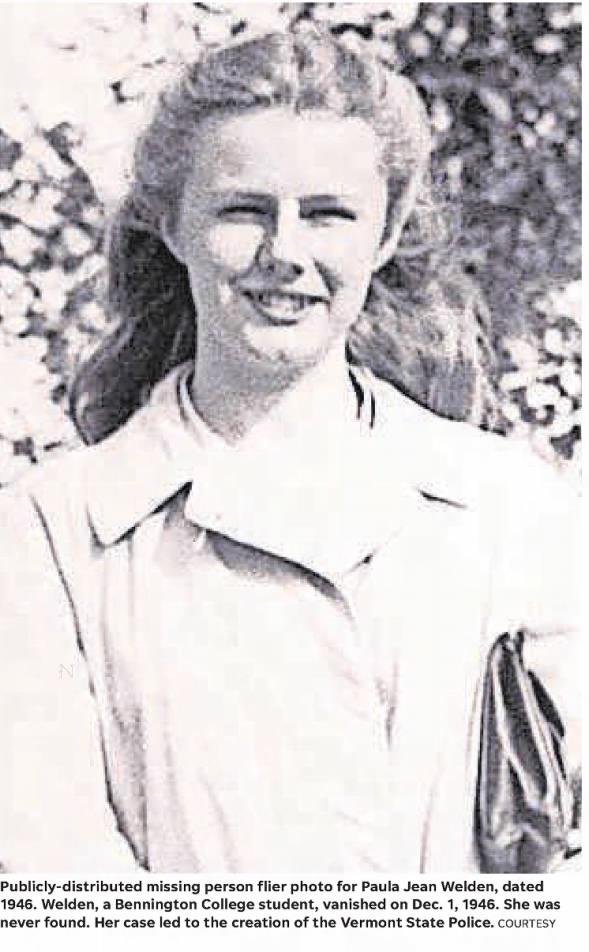
Missing Person: Paula Jean Welden Last seen or contact date: December 1st, 1946
At about 245pm Lou Knapp, a man who picked her up, claimed he dropped her off near Route 9 and she headed in the direction of the Long Trail.
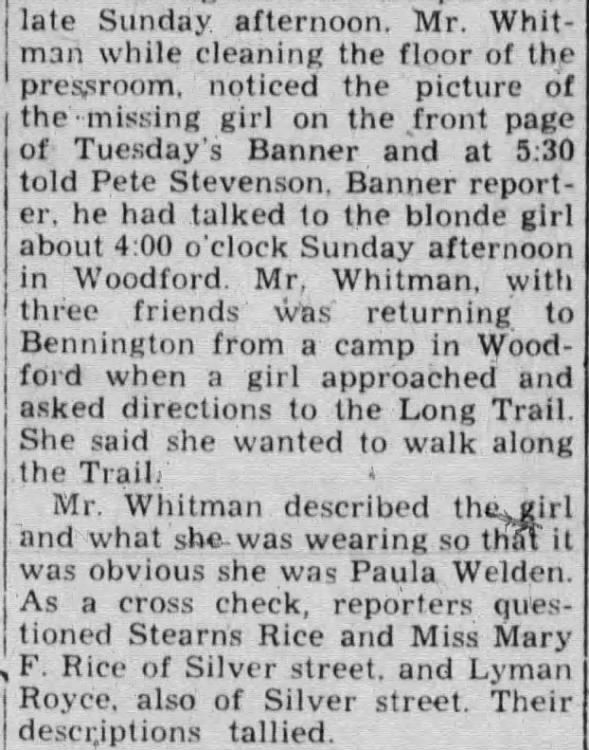
About an hour later there's a report that someone named Ernie Whitman met her in an area called Woodford Hollow and directed her toward the Long Trail still.
Other residents of Woodford Hollow claimed they saw her at a place called Fay Fuller camp, a shelter on the Long Trail.
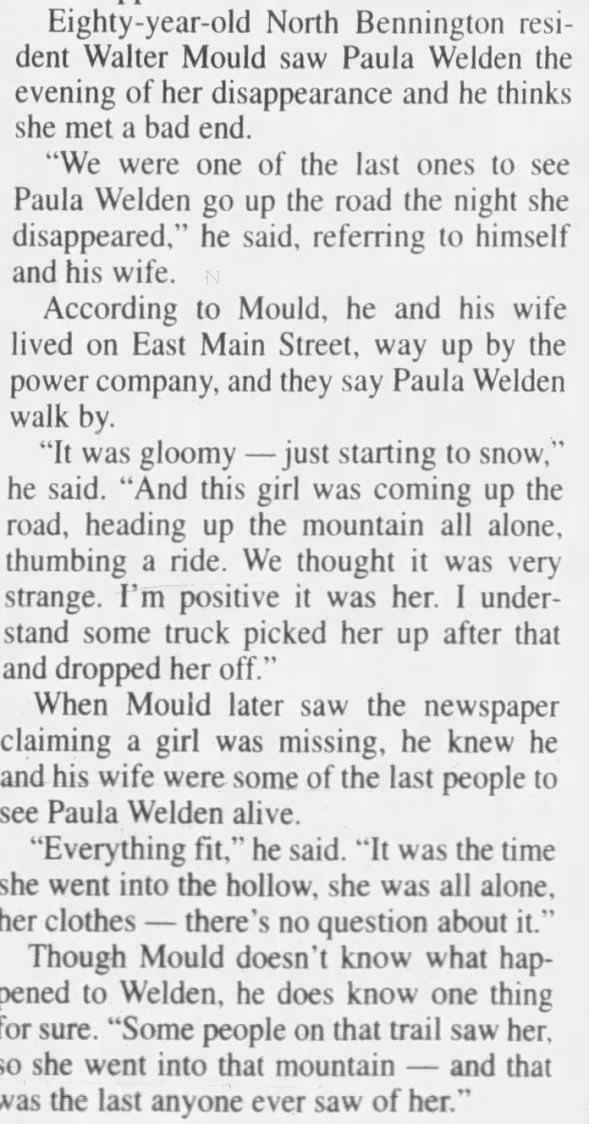
An eighty-year-old named Walter Mould claimed he saw her thumbing a ride but there's an indication that she was seen after this by those on the Long Trail (see clipping below picture).
Paula Jean Welden Sun, Feb 4, 2018 – C5 · The Burlington Free Press (Burlington, Vermont) · Newspapers.com
The case of Paula Jean Welden has a similarity to an old story that we have all heard: Little Red Riding Hood. Welden, an 18-year old college student, went into the forest on December 1st, 1946 wearing a red parka. She met an unclear fate and what resulted has been a vexing missing person's case for decades. However, I think the balance of the reasonable conjecture would support the opinion that she simply got lost in the forest, perished there, and remains there to be found.
She left the Bennington College campus on the afternoon of December 1st, 1946, which was a Sunday. She told her roommate, Elizabeth Johnson, that she was going for a hike and several other hikers claimed that they did see her on the Long Trail. She has not been seen since.
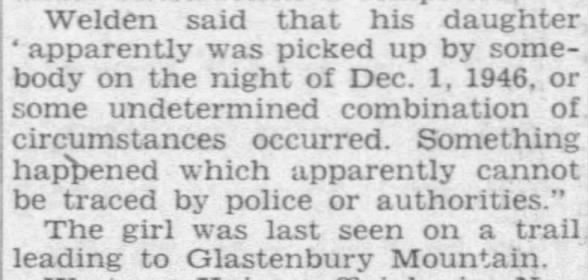
Where last seen: Long Trail near Glastenbury Mountain in Vermont.
Age at time of disappearance: 18 years old Hair: Strawberry blonde ("worn in a long bob"/The Journal, Page 7, Jan 17 1947) Eye color: Blue Height and weight at the time of her disappearance: 5'5" and 122 pounds Other: "a slightly turned up nose and a cleft in her chin" and an athletic body (The Journal, Page 7, Jan 17 1947) Scars: left knee, left eyebrow, vaccination mark on right thigh
Case Form D:
(1) Missing Person Went Hiking Alone
(2) Missing Person Enters Dangerous Area*
*Loose fit. The hiking area wasn't particularly dangerous, but it was for Welden's poor preparations.
What Happened to Paula Jean Welden - Theories
Did Welden meet up with the Big Bad Wolf? That question could be taken almost literally.
Whenever someone goes missing on a forest excursion, there is a chance that it's because of a deathly encounter with wildlife. If you take the question metaphorically, then perhaps the Big Bad Wolf is an unknown rapist, murderer, and/or abductor.
Besides an animal encounter or an abduction, there's the chance of an accident. One could slip down a cliff while hiking or one could fall in a crevice. That depends on how adventurous you get. But, perhaps the Big Bad Wolf, in this case, is just the cold December night.
Hypothesis: Paula Jean Welden Died of Hypothermia
Some people get lost on hikes and succumb to the elements. There's probably a much greater-than-average chance that this happened to Welden.
I have a hiking website as my other blogging passion, and I live in a location of similar northern latitude to Vermont. Take it from me, if it's 4pm in December and you haven't found your trailhead yet, then it's just time to turn around. The night falls fast in December for those that live well north of the equator and it doesn't yield to the sunlight for some 14 hours. That's important to note in this case.
Paula Jean Welden Was LOST From the Start: The Long Trail Mystery of 1946
According to some newspaper reports, Paula Jean Welden had not located the trail that she wanted to hike as of 4pm. That's when a man named Ernie Whitman gave her directions to the trail.
Think about that: as of 4pm, at a time of year when it's dark by 5pm and pitch black by about 530pm, she's still looking for the trail she wants to hike. That's nothing less than a mistake resulting from hiking inexperience. People who hike at night go in groups, with lots of supplies and clothing, and they sometimes have helmet lights.
I didn't find the sunset time for December 1st, 1946, in newspapers from the area. However, I found the next best thing: the sunset time for December 2nd of that year. It would probably only change by minutes or even seconds from one day to the next.
On December 2nd, the sunset time was 413pm at a time of year when it gets a little darker day-by-day. On December 1st, I bet the sunset time was about the same time and that forces an insightful premise: about 13 minutes before sunset she was still getting directions to the trail.
Mon, Dec 2, 1946 – 1 · The Bennington Evening Banner (Bennington, Vermont) · Newspapers.com
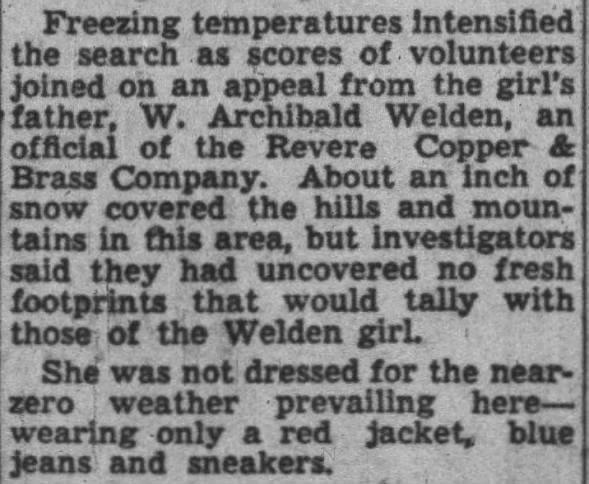
This 18-year old, who by some other reports was not dressed warm, was also lacking in experience when it came to trail-hiking. People that hike trails in the evening have warm clothes, they have flashlights if not helmets with lights on them, and they know where the trailhead is. I've left long trails at dusk and questioned experienced hikers still going up on these matters.
Read the snipping of an article below. I think there's your clue as to what might have happened with this girl.
Wed, Dec 4, 1946 – 1 · The Bennington Evening Banner (Bennington, Vermont) · Newspapers.com
If you are still getting directions to a trail at "about 4:00 o'clock" in December, it's just time to turn around and go home as the darkness of a winter evening should be anticipated. Given the time of year and the northern location, if she was hellbent on visiting the Long Trail at 4pm, then it's possible that she would still have been in a forested setting well after darkness set. She was poorly dressed for the conditions, she could have got lost, and she might have frozen to death in some strange spot.
Do you think that a girl smart enough to be in college wouldn't get lost? I would suggest thinking again and I will use my own hiking experience -- which I submit is much superior to that of Welden's -- to make my point. I have been lost in the forest for short periods.
Hiking trails can curve ever-so-slightly so that you are at first heading in one direction but, over time, you end up going in another. It's very possible to think that you are heading north or south or east or west only to have a slight-degree change hold up for a certain length of time, a change that gradually causes you to be heading in a direction that you didn't think you were going.
Of course, place markers help keep you oriented. When I have been lost, it has always been in the light of day. Paula Jean Welden was going into the forest as night-time loomed. Furthermore, when it comes to getting lost in the forest, one factor is that out-and-back trails (as opposed to trails that make a loop route) aren't always as straightforward as you might think.
When you take a trail out and then double back, things can look a little different in reverse. If you don't make a point to memorize forks, then you might head the wrong way on your return.
That's especially a risk if you head one way at dusk and don't recognize the forks in the trails after twilight. All trails that I've hiked in the forest have had diversions, even ones that are not on the trail maps.
The elephant in the room with Paula Jean Welden is that she did not know where she was to begin with. I think this is the point that has been missed in all other publications that cover this missing person.
Her reliance on other people to simply find the trail in the first place is clear. That speaks to a complete lack of familiarity with the area and I repeat -- she's heading into this unfamiliar area as wintertime evening darkness looms.
Paula Jean Welden's Hiking Tips Wouldn't Make it in a Safety Guide
Nothing about her hiking plan would be included in a safe-hiking guide. She's going out alone to somewhere she isn't familiar with as a snowstorm looms (see below) without proper clothing as evening sets in. I challenge anyone to make a stronger case against the opinion that she simply went missing in the forest. Such a person, I submit, would only be the non-hiking type because any experienced hiker will tell you that what Paul Jean Welden was doing was dangerous.
Paula Jean Welden Tue, Dec 3, 1946 – 1 · The Berkshire Eagle (Pittsfield, Massachusetts) · Newspapers.com
So where did Paula go? If she remains in the forest why wasn't she found? Forests are notorious for gobbling up evidence.
On that matter, I could digress, however, I won't. I'll simply state that many times when a person goes missing and a search ensues the person still gets found not far from where they went missing at some time well after the original search. Phrases like "the area was scoured" and "no rock was left unturned" don't mean what they say. Searches fail -- plain and simple.
The scene I'm depicting is exactly what can be taken out of the journalism from the time. The witnesses who saw her last say she was still heading toward the trail to Glastenbury Mountain as night-time fell. Night-time doesn't fall instantly -- there's a period where the shadows start to creep in that can be deceiving. I see the half-light of dusk as a period where Paula kept hiking. A return might be different.
If she gets too deep into the trail and gets lost in the darkness of night, then anything can happen to her. As she loses her vision from darkness, so does she lose her ability to spot place markers, like high points in the horizon.
If she goes in the wrong direction at any time, how long might she stay going in that direction with nothing visible to help her chart a correct course home?
She was 18 years old and described as athletic. As a 43-year-old male, I can still hike in the forest for 6-8 hours. An 18-year-old female with do-or-die adrenaline could walk at least that long if not much longer.
But if she's walking the whole time in the wrong direction, then what happens? At some point, she has to realize that she has gone the wrong way and that she needs to survive the elements of the freezing mountain night.
That means finding a place where the wind doesn't stab, getting into a fetal position, and hoping she lives until help arrives. If she doesn't have water, matters get worse because she'll need to eat snow as a substitute source. That's not going to help her body temperature at all and the balance of everything starts to point to death.
No foul play is required to create this death. She's like a pilot that crashed a perfectly good plane.
Reason vs Rumor in the Forest
I once shared a ride with a woman who spent many nights in the forest. We met using a ridesharing app and she spoke about how she never paid for accommodation while traveling. She claimed that as evening set in she just went into the forest, pitched a tent, and went to sleep. When I asked about concerns over someone coming across her, she made a memorable response.
"You have to understand that once you get 20 yards off of a trail or highway, you are somewhere that no one ever goes."
If Paula Jean got lost she could might have trudged miles and miles into the forest, in an unknown direction, before she realized that she had to surrender for the night. She could have located a wind-free spot 10 to 30 yards off of any trail in a large area in the vicinity of Glastenbury Mountain. That is where I think she will still be found and it's only that the original search area didn't realize just how much territory they had to cover.
An 18-year-old girl on adrenaline that the partly imaginary horrors of the forest at night would create could have walked a very long way before she realized that she had to sleep in the forest. If she gets hypothermia, then she's on her way to death. Then she's buried under the snow that's coming. Then, wearing a red jacket doesn't matter anymore as it doesn't stand out as visible while underneath the snow.
It didn't help at all that the frivolous journalists of the time were selling newspapers claiming that she ran off to Canada and that the run-about police followed those leads. It didn't help at all that every blue-eyed blonde that was spotted in public that was close to the age of 18 was being treated as a Paula Jean Welden sighting. She went missing on her own but make no mistake: she stayed missing in a society where media sensationalism rules and often in place of reasonable conjecture.
I think the sightings of this young woman that were reported that were not on the Long Trail were all entirely fluff. Furthermore, I think the sensationalists that designated the area to be like the Bermuda Triangle did much more harm than good. If everyone that looked for her attested to logic-based conjecture instead of "Bennington Triangle" crap, then only one of two scenarios seems plausible: lost in the forest and one other.
There is, after all, still the Big Bad Wolf to think about in the form of the man that preys on women. In my opinion, that Welden was a beautiful college student that was hiking alone and not afraid to hitch a ride does point toward abduction. That she has not been found in the area, even the greater area, that she was last seen in for what is, at the time of writing, 74 years since her disappearance does weaken the plausibility of the guess that she suffered a hiking mishap that comes when one faces nature.
Welden disappeared but her missing person's case is not one that simply disappeared in the media as many missing-person cases do. Her name was mentioned as recently as June 5th, 2020 in the Los Angeles Times (Page E2). A modern writer drew inspiration from the case.
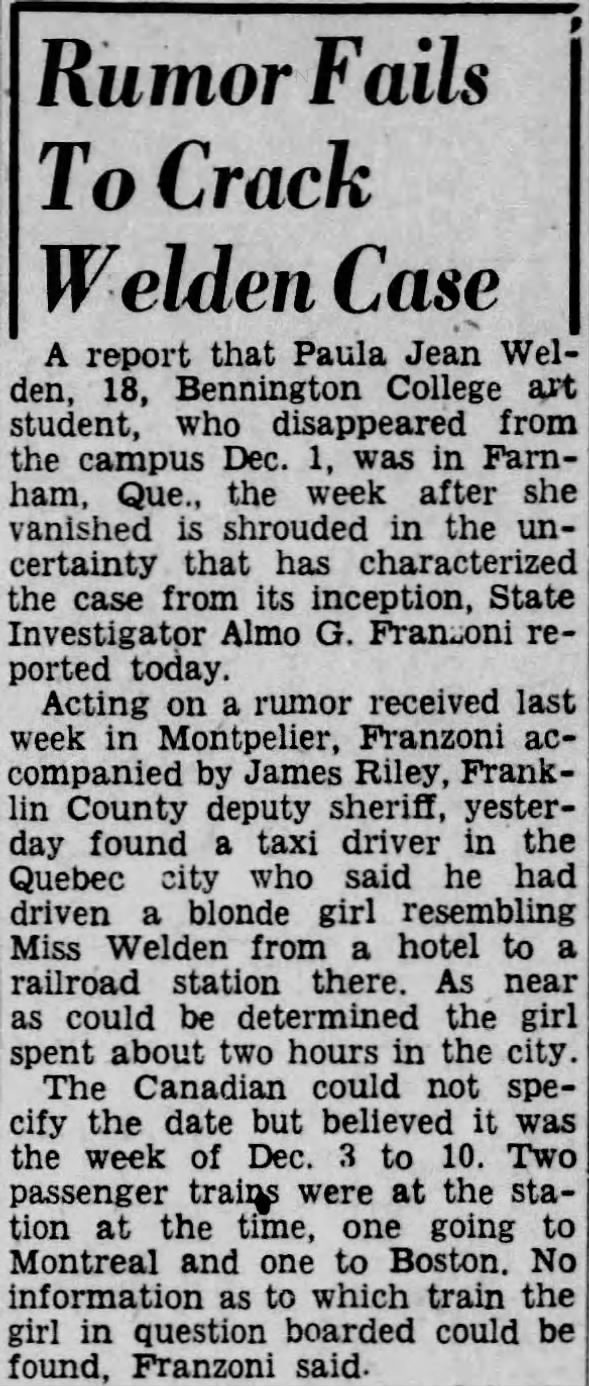
But the journalism from close to the time of the disappearance is less from the inspired and more from the baffled. In one article, a taxi driver in Quebec claimed he saw her during the week of December 3rd to December 10th.
Paula Jean Welden Wed, Jan 22, 1947 – 1 · St. Albans Daily Messenger (St. Albans, Vermont) · Newspapers.com
Another taxi driver that was local to the disappearance claimed he might have driven her as well. He wasn't certain but he remembered driving a college student at about the time of the disappearance. Of course, if what he says was true then that suggests that her hiking excursion was a front for a voluntary disappearance. Yet, it doesn't explain why she was actually seen hiking by others.
To this day, the case remains unsolved. But I think she froze to death or she's one of the never-to-be-seen-again hitchhikers of North America. Honestly, between the two I would lean to the former by a margin of 85% to 15% in this case. This girl didn't exercise good judgment on December 1st, 1946 and it produced one of the great missing-person's mysteries of the last century. My prediction is that she will be found someday through a random event, like an off-trail hike, or through spreading real-estate development.
Clothing: Red parka jacket with a fur-trimmed hood, blue jeans, and white sneakers with heavy-soled Top-Sider (size 6 1/2 or 7). She was also wearing a small, gold Elgin ladies wristwatch with a narrow black band. Importantly, this watched have specific engravings or scratches: "13050 HD" on the inside of the back case.
Paula Jean Welden Disappearance: The Ongoing Legacy
There has not been a development in Paula Jean Welden's missing person case in quite a number of years, if not decades. Her story is part of culture and history more than investigation.
She appeared in an episode The Infographics Show in 2024, as shown below. Furthermore, a couple of websites, including the A.V. Club, mentioned her in fresh articles in 2024. However, these are often the kind of websites that makes lists for "Top Ten" fans.
May 5th, 2024 update: The Infographics Show
Paula Jean Welden's likeness as depicted by The Infographics Show.
Paula Jean Welden was featured in an episode on The Infographics Show on YouTube on May 4th, 2024. The video below starts at about the 9:10 mark. I would say the early timeline is not complete for those who saw her on the day she disappeared. Also, I would say their focus on "The Bennington Triangle" is just to appeal to the teenagers out there that fall for this kind of crap.
Author: Shane Lambert Original Time of Writing: December 19, 2020 Updated: October 20th, 2025
Linda Kerr has been missing for nearly 45 years at the time of writing. According to NamUs, Linda was reported missing in the early morning hours of February 19th, 1976. She left her residence to visit a friend and has never been seen again. She left her purse and shoes at the residence, details that might suggest that she did not run away as some presumed.
The friend that she was going to visit, according to the journalism around the time of the disappearance was a boyfriend. Foul play was considered.
In the journalism from 1976, it was suggested that this disappearance had to do with retribution. Kerr or her friends (it's not clear which) may have testified against someone about a year earlier that vowed revenge.
After the girl was missing for ten days, there was extortion involved in her disappearance. However, according to an article from February 29th, 1976 in the Orlando Sentinel, these extorters did not know where the girl was. This same article says that law enforcement "discounted" the theory that she went missing as revenge for testimony from her friends a year earlier.
She was also called a runaway in an article. The father expressed frustration with this designation.
Missing Person: Linda Louise Kerr Last seen or contact: February 19th, 1976 (a Wednesday), or a few months later in a less credible sighting. Where last seen: Missing from Orlando, Florida (32806). She left her residence at about 4pm. Her address was 2131 or 2121 Dawley Street and her destination was an area called "Erin Court." Conversely, she may have been seen a few months later at a bar in Jacksonville as a dancer.
NamUs # and Link: #MP7589 Ethnicity/Race: White Sex: Female Age at time of disappearance: 15 years old Hair: Strawberry blonde Eye color: blue Height and weight at the time of disappearance: 5'7" and 106 pounds Scar: scar on right leg Clothing: White blouse, brown pants/Promise ring on left hand. Diamond ring on right hand.
Linda made headlines several years after her disappearance. Someone, who was perhaps not too credible, claimed that she was dancing topless in a bar in Jacksonville.
Furthermore, Kerr's brother was charged in murder in 1983, leading to Linda's case being looked at again. In a 1989 article, it is stated that nothing tied Kerr's brother to her disappearance.
May 8th, 1983. The Orlando Sentinel.
The next page of the article above suggests that she moved to Miami and married into a new name. But there wasn't any strong evidence.
All articles are subject to editing after original posting.
Reportedly, this individual was found deceased. Azcentral headlined on August 4th, 2023 "Skeletal remains found in South Mountain Park in January are ID'd as Jerole Tsinnijinnie." The deceased was not identified for several months. The composite sketch appeared to be a reasonably good one.
Original Time of Writing: December 19th, 2020
All articles are subject to editing after the original posting.
Jerole Nathan Tsinnijinnie is a missing person that disappeared from Phoenix, Arizona on New Year's Day in 2020. According to this NamUs profile, he was last seen at about 8AM that day, near South 58th Avenue and South Cottonfields Lane. He was leaving a family member's residence as a pedestrian.
Information on this case is sparse. Looking in online resources and newspaper databases, I didn't find anything except for what NamUs included in his missing person's profile. I have reached out to family members but as of the time of writing, I did not receive a response and updates are pending.